He knew prom was supposed to be one of those final, glittering snapshots of youth.
The kind of night people tucked away in memory for years afterward. A gym transformed by cheap lights and paper decorations. Music loud enough to make everyone forget how nervous they were. Girls in carefully chosen dresses. Boys adjusting ties they were not used to wearing. Corsages pinned with trembling fingers. Photographs taken in front yards, on staircases, beside cars, everyone smiling as if the future were still soft and endless.
For most teenagers, prom was a celebration of almost-adulthood.
For his mother, it had been a night that never happened.
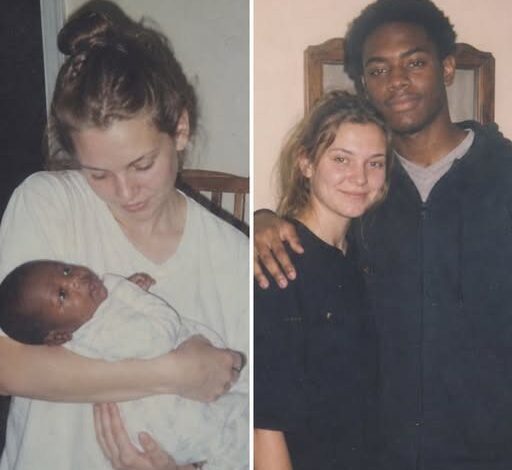
At seventeen, while her classmates were trying on dresses and talking about dates, she was learning how to hold a newborn without fear. While other girls worried about hairstyles, she was counting diapers, stretching groceries, and trying not to fall asleep during class. While music played in a decorated gym somewhere across town, she was rocking her baby in a quiet room, whispering promises she was too young to fully understand but old enough to mean.
She had traded slow dances for double shifts.
Corsages for bottles.
Late-night phone calls with friends for late-night feedings.
The excitement of her own future for the fragile hope of his.
She never complained about it, at least not in a way he could remember. She never sat him down and listed everything she had given up. She did not use sacrifice as a weapon or motherhood as a debt he was expected to repay. She simply did what needed to be done, year after year, with a kind of quiet strength he only began to understand as he grew older.
When he was small, he thought every mother was like that.
Always tired, but still smiling.
Always working, but somehow present.
Always saying there was enough, even when he later realized there probably had not been.
She helped with homework after long shifts. She showed up to school events in work shoes because there had been no time to change. She packed lunches, signed forms, remembered appointments, stretched paychecks, and made ordinary days feel safe even when life was anything but easy.
Only later did he understand the cost.
He began noticing the photographs she did not have. The stories she never told. The way she smiled when other women talked about their senior year, but always changed the subject before anyone asked about hers. He noticed the absence of prom pictures in the old family albums. No satin dress. No corsage. No awkward teenage pose beside a date. No memory preserved under soft flashbulb light.
There was only him.
A baby in her arms.
The beginning of a life she had chosen to protect at the expense of her own girlhood.
So when his senior year arrived and people started talking about prom, he listened differently.
His friends debated dates, suits, limousines, after-parties, and who might ask whom. Everyone seemed obsessed with making the night perfect. But the more they talked, the more he thought about his mother. About the night she had missed. About the version of her who never got to walk into a gym dressed beautifully, hear her name called, dance without worrying about a crying baby or an early shift the next morning.
He could have chosen anyone.
A girlfriend.
A classmate.
Someone who would have made the night look normal in photographs.
Instead, he chose the person who had quietly carried him all the way there.
He planned it in secret.
First, he spoke to the principal. Then to a few teachers who knew enough of his story to understand why it mattered. He explained what his mother had given up, not with resentment or pity, but with pride. He wanted the night to be more than a sweet gesture. He wanted it to become a public thank-you for a woman whose sacrifices had mostly happened in private.
The principal listened carefully.
Then agreed.
For days, he carried the secret with him, watching his mother move through her routines as usual. She reminded him to pick up his suit. Asked whether he had arranged transportation. Told him to take pictures. Asked if he was nervous. She assumed, naturally, that he was taking someone else.
He only smiled and told her everything was handled.
On the night of prom, she thought she was simply helping him get ready. She adjusted his collar, smoothed the front of his jacket, and stepped back with tears already forming in her eyes.
“My handsome boy,” she said softly.
He laughed, embarrassed in the way sons often are when their mothers love them too openly.
Then he handed her a dress bag.
At first, she did not understand.
“What’s this?”
“Your dress,” he said.
She stared at him.
“For what?”
“For prom.”
The room went quiet.
Her face changed slowly — confusion, disbelief, then something too emotional to name. She shook her head immediately, saying no, saying it was his night, saying she was too old, saying people would talk, saying he should take someone his own age and enjoy himself properly.
But he had expected every argument.
And he answered each one gently.
“It is my night,” he told her. “That’s why I want you there.”
She tried to laugh it off, but her hands trembled when she touched the dress bag. For a moment, he saw the seventeen-year-old girl she had been, still hidden somewhere beneath the years of work, worry, and motherhood. The girl who had missed the music. The lights. The pictures. The simple joy of being celebrated.
Eventually, she said yes.
When they arrived at the school, heads turned.
Of course they did.
Teenagers notice everything. Some whispered. Some smiled. Some looked confused. But he did not let go of her arm. He walked beside her proudly, as if he were arriving with royalty.
Inside, the gym glowed with colored lights. Streamers hung from the ceiling. Music pulsed through the room. For a moment, his mother stood near the entrance, frozen by the sight of it all.
It was not fancy.
Not really.
The decorations were simple. The lights were borrowed. The music was too loud. The floor was crowded with students pretending not to be self-conscious.
But to her, it was a doorway into a memory she had never been allowed to make.
Then the principal stepped forward.
The music softened.
A hush spread through the room.
At first, his mother looked alarmed, as if she had done something wrong. But he squeezed her hand.
The principal began to speak.
He told the story with care. Not as gossip. Not as pity. But as tribute. He spoke of a seventeen-year-old girl who became a mother before she had the chance to finish being a teenager. He spoke of sacrifice, endurance, love, and the quiet heroism that rarely receives applause because it happens in kitchens, on buses, in late-night shifts, and beside cribs.
He spoke of the son who had grown up watching.
The son who understood.
The son who wanted his mother to know that nothing she had given up had been invisible.
By the time the principal finished, the room was silent.
Then the applause began.
Soft at first.
Then stronger.
Then overwhelming.
Students stood. Teachers wiped their eyes. Parents near the back of the room clapped with both hands pressed hard together, as if trying to make the sound carry every emotion words could not.
His mother covered her mouth.
Tears slipped down her face.
For years, she had carried the story as a loss. The girl who missed prom. The young mother who gave up everything. The woman who chose responsibility before joy.
But in that moment, surrounded by applause, she finally saw what her son had always known.
She was not the girl who missed prom.
She was the woman who made everything possible.
He led her to the dance floor when the music changed. She protested again, laughing through tears, but he bowed dramatically and held out his hand.
“May I have this dance?”
This time, she did not say no.
They danced beneath cheap lights and paper stars while everyone watched with a tenderness that made the room feel softer. She cried quietly against his shoulder, and he held her carefully, aware that he was no longer just the baby she had once rocked to sleep.
He was her son.
Her witness.
Her proof that the sacrifice had become a life.
Around them, teenagers returned slowly to dancing, but something about the night had changed. It was no longer only about youth, romance, or celebration. It had become a reminder that love often writes its most beautiful stories through sacrifice no one sees at the time.
Later, they took pictures.
Real prom pictures.
His mother in her dress.
Him in his suit.
Both of them smiling through tears.
This time, there would be proof. A memory she could hold. A photograph for the album where one had always been missing.
Years from then, people might look at that picture and see a mother and son at a school dance.
But they would know the truth.
It was more than a dance.
It was a thank-you.
An apology for every moment life had taken from her.
A celebration of every moment she had given him.
A son’s way of saying that he had seen it all — the long shifts, the tired mornings, the unpaid bills, the quiet tears, the dreams folded away so his could unfold.
That night, under borrowed music and soft gym lights, love did something time could not.
It reached backward.
It found the seventeen-year-old girl who never made it to prom.
It took her by the hand.
And finally, after all those years, asked her to dance.