I Was Paid to Pretend to Be a Blind Veteran’s Granddaughter Every Sunday—But After He Passed Away, His Final Wish Changed My Life Forever

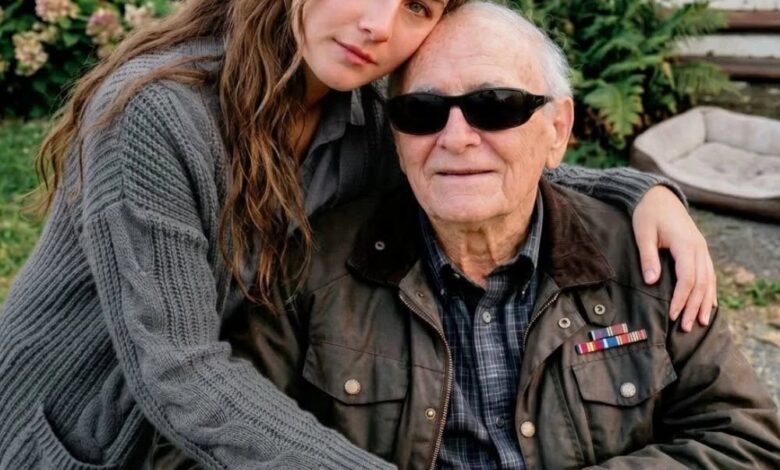
I walked into that law office certain my life was about to collapse.
The room felt too bright, too quiet, too formal for the kind of shame I was carrying. Every polished surface seemed to reflect back the same accusation: fraud, liar, impostor. I had spent the whole ride there imagining Walter’s family gathered like a jury, ready to expose me, humiliate me, and cast me out as someone who had taken advantage of a lonely old man. They shared his blood. I did not. I was sure that would be all that mattered.
But then the lawyer began to read.
And with every sentence, the story I had told myself started to fall apart.
Walter had known.
Not at the end. Not after months of suspicion. Not because someone had warned him or because he had uncovered some hidden proof. He had known from the very first hello. He had heard the lie in my voice before I even understood how badly I needed it to be believed. He had listened beyond the words, beyond the name I gave him, beyond the story I tried to wear like armor.
Walter had heard my footsteps on the porch. He had heard the way I paused before answering simple questions. He had heard the tremor of someone desperate enough to pretend, but still decent enough to feel ashamed. He had heard a person trying to be brave with nothing left to stand on.
Where others might have felt betrayed, Walter had felt something else entirely.
Gratitude.
The lawyer’s voice remained steady as he read Walter’s words, but mine had stopped working. I sat there with my hands folded so tightly in my lap that my knuckles hurt, listening to a dead man forgive me more completely than I had ever forgiven myself. Walter wrote that I had stopped pretending long before I realized it. He said that somewhere between the first false name and the final cup of tea, I had become honest in all the ways that mattered.
He had not loved me because I was perfect. He had loved me because I kept showing up.
I had come to him out of fear, debt, and desperation. I stayed because he made the little white house feel like a place where shame could loosen its grip. At first, I thought I was giving him company. I thought I was filling an empty afternoon, offering conversation to a man forgotten by the world. But Walter saw through that too. He knew I needed those visits as much as he did. Maybe more.
His final gift changed everything.
It did more than erase the debt that had been pressing on our lives like a hand around the throat. It gave us air. It gave us time. It gave us a future that no longer had to be built entirely out of panic. Noah got the treatments we had been praying for and postponing and bargaining with God over. My mother finally slept through the night without waking to count bills in the dark. I went back to school, not because life had suddenly become easy, but because Walter had made it possible for me to imagine something beyond survival.
For a while, people thought the money was the miracle.
They were wrong.
The money helped. It opened doors that had been locked for years. It paid doctors, cleared balances, and steadied the ground beneath us. But money was not what saved me. Walter did. Not because he rescued me from consequence, but because he saw the truth of me and chose compassion anyway. He gave me the rarest kind of mercy: the chance to become better without being destroyed for having once been wrong.
That is why I still go back on Sundays.
Not for the inheritance. Not for the paperwork. Not for the house, though the little white place still stands with its worn steps, quiet rooms, and curtains that move when the afternoon air comes through. I go because some part of Walter is still there. I sit in his old chair, the one angled toward the window, and I talk to him the way I did when he was alive.
I tell him about Noah’s appointments. I tell him about school. I tell him when I am tired, when I am scared, when I have done something brave and wish he were there to nod like he always knew I could. Sometimes I apologize again, though I think he would tell me to stop. Sometimes I just sit in the silence and let it hold me.
Walter taught me that family is not always the people who can prove a claim through blood, documents, or last names. Sometimes family is built slowly, through cups of tea, answered knocks, remembered stories, and the decision to keep choosing each other after the truth comes out. Sometimes family begins in imperfection and becomes real through care.
I entered his life wearing a lie because I thought a lie was the only way through the door.
Walter opened the door anyway.
And in the end, he left me with more than money, more than forgiveness, more than a way out of debt. He left me with a different understanding of love. Love is not always clean at the beginning. It is not always earned in the order we expect. Sometimes it arrives tangled in fear and mistakes, then becomes honest through the simple act of staying.
Walter saw me when I was pretending.
Then he loved me until I learned how to stop.