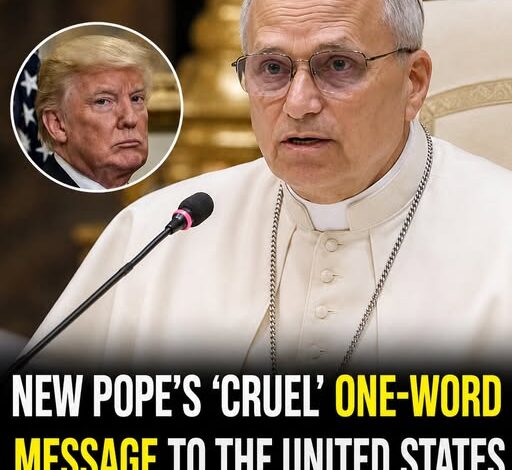
Pope Leo has once again spoken out against the war involving Iran, renewing his call for peace and adding further tension to his already public disagreement with President Donald Trump. The pope’s latest remarks continue a message he has repeated throughout the conflict: nations must choose dialogue over destruction, protect innocent civilians, and resist the temptation to treat war as the only solution.
For Pope Leo, the issue is not simply political. His statements have focused on the human cost of the conflict, especially the suffering of ordinary people who have little control over the decisions being made by powerful leaders. He has urged governments to remember that behind every military strategy and political argument are families, children, workers, and communities caught in fear and uncertainty.
President Trump recently pushed back against the pope’s criticism, arguing that Pope Leo does not fully understand the danger posed by Iran’s nuclear program. Trump also suggested that the pope’s position could be interpreted as support for Iran having nuclear weapons. However, Pope Leo has repeatedly spoken against nuclear weapons and has urged world leaders to move away from nuclear threats, escalation, and arms races. His position has centered on disarmament, diplomacy, and the belief that peace cannot be built through fear alone.
Speaking to reporters while returning from his first major trip outside Italy, Pope Leo described the situation between Iran and the United States as chaotic, unstable, and increasingly dangerous. He warned that shifting positions, unclear messages, and rising hostility on both sides were creating deep uncertainty, not only for the nations directly involved but for the wider international community. According to the pope, when powerful countries send mixed signals during a crisis, the entire world becomes more vulnerable to misunderstanding and escalation.
The pope also emphasized that leaders must not lose sight of the innocent people suffering because of the war. He said civilians in Iran are paying a terrible price for decisions made far above them, often by governments and military officials far removed from the daily consequences of violence. Homes, schools, hospitals, and neighborhoods can be destroyed in a matter of moments, while families are left to grieve, flee, or rebuild lives shattered by conflict.
Pope Leo’s remarks have fueled a broader debate about the role of religious leaders in times of war. Supporters argue that the pope is fulfilling a moral responsibility by speaking up for peace, human dignity, and the protection of civilians. They see his words as a necessary reminder that political leaders should be held accountable not only for military goals, but also for the lives affected by their decisions.
Critics, however, believe the pope is stepping too deeply into political affairs. They argue that national security questions, especially those involving nuclear threats and military action, are complex matters that religious figures may not fully understand. Some have accused Pope Leo of weakening the position of Western leaders by criticizing war efforts while tensions remain high.
Still, the pope has shown no sign of backing away from his message. He continues to frame the conflict as a moral crisis as much as a political one. His focus remains on peace, negotiation, humanitarian protection, and the need to prevent further suffering.
The disagreement between Pope Leo and President Trump has now become part of a larger conversation about faith, power, leadership, and war. At its center is a difficult question: when governments choose force, who speaks for the people caught beneath the consequences?
For Pope Leo, the answer appears clear. He believes that silence in the face of suffering is not neutrality, and that calling for peace is not weakness. Whether praised as a voice of conscience or criticized as politically intrusive, his remarks have made one thing certain: the war in Iran is not only being fought on battlefields and in government offices, but also in the moral arguments shaping how the world understands justice, security, and human life.


