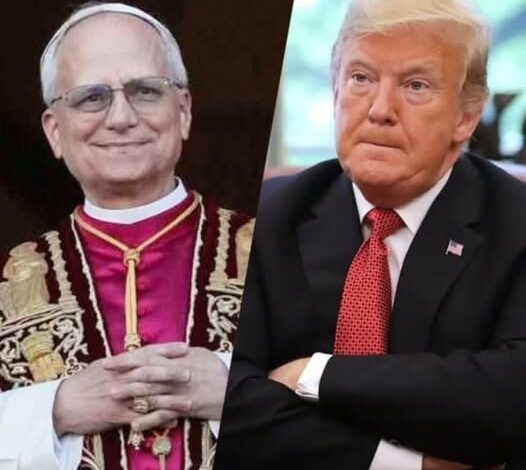
Pope Leo XIV’s past social media activity has drawn renewed attention following his historic election as the first American pope, prompting debate over how his earlier public comments may reflect his approach to major moral, social, and political issues.
Before his election to the papacy, Robert Francis Prevost maintained an account on X, formerly Twitter, where he occasionally shared or reposted content connected to U.S. political debates. Some of those posts criticized policies and statements associated with conservative American politics, including immigration measures from the Trump era and remarks made by Vice President JD Vance.
One post that resurfaced after his election shared an article challenging Vance’s view of Christian responsibility, particularly around questions of compassion, charity, and the moral order of caring for others. Other posts focused on immigration policy, including criticism of family separation, limits on refugee admissions, and broader restrictions affecting migrants and vulnerable communities.
The renewed scrutiny began shortly after Prevost was elected pope on May 8, 2025, taking the name Leo XIV. His election marked a major moment in Catholic history, as he became the first U.S.-born pontiff to lead the Roman Catholic Church. The moment was especially significant because the papacy has traditionally been associated with European, Latin American, and other global Catholic leadership traditions rather than the United States.
Although American by birth, Pope Leo XIV’s background is deeply international. He spent many years serving in Peru, where he worked closely with local communities and became familiar with issues affecting migrants, the poor, and people living on the margins of society. He later held important leadership roles within the Vatican, giving him experience both at the pastoral level and inside the Church’s central administration.
The resurfacing of his old posts has created discussion about how Pope Leo XIV may address issues such as immigration, poverty, social justice, economic inequality, and the Church’s relationship with modern political movements. Supporters argue that the posts appear consistent with the priorities emphasized by Pope Francis, especially concern for migrants, refugees, and communities facing hardship. They see his comments as part of a broader Catholic social teaching tradition that places strong emphasis on human dignity, compassion, and care for the vulnerable.
Critics, particularly from Trump-aligned political circles, have interpreted the posts differently. Some argue that the old social media activity suggests political bias or signals that Pope Leo XIV may be inclined to criticize nationalist or conservative immigration policies. Others have questioned whether a pope with visible past commentary on U.S. political issues can remain above partisan divisions, especially given the polarized climate in American public life.
The debate reflects a larger tension surrounding the modern papacy. Popes are spiritual leaders, but their teachings often touch on political realities, especially when addressing war, migration, poverty, labor, climate, human rights, and social justice. As a result, comments grounded in Catholic doctrine can still be interpreted through a partisan lens, particularly in countries where religious and political identities are closely intertwined.
For Pope Leo XIV, the controversy presents an early test of how he will be understood by different audiences. To some, his past posts suggest continuity with a Church that speaks forcefully on behalf of displaced people and the poor. To others, they raise concerns that his leadership may become entangled in U.S. political disputes. The fact that he is the first American pope only intensifies that scrutiny, since his words and actions are likely to be examined especially closely in the United States.
So far, Pope Leo XIV has not made the resurfaced posts a central focus of his early papacy. In his first public message, he emphasized peace, unity, dialogue, and the importance of building bridges. That tone suggested a desire to begin his leadership not with confrontation, but with a call for reconciliation and shared responsibility.
Still, the attention surrounding his previous social media activity is unlikely to disappear quickly. As his papacy develops, observers will be watching to see how he addresses immigration, poverty, international conflict, and the moral responsibilities of political leaders. His past posts may continue to shape early perceptions, but his future statements, decisions, and priorities will ultimately define how Pope Leo XIV is understood as a global religious leader.
For now, the debate reveals as much about the current political moment as it does about the new pope. In a divided world, even appeals to compassion, solidarity, and human dignity can become sources of argument. Pope Leo XIV’s challenge will be to speak from the moral and spiritual traditions of the Church while leading a global Catholic community that spans nations, ideologies, and deeply different political realities.