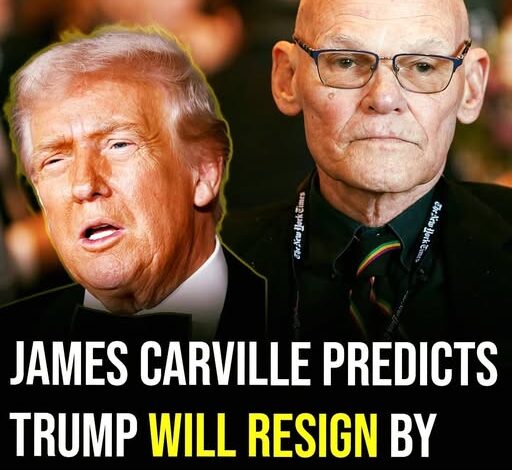
James Carville is not merely taking another public swipe at Donald Trump. This time, he is attaching a timeline to what he believes could become one of the most dramatic political unravelings in modern American history. Speaking on his podcast, the veteran Democratic strategist described Trump as a president moving toward a crisis point with little awareness of how quickly the ground beneath him could shift.
Carville’s argument is built around a simple but explosive prediction: that the political consequences of the 2026 midterm elections could become so overwhelming that Trump may eventually decide leaving office is easier than fighting through the storm. In his view, Trump is not simply facing the normal pressures of a presidency. He is facing a combination of political fatigue, legal exposure, public disapproval, and institutional scrutiny that could become impossible to ignore.
According to Carville, Trump’s second-term posture is defined less by governing than by self-protection. He portrays Trump as increasingly focused on shielding himself from Democratic investigations, avoiding accountability, and staying ahead of potential scandals rather than managing the daily responsibilities of the presidency. To Carville, that kind of defensive governing cannot last forever, especially if Democrats regain power in Congress and begin using subpoenas, hearings, and investigations to expose what they believe has been hidden from the public.
Carville’s prediction centers on the 2026 midterms, which he believes could serve as a political breaking point. If voters deliver a major rejection of Trump-aligned candidates, the result would not only weaken Trump’s grip on Washington but also empower his opponents to investigate his administration more aggressively. Carville imagines a wave of congressional subpoenas, damaging testimony, document releases, and public hearings that could dominate the national conversation and place Trump under relentless pressure.
In this scenario, the danger for Trump would not come from one single scandal or one dramatic revelation. Instead, Carville suggests it would come from accumulation. One hearing would lead to another. One document request would uncover another dispute. One witness would open the door to more questions. Over time, the weight of scrutiny could create the sense of a presidency surrounded, exhausted, and unable to control the story.
Carville also presents Trump as a leader who may not be emotionally or politically prepared for that kind of sustained pressure. He describes a president who is bored with the actual work of governing, insulated by loyal aides, and surrounded by people who may soften or hide bad news to protect him from political reality. In that environment, Carville argues, Trump could continue believing he is stronger than he actually is until the evidence becomes impossible to dismiss.
The image Carville paints is not of a president defeated overnight, but of one slowly boxed in by circumstances. Public approval weakens. Congressional allies grow nervous. Investigations expand. Media attention intensifies. The legal and political costs rise. The presidency, once a source of power and protection, begins to feel like a trap. In Carville’s telling, Trump could eventually decide that escape is more appealing than endurance.
That is where Carville’s most striking claim comes in. He has suggested that by Easter 2027, Trump could be gone from the presidency, not necessarily because he is forcibly removed, but because he chooses to walk away. It is a dramatic forecast, and one that immediately drew attention because it sounds less like ordinary political analysis and more like a countdown.
The White House response was swift and furious. Rather than treating Carville’s prediction as harmless speculation, Trump’s team attacked him personally, dismissing him as a bitter and irrelevant figure. The response branded Carville as a “loser” and suggested that his prediction was nothing more than partisan fantasy. But the intensity of the reaction only added fuel to the story, creating a sharp contrast between Carville’s warning of collapse and Trump’s allies insisting that the president remains politically untouchable.
That contrast is what makes the prediction so powerful as a piece of political theater. On one side is Carville, a longtime strategist known for blunt language and dramatic instincts, arguing that Trump is heading toward a wall he cannot avoid. On the other side is Trump’s political operation, projecting strength, loyalty, and inevitability. Between those two views sits a deeply divided country waiting to see whether the next election cycle brings confirmation or contradiction.
Of course, Carville’s prediction remains just that: a prediction. Political history is full of bold forecasts that never came true. Trump has survived scandals, investigations, impeachments, indictments, and electoral setbacks before. His supporters have repeatedly shown that controversies which might destroy other politicians often strengthen his bond with his base. Anyone predicting his political collapse has to contend with the fact that Trump has made a career out of surviving moments that were supposed to end him.
Still, Carville’s argument reflects a broader concern among Trump’s critics: that the true test of his presidency may come not from campaign rallies or public statements, but from institutional pressure. If Democrats gain power in Congress, if investigations intensify, if the economy weakens, or if public frustration grows, the political environment could become far more dangerous for Trump than it appears today.
The question is whether Trump’s political brand, built on defiance and survival, can withstand a sustained wave of oversight and rejection. Carville believes the answer may be no. He sees a president who thrives on conflict but may not have the patience, discipline, or interest to endure the grinding reality of a hostile Congress, damaging hearings, and a country increasingly questioning his leadership.
In the end, Easter 2027 may pass as just another date on the calendar, with Trump still standing and Carville’s prediction remembered as another failed political prophecy. Or it may become a symbol of something larger: the moment when pressure, exhaustion, investigation, and public rejection finally converged.
For now, Carville has done what political strategists often do best. He has taken scattered signs of weakness, connected them into a larger story, and turned that story into a warning. Whether that warning becomes reality will depend on voters, Congress, the courts, the media, and Trump himself. But one thing is clear: Carville is not simply mocking Donald Trump. He is arguing that the countdown has already begun.