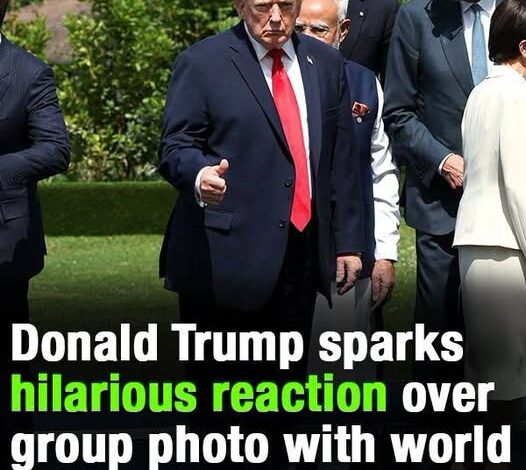
Donald Trump sparks hilarious reaction over group photo with world leaders at G7 summit

In Évian-les-Bains, where leaders of the world’s largest economies gathered to project unity on Iran, Ukraine, and the fragile state of global security, the moment expected to define the summit was supposed to be diplomatic. Officials had worked carefully over the language of a joint statement, shaping phrases meant to signal resolve, cooperation, and shared purpose at a time of mounting international tension.
But what captured global attention was not the statement.
It was a brief, strange, unscripted moment during the leaders’ photo.
As cameras rolled, Trump appeared to peel away from the group, his attention seemingly fixed somewhere beyond the carefully arranged scene. While other leaders held position for the cameras, he stepped out of alignment, creating an awkward visual that quickly overshadowed the choreography of the summit. The moment lasted only seconds, but in today’s political environment, seconds are more than enough.
Within hours, the clip was everywhere. It was looped, slowed down, replayed, cropped, captioned, and analyzed frame by frame. Commentators searched for meaning in his posture, his expression, and the direction of his gaze. Social media users turned the footage into jokes, accusations, defenses, and theories. What might once have been dismissed as a minor awkward moment became a global talking point.
For Trump’s critics, the image was instantly symbolic. They saw it as a visual metaphor for a president out of step with allies, distracted during a moment of international consequence, and adrift on the world stage. To them, the clip seemed to confirm a larger argument they have long made: that Trump’s style of leadership isolates the United States, weakens alliances, and turns serious diplomacy into spectacle.
For his supporters, the reaction was equally predictable. They argued that the media had seized on an ordinary, meaningless moment and inflated it into a controversy because it fit a hostile narrative. In their view, the focus on a few seconds of movement was not journalism but performance — another example of commentators ignoring the substance of the summit in order to mock, diminish, or misrepresent him.
Between those two opposing interpretations lies a quieter and more unsettling truth: modern politics is increasingly governed by images that move faster than context can catch up. A carefully negotiated statement on war, energy, diplomacy, and global security can take days or weeks to prepare. But a single awkward gesture, captured from the right angle, can consume the public conversation before anyone has read the document.
That is the reality leaders now face. Diplomacy may still happen in closed rooms, through long meetings and cautious language, but public perception is shaped by fragments. A glance, a handshake, a pause, a step in the wrong direction — each can become evidence in a much larger story people already believe. Supporters and critics do not simply watch the same clip. They bring their own expectations to it, then use it as proof.
The Évian-les-Bains moment became powerful not because it revealed everything, but because it could be made to mean almost anything. To one side, it showed confusion. To the other, media manipulation. To observers tired of both narratives, it showed how thin the line has become between politics and theater.
The summit’s leaders wanted to present a united front on some of the world’s most dangerous crises. Yet the viral image of Trump drifting away from the group became the story that traveled farther and faster than the policy itself. That contrast says as much about the media age as it does about any individual politician.
In the end, the episode was less about one step away from a photo line than about the way public life now operates. Leaders may still negotiate in paragraphs, but the world often judges them in clips. And in a political culture built on speed, suspicion, and constant replay, a single unscripted second can drown out every carefully chosen word.