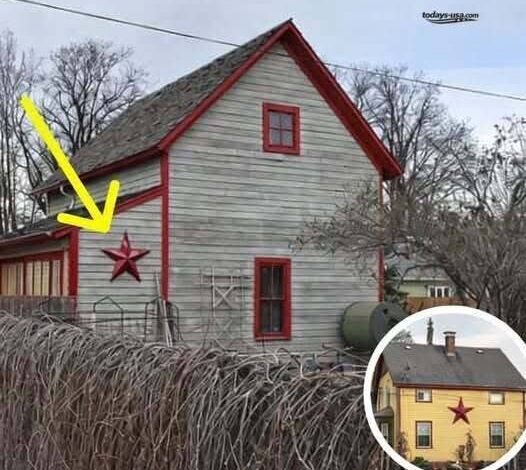
The stars are everywhere.
They look down from weathered barn walls, rusted tin siding, porch gables, fences, sheds, and fading wooden beams. They are quiet, fixed, and familiar, yet they have a way of catching the eye. Drivers pass them on country roads and glance up for just a second, wondering whether they are simple decoration or something older, something carrying a meaning that has survived longer than the people who first placed them there.
They do not explain themselves. They do not need to.
For generations, these stars have watched over farms, families, harvests, storms, weddings, funerals, wars, and seasons of ordinary labor. They have seen children grow up and leave home. They have seen barns raised, repaired, abandoned, and restored. Some have outlived the hands that painted them, the families that first claimed the land, and even the farms they were meant to mark. Yet somehow, the stars remain.
Their story began with German-speaking settlers who brought with them a deep respect for order, craft, faith, and usefulness. These were people who often valued quiet meaning over loud display. On barns and beams, they painted or mounted stars with careful attention to shape and balance. Some had five points, others six or eight, each one measured and placed with intention.
They were not merely decorations thrown onto a wall to fill empty space. They were signs of care. Signs of identity. Signs that the people who lived and worked there believed even ordinary labor deserved dignity. A barn was not just a structure for animals, tools, grain, and hay. It was part of the household’s life, part of its survival, and therefore worthy of beauty.
In that sense, the stars were less about superstition than presence. They seemed to say, without words: We are here. This place matters. This work matters. The hands that built this, repaired this, and depended on this are not invisible.
Over time, the materials changed. Painted wood gave way to metal. Handmade forms gave way to store-bought versions. Old farm buildings disappeared, while the stars began appearing on suburban homes, storefronts, garden walls, and decorative signs. Their meanings became blurred, repeated, borrowed, and sometimes forgotten. Yet the shape endured.
That endurance is part of their power.
The barn star survives because it carries more than a single explanation. For some, it suggests protection. For others, heritage. For others still, it is simply a mark of rural beauty, a reminder of fields, old roads, family farms, and a slower kind of life. But beneath all those meanings is something steadier: the belief that beauty belongs in ordinary places.
That may be the true inheritance of these stars. They remind us that meaning does not always arrive loudly. It does not always need a plaque, a speech, or a formal explanation. Sometimes it is nailed to the side of a barn and left there through rain, heat, snow, and decades of silence.
When those stars appear today on new houses, porches, shops, or restored barns, they carry that older message forward. They connect the present to people who believed in craft, intention, and the quiet dignity of work. They remind us that decoration can become memory, and memory can become tradition.
The stars do not ask to be understood all at once. They simply remain.
They remain as evidence that symbols can outlive their makers. They remain as reminders that ordinary buildings can hold extraordinary meaning. They remain because some traditions do not need to shout in order to survive.
And perhaps that is why they still draw the eye from the roadside. In a world full of noise, speed, and constant explanation, these quiet stars offer something different. They ask us to pause, to wonder, and to remember that the deepest meanings are often the ones that never needed to announce themselves at all.