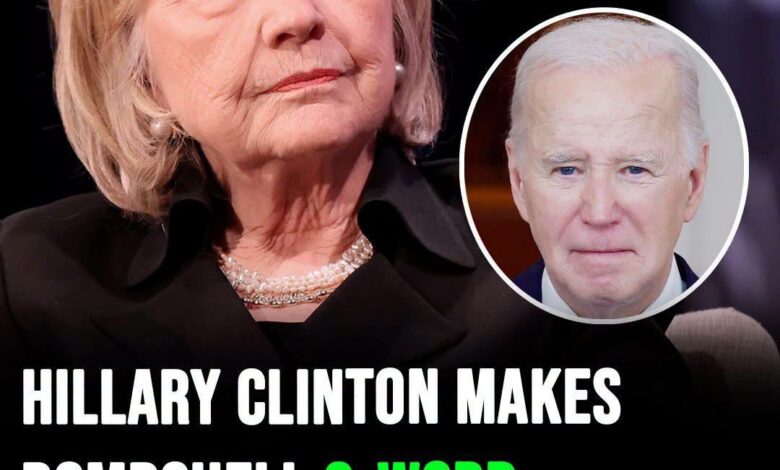
Hillary Clinton’s criticism reaches beyond the wounds of one election cycle. At its core is a harder question about power, timing, and the consequences of staying too long at the center of a party that was waiting for renewal.
By her telling, Joe Biden’s decision to seek another term did more than reshape the Democratic primary. It narrowed the party’s options before the race had even truly begun. A field of younger Democrats, many of whom had spent years positioning themselves for a generational transition, never had the chance to fully test themselves before voters. What might have been a competitive, clarifying primary instead became a campaign built around continuity, loyalty, and the assumption that Biden remained the safest choice.
That calculation proved costly. When Biden’s campaign faltered, the party was left with little time and even less room to maneuver. The eventual handoff to Kamala Harris carried historic significance, but it also unfolded under immense pressure, without the long runway most presidential nominees need to introduce themselves to the country, define their message, build a coalition, and withstand the full force of a national campaign.
In that vacuum, Donald Trump found an opening. His resurgence was not necessarily proof of overwhelming public affection, but of political opportunity. He faced an opponent who had not emerged from a long primary battle, had limited time to separate herself from the outgoing administration, and was forced to campaign while carrying both the burdens of incumbency and the urgency of a last-minute transition.
Clinton’s remarks will undoubtedly sting Biden loyalists, many of whom see his presidency as defined by legislative victories, foreign-policy crises, and the difficult task of stabilizing the country after years of political upheaval. To them, criticism of his decision to run again may feel ungenerous, especially given the pressures he faced and the loyalty he inspired within the party.
But her argument also echoes a frustration that has quietly circulated among some Democrats: that Biden, who once presented himself as a bridge to a new generation of leadership, tried to cross that bridge twice. The result, critics argue, was a party caught between gratitude for what he had accomplished and anxiety over what his continued candidacy prevented.
The deeper warning in Clinton’s critique is about legacy. Political legacies are not shaped only by elections won, bills passed, or enemies defeated. They are also shaped by judgment — by knowing when the moment has changed, when a movement needs fresh voices, and when stepping aside may serve the cause better than staying in the fight.
That is what makes her criticism so sharp. It is not merely about Biden’s age, Harris’s campaign, or Trump’s return. It is about whether leaders can recognize when their personal sense of duty begins to conflict with the future of the coalition they claim to protect.
Whether one agrees with Clinton or not, the message is unmistakable: in politics, power is not only measured by the offices one holds. Sometimes it is measured by the discipline to let go before the moment passes.
And for Democrats still searching for answers, her warning lands with uncomfortable force. A party cannot build the future while endlessly deferring it. At some point, the bridge must lead somewhere.