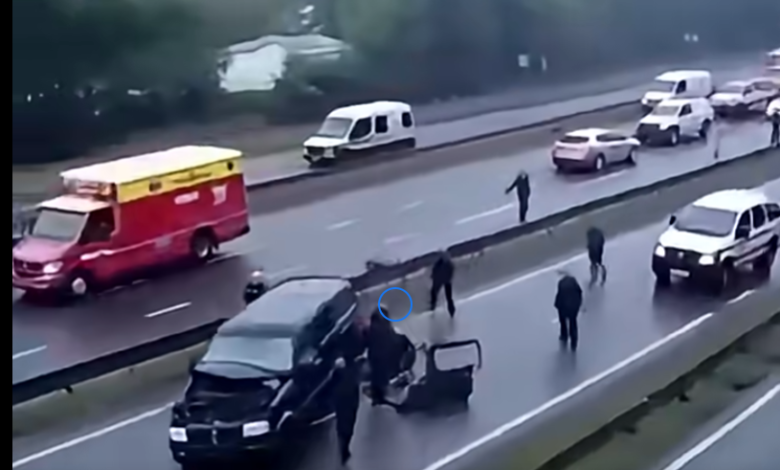
The chain-reaction crash that followed the driver’s sudden stop left more than twisted bumpers, shattered glass, and flashing hazard lights scattered across the Florida highway. It exposed something harder to repair than metal: the painful dilemma that appears when instinctive kindness collides with the brutal physics of high-speed traffic. In that instant, the driver was not weighing philosophy or law. There was a turtle in the road, a living thing moving slowly through a place built for speed, and a decision had to be made before thought could fully catch up.
To some, the choice was simple in its compassion. The turtle’s life mattered. It was vulnerable, defenseless, and unaware of the danger around it. Stopping, in that view, was not foolishness but humanity—a refusal to let convenience and momentum erase the value of a smaller life. They saw in the driver’s action a rare tenderness, the kind of impulse that says a creature’s fragility should still mean something, even on a road designed for machines.
But others saw the same moment very differently. To them, the sudden stop was not an act of mercy but a dangerous failure of judgment. A highway is not a quiet neighborhood street. Vehicles are moving fast, drivers have only seconds to react, and one unexpected decision can turn into a violent chain of consequences. For those shaken by the crash, the argument felt painfully clear: risking human lives for an animal, however innocent, is not compassion. It is recklessness dressed in good intentions.
That is what makes the story so unsettling. Both reactions come from recognizable places. Most people do not want to be cruel. Most people also do not want to die, or watch their children, passengers, or strangers become casualties of someone else’s sudden choice. The conflict is not between kindness and indifference alone. It is between two kinds of moral urgency: the urge to protect the vulnerable life in front of you, and the responsibility to protect the unseen lives behind you.
Investigators will sort through the practical questions. They will examine where the vehicles were, how fast they were traveling, whether brake lights appeared in time, whether following distances were safe, and whether any citations should be issued. Insurance companies will reduce the chaos into reports, liability, claims, repairs, and numbers. In the official record, the crash will become a sequence of facts arranged into a file.
But the emotional aftermath will not be so easily organized.
Long after the tow trucks leave and the highway returns to its usual rhythm, the people involved will remember the moment differently. One driver may remember the impossible closeness of the vehicle ahead. Another may remember the sound of brakes locking, the jolt of impact, the sickening realization that there was no room left to avoid what was coming. Someone else may remember seeing the turtle and wondering, in the split second before everything went wrong, whether they would have done the same thing.
And the first driver must live with the heaviest version of the question. What happens when a choice that feels right in the moment ends in chaos? Compassion does not erase consequence. Panic does not undo damage. A person can act from genuine care and still create danger. That is one of the hardest truths in ordinary life, and on a highway, it can reveal itself in a matter of seconds.
There is a particular cruelty in judging instinct after the fact. From the calm distance of safety, everyone can imagine the better choice. Keep driving. Slow down gradually. Pull over first. Avoid swerving. Think of the cars behind you. Think of the people. Think of the physics. But the person in the moment may not experience it as a list of options. They may only see a helpless creature and feel the immediate command to stop harm. Later, under the harsh light of consequence, instinct becomes evidence. A split-second reaction becomes a moral trial.
The crash also leaves behind an unsettling lesson for everyone who hears about it. Roads demand a kind of discipline that can feel almost inhuman. They ask drivers to suppress sudden emotion, even when that emotion is mercy. They ask us to remember that our vehicle is not only our own space, but part of a moving system where every action reaches outward. On a highway, kindness must be filtered through safety, because one person’s urgent compassion can become another person’s impact.
Yet it would be too easy to turn the story into a cold warning against caring. The deeper truth is not that animals do not matter, or that compassion has no place on the road. The deeper truth is that compassion without judgment can become dangerous, while judgment without compassion can become cruel. The challenge is to hold both at once: to value life, but also to understand the terrifying force of speed, distance, and momentum.
Sometimes the safest mercy is not immediate rescue. Sometimes it is slowing carefully, pulling over when possible, calling authorities, alerting wildlife rescue, or helping only when doing so does not place others in danger. Those choices may feel less heroic because they are quieter and slower. But on a highway, the right kind of care must include every life at risk, not only the one directly in front of the bumper.
Still, for the people involved, abstract lessons may offer little comfort. They are left with the sound of the crash, the anger afterward, the guilt, the fear, and the replaying of those few seconds. The driver who stopped may be haunted by the possibility that kindness caused harm. The drivers behind may be haunted by the realization that normal travel can become disaster without warning. Everyone on that road now carries a new awareness of how fragile control really is.
In the end, the Florida crash lingers because it refuses to give us a clean moral answer. It is not simply a story about a turtle, a careless driver, or angry motorists. It is a story about the terrifying gap between intention and outcome. It is about how quickly a humane impulse can meet the unforgiving reality of traffic. It is about how people make imperfect decisions in fear, instinct, and urgency, only to have those decisions judged later in the calm they did not have.
Nobody truly wins in a moment like that. Not the drivers left shaken. Not the person who tried to help. Not the animal whose presence turned a stretch of highway into a moral test. What remains is the uncomfortable knowledge that life often offers no perfect option—only choices made too quickly, consequences that arrive too loudly, and lessons learned after the sirens fade.