I stopped breathing.
For a moment, the room around me blurred. Michael was sitting beside me, already unfolding his own letter. Mara held hers against her chest as if she were afraid to open it. Noah stared at the envelope in his hands, his jaw tight.
Susan stood near the window, still as stone.
I looked back down.
“My sweet girl, Susan left because she discovered something about me the rest of you never knew.
And before you read another word, I need you to understand this: she was not wrong to be angry.
When Susan was sixteen, she found the old court papers in the attic. I should have told all of you sooner, but I was afraid. Not afraid of punishment. I had already lived with that. I was afraid you would look at me differently. I was afraid the man who packed your lunches and sat through your school concerts would disappear in your eyes, replaced by someone I had spent my whole life trying not to be anymore.
Before I met your mother, before I became anyone’s father, I made a terrible mistake.
When I was twenty-two, I was drinking heavily. I had no direction, no sense, and no courage. One night, I got behind the wheel after too many drinks. I hit another car.
A man died.
His wife survived, but she never walked again.
I went to prison for four years.
There is no softer way to say it. No better version. No excuse that makes it less ugly.
When I came out, I had nothing but shame and the knowledge that I had taken something from the world I could never return. I tried to live quietly. I worked. I stayed sober. I sent money anonymously for years to the woman I had hurt, though I knew money could never repair what I had done.
Then I met your mother.
She knew everything.
I told her on our third date because I believed she deserved the truth before she decided whether I was worth knowing. I expected her to leave. Instead, she told me that remorse was not the same as goodness, but it could become the beginning of it.
She made me want to become better.
When she died, people told me I had no obligation to keep you. They said you had grandparents, that you were not mine, that I was still young enough to start over.
But by then, you were already my daughter.
Not because the law said so.
Not because blood said so.
Because love had already made the decision for me.
Years later, when Michael and Mara came into my life, I thought I understood what it meant to be needed. Then Noah and Susan arrived, and I realized every child carries a locked room inside them. Some open it quickly. Some never do. Susan guarded hers with both hands.
I saw myself in her anger.
Maybe that is why I failed her.
I thought love would be enough if I just kept showing up. I thought if I stayed patient, stayed gentle, stayed steady, she would eventually believe she was safe. But when she found the truth about my past, she did not see the man I had become. She saw the man I had been.
And I could not blame her.
She asked me if any of you knew. I told her no.
She asked me how I could take in children after taking a father away from someone else’s family.
I had no answer that could satisfy either of us.
The truth is, I never adopted you children because I believed it erased my past. I adopted you because I knew what one destroyed life could do to a family, and I could not bear to see more children grow up believing no one would choose them.
But Susan thought I was trying to buy forgiveness with fatherhood.
Maybe part of me was.
That is the hardest truth I have ever written.
I loved you all honestly. Completely. Without condition. But I would be lying if I said saving you did not also feel like the only way I knew how to keep living with myself.
Susan left because she saw that before I was brave enough to admit it.
Please do not be angry with her.
She carried a truth alone that I was too cowardly to share.
If you hate me after reading this, I will understand. If this changes every memory, I will understand that too. But I hope, someday, you can hold both truths at once: that I once caused unforgivable harm, and that I spent the rest of my life trying to give love where I had once left grief.
You were never my redemption project.
You were my children.
And being your father was the only good thing I ever knew how to do.”
My hands were shaking by the time I reached the end.
Across the room, Michael lowered his letter. His face had gone pale. Mara was crying silently, one hand over her mouth. Noah stood up so fast his chair scraped against the floor.
“What does yours say?” he asked, looking at me.
I couldn’t answer.
The lawyer cleared his throat gently.
“Your father asked that each letter remain private unless you chose otherwise,” he said. “He wrote different things to each of you.”
Susan laughed once, bitter and broken.
“He always was good at secrets.”
Noah turned on her. “You knew?”
Her eyes flashed. “Yes.”
“And you never told us?”
“I was sixteen,” she said. “I found out the man who tucked me in at night had killed someone. What exactly was I supposed to do with that?”
The room went silent.
Michael rubbed both hands over his face. “That’s why you left?”
Susan looked away.
“That’s part of why.”
Mara’s voice trembled. “What’s the other part?”
Susan held her envelope tighter. For the first time that day, she looked less angry than exhausted.
“He wrote to me too,” she said. “He told me the name of the man who died.”
The lawyer closed his eyes briefly, as if he had expected this moment and dreaded it anyway.
Susan swallowed hard.
“The man had a daughter,” she continued. “She was three when he died.”
I felt something cold move through me.
Susan’s eyes met mine.
“That daughter was my mother.”
No one moved.
The air seemed to leave the office all at once.
Mara whispered, “What?”
Susan’s face crumpled, but she kept speaking.
“My birth mother. The one who gave me up. Thomas killed her father. My grandfather.”
Noah sank back into his chair.
Michael looked at the lawyer. “Did he know?”
The lawyer nodded slowly.
“Not when he first fostered her,” he said. “He learned later, during the adoption process. Some records revealed the family connection. He nearly withdrew his petition.”
Susan’s voice broke. “But he didn’t.”
The lawyer looked at her with quiet sadness.
“No. He did not. He said abandoning you after learning the truth would only be another act of cowardice.”
Susan pressed the letter against her chest.
“I hated him for that,” she whispered. “I hated him for loving me. I hated that he could be kind. I hated that he made pancakes and fixed my bike and cried at my graduation. Because it would have been easier if he had been a monster.”
I looked down at my father’s handwriting, suddenly understanding why his letters had been sealed separately. Thomas had not left us a confession meant to clear his name. He had left five different pieces of a truth too heavy for any one of us to carry alone.
Mara finally opened her letter. Then Noah. Then Michael.
For a long time, no one spoke.
Each of us read in silence.
Michael’s letter told him that Thomas had kept every drawing he and Mara had made during their first year in the house, even the angry ones with black scribbles over Thomas’s face.
Mara’s told her that he had known she used to hide food under her bed, and that he never scolded her because he understood hunger was not always about an empty stomach.
Noah’s told him that the watch he had given him on his wedding day had belonged to the man Thomas killed. The widow had returned it years later with a note that said, “Do something better with time than he did.”
And Susan’s letter, when she finally let me read it weeks later, was the longest of all.
It was not a request for forgiveness.
It was an apology for becoming her father without first giving her the right to know who he had been.
When we left the lawyer’s office that day, none of us felt healed. There was no clean ending, no easy forgiveness, no sudden peace. Thomas had been our father, but he had also been someone else’s tragedy. Both things were true, and the weight of holding them nearly broke us.
Susan did not come home with us.
But she did not disappear again either.
At first, she answered only my messages. Then Mara’s. Then, slowly, Noah’s. Michael took longer. He was angry in a way that needed somewhere to go, and for months it landed on silence.
But grief has a strange way of making room.
That winter, we gathered at Thomas’s house to sort through his things. Susan arrived late, carrying coffee for everyone and wearing the same black coat from the funeral.
No one asked if she planned to stay.
We simply moved aside and made room for her.
In the attic, we found boxes labeled in Thomas’s careful handwriting.
School Papers.
Birthday Cards.
First Lost Teeth.
Michael’s Bad Poems.
Mara’s College Letters.
Noah’s Baseball Clippings.
Susan’s Everything.
Susan stared at that last box for a long time.
Then she opened it.
Inside were photos, report cards, crayon drawings, a broken bracelet, a hospital band from when she had pneumonia at eight, and every unopened birthday card she had ever returned to him.
He had kept them all.
At the bottom was one more envelope.
Susan’s name was written on it, but beneath it were five words:
“When you are ready, sweetheart.”
Her hands shook as she opened it.
There was only one page inside.
“I do not expect forgiveness.
I only hope someday you believe this: I did not choose you because of what I owed your family.
I chose you because you were a child standing in front of me, and you deserved to be chosen.
I could not save the man I killed.
I could not undo the pain I caused your mother.
But I could love you without asking you to make my past easier to bear.
You were never my punishment.
You were my daughter.”
Susan folded the letter slowly.
Then she sat down on the attic floor and cried in a way I had never seen her cry before. Not controlled. Not angry. Not distant. Just broken open.
Mara sat beside her first.
Then Noah.
Then Michael.
Then me.
We stayed there surrounded by dust, cardboard boxes, and the proof of a man who had been both deeply flawed and deeply loving.
Years have passed since that day.
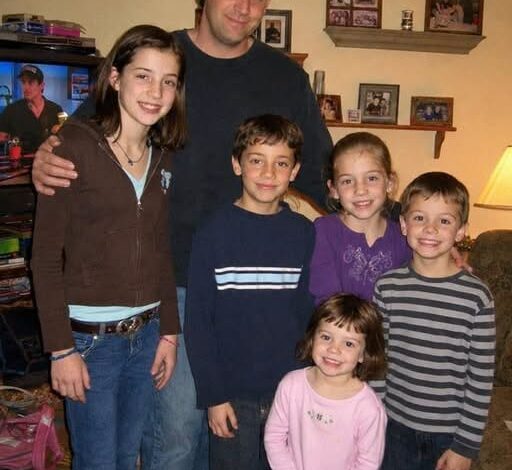
We still talk about Thomas carefully. Some memories make us smile. Some still hurt. Susan visits the grave sometimes, though she never tells us what she says there. Michael eventually placed the old watch in a glass case beside a photo of Thomas holding all five of us on the front porch. Noah named his youngest son Thomas, then cried for an hour after signing the birth certificate.
As for me, I kept my letter.
Not because it explains everything.
It doesn’t.
No letter could.
But sometimes I read the last line when I need to remember that people are rarely only one thing.
My stepfather was not a saint.
He was not a monster.
He was a man who once destroyed a family, then spent the rest of his life building one with trembling hands.
And maybe that is why, even now, when people ask me who raised me, I still give the same answer he gave all those years ago.
“My father did.”