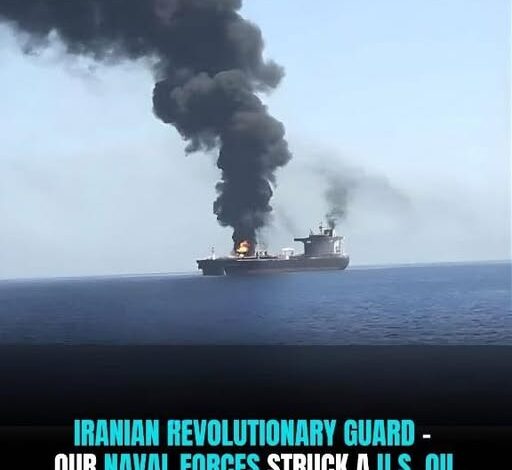
Iran has claimed that naval forces from its Islamic Revolutionary Guard Corps struck a U.S.-linked oil tanker in the northern Persian Gulf, saying the vessel is now on fire. According to Tehran’s statement, the operation was carried out by Iranian naval units early Thursday morning, though the details of the incident remain unverified by independent sources.
The announcement was presented by Iranian officials as part of what they described as a new phase of military operations during a “time of war.” Tehran also warned that it intends to assert control over passage through the Strait of Hormuz, one of the most strategically important waterways in the world. Iranian officials said that U.S., Israeli, European, and allied military or commercial vessels could face challenges if they attempt to transit the area.
At this stage, U.S. officials have not confirmed Iran’s claims. There has been no verified statement from the Pentagon, no independent confirmation from major maritime monitoring agencies, and no official report confirming the tanker’s condition, location, crew status, or the extent of any damage. Because of that, the situation remains highly uncertain.
The claim comes amid sharply rising tensions between Iran, the United States, and Israel after a series of recent attacks, counterattacks, and military warnings across the region. Each new development has added to fears that the conflict could widen beyond isolated strikes and move toward a broader confrontation involving regional and international powers.
The Strait of Hormuz is central to the seriousness of the situation. A significant portion of the world’s oil supply passes through the narrow waterway, making any threat to shipping there a matter of global economic concern. If Iran’s claims are verified, analysts warn the incident could raise oil prices, disrupt commercial shipping, increase insurance costs for vessels operating in the Gulf, and further intensify military deployments in the region.
Tehran appears to be using the reported incident to send a broader message about its ability to influence or restrict movement through the strait. By linking the alleged strike to wartime authority and control over maritime passage, Iran is signaling that commercial and military shipping could become part of the wider confrontation if tensions continue to escalate.
However, major questions remain unanswered. It is not yet clear whether a tanker was actually struck, whether the vessel has sustained serious damage, whether there are casualties, or whether the ship’s crew has issued any distress call or public statement. No shipping company, vessel operator, or international maritime authority has independently confirmed the incident as described by Iran.
Until more information becomes available, the reported attack should be treated as an unverified claim with potentially serious consequences. Governments, energy markets, shipping companies, and military observers are likely to monitor the region closely in the coming hours for satellite data, vessel-tracking updates, official statements, or emergency maritime alerts.
For now, the situation remains fluid. Iran’s announcement has already heightened concerns over security in the Persian Gulf, but without independent confirmation, the full scale and reality of the incident remain unclear. What is certain is that any verified attack on a U.S.-linked tanker near the Strait of Hormuz would mark a major escalation, with consequences that could extend far beyond the region.