My Family Didn’t Come to My College Graduation Because They Were Embarrassed by My Age – Then a Professor Brought Me Onto the Stage and What He Did Made My Knees Tremble

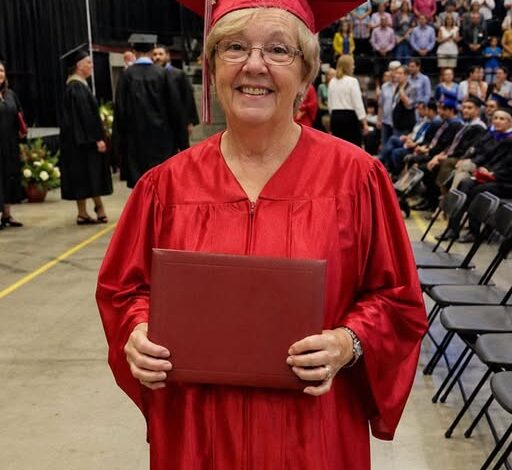
At 62 years old, I walked into my college graduation carrying a dream I had set aside for more than forty years.
My children were too embarrassed to be there.
I told myself it was fine.
I told myself pride did not need an audience.
But standing alone in that crowded university hallway, surrounded by families holding flowers, balloons, cameras, and tearful smiles, I kept looking toward the doors anyway.
My name is Dana. I am 62 years old, and when some people thought I should be slowing down, I decided to begin again.
I had wanted to become a teacher since I was a teenager. Back then, the dream felt so clear it seemed impossible to lose. I could picture myself standing in front of a classroom, writing on a board, helping students discover that learning could open doors they did not even know existed.
It felt simple.
It felt obvious.
It felt like mine.
Then, during the year I graduated from high school, my father became ill. The medical bills arrived faster than we could breathe, and everything my family had saved disappeared into hospital rooms, prescriptions, and payments we could barely manage.
College vanished before it ever truly began.
I took a job in the school cafeteria to help my mother keep us afloat. I told myself it was temporary. I told myself I would go back once things settled down.
But life has a way of turning “just for now” into decades.
I married Graham.
We had two children, Jay and Sofia.
Then came mortgages, grocery lists, school lunches, doctor appointments, parent-teacher conferences, scraped knees, birthday parties, late-night fevers, college savings, grandchildren, and all the quiet sacrifices women make while convincing themselves they will get their turn later.
My dream did not disappear.
It simply grew quiet.
The only person who ever seemed to hear it was Graham.
He had been gone for ten years by the time I finally graduated, but I could still hear his voice as clearly as if he were standing beside me.
“You’re going to do it one day, Dana,” he used to say.
“I’m too old for school,” I would tell him.
“The kids will grow up,” he would answer. “One day, you’re going back.”
For years, I thought he was only trying to comfort me. I thought those words were something sweet he said because he loved me.
Then one morning, I woke up and realized I was tired of treating my own life like something that could always wait.
So I enrolled.
At first, I was terrified.
I was older than some of my professors. I did not understand online portals, digital textbooks, discussion boards, or half the technology everyone else seemed to use without thinking. I apologized every time I asked a question, as if learning at my age required permission.
But slowly, something changed.
I began to belong.
I found my rhythm. I read late into the night. I wrote essays at my kitchen table. I learned to raise my hand without shrinking. I stopped pretending my age was a problem and began to understand it as proof that I had survived long enough to return to myself.
Not everyone saw it that way.
A few months before graduation, Jay and Sofia came over for Sunday dinner. Jay noticed a literature book on the counter and frowned.
“Mom, you’re really still doing this?”
“I’m finishing my final semester,” I said, setting the pot roast on the table.
Sofia glanced at him before looking back at me.
“We thought the novelty would wear off.”
“It was never a novelty,” I said. “It was my dream.”
Jay sighed.
“Mom, you’re 62.”
He said it as if the number should have embarrassed me into silence.
“What does my age have to do with learning?” I asked.
“It has to do with reality,” he snapped. “Who is going to hire a first-year teacher at retirement age?”
I told myself he was worried.
Later, I would understand he was ashamed.
When I gave them the date of my graduation, Sofia stared at me.
“You’re actually going to walk across the stage?”
“In three weeks,” I said.
Jay rubbed his forehead.
“What if the grandkids’ friends go to that school someday? Can you imagine how awkward that would be for them?”
I sat very still.
That was the moment I knew.
They were embarrassed by me.
Neither of them came to graduation.
On the morning of the ceremony, I put on my cap and gown alone. The fabric felt stiff across my shoulders, and my hands trembled as I adjusted the tassel in the mirror.
I looked older than most graduates.
I knew that.
But I also looked like a woman who had finally kept a promise to herself.
At the auditorium, the hallway was crowded with families. Mothers cried. Fathers took photographs. Children carried flowers nearly as big as they were. Everywhere I looked, someone was being celebrated.
A classmate young enough to be my granddaughter smiled at me.
“Are your kids in the front row? I saved seats.”
“They couldn’t make it,” I said.
The words hurt more than I expected.
She touched my arm gently.
“That’s such a shame. You must be proud of yourself, though.”
I forced a smile.
“I’m trying to be.”
And I was.
But some part of me kept looking toward the doors.
Then the ceremony began.
When my name was called, Professor Gilmore walked beside me near the stage. He had been one of my kindest professors, the kind of teacher who never made me feel unusual for being older. He helped me up the stairs because he knew I was nervous, not because I was weak.
Then I took my diploma.
For one bright, perfect second, everything else disappeared.
I had done it.
I had really done it.
Before I could fully catch my breath, Professor Gilmore hurried toward me backstage, slightly out of breath.
“Dana,” he said, “you need to come with me. Someone is waiting for you in the hallway.”
My heart jumped.
Jay?
Sofia?
Had they changed their minds?
I followed him quickly, clutching my diploma against my chest.
But when I stepped into the hallway, it was not my children waiting for me.
It was a man I had not seen in ten years.
“Arthur?” I whispered.
He stood near the wall, older than I remembered, gray at the temples, with tears already shining in his eyes.
“Hello, Dana.”
I stepped closer, hardly believing he was real.
“I haven’t seen you since Graham’s funeral.”
Arthur had been Graham’s best friend. After the funeral, grief had scattered everyone in strange directions, and somehow we had lost touch.
I looked at Professor Gilmore.
“How did you find him?”
“You mentioned him in your essay,” he said quietly. “The one about the person who changed your life. You wrote about Graham, and Arthur’s name was there. I remembered.”
“It was just a detail,” I said.
Professor Gilmore smiled softly.
“Some details matter.”
Arthur reached into his jacket and pulled out an envelope. Its edges were worn and yellowed with age.
My breath caught.
“Graham gave this to me before he passed,” Arthur said. “He told me to keep it safe.”
“For what?” I asked.
Arthur swallowed.
“For today.”
My hands began to shake.
“He said that if you ever went back to school, if you ever finished, I was supposed to give you this.”
I opened the envelope carefully.
The handwriting nearly broke me before I read a single word.
It was Graham’s.
The same handwriting from grocery lists, birthday cards, and the little notes he used to leave beside my morning coffee.
I read the first line and started crying.
“Dana,
If you’re reading this, it means you did it. I want you to know I never doubted you for a second, even on the nights you doubted yourself.
I know you better than you think I do. I know you were always going to wait until everyone else was taken care of first. The kids. The grandkids. The bills. The emergencies. Every little thing that felt more urgent than your own life.
That is who you are, and I loved you for it, even when it broke my heart to watch you put yourself last.
But I also knew the dream never left. It only got quiet.
So if you are standing somewhere in a cap and gown, finally finishing what you started before I even knew you, I hope you are as proud of yourself as I have always been of you.
Go be somebody’s teacher, Dana.
You were always going to be wonderful at it.
I love you.
Graham.”
I read it once.
Then again.
Then a third time out loud to Arthur, because I needed someone else to hear that Graham had believed in me all the way from the past.
Professor Gilmore waited until I folded the letter back into its envelope.
Then he asked softly, “Dana, would you allow me to say something about you inside? Not just about today, but about everything it took for you to get here.”
I hesitated.
Some old fear inside me expected laughter.
Or pity.
Or judgment.
Professor Gilmore seemed to understand.
“Only if you want,” he said.
I looked down at Graham’s letter.
Then I nodded.
He led me back into the auditorium and stepped onto the stage. When he took the microphone, the room slowly quieted.
“Most of our graduates today spent four years earning this degree,” he said. “Dana spent a lifetime.”
The room went still.
“She raised a family, helped raise grandchildren, worked for decades, and kept a dream alive while making room for everyone else’s needs before her own.”
My hands covered my mouth.
“She is not late,” Professor Gilmore continued. “She is exactly on time for the life she refused to give up on.”
The applause began before he finished.
Then the auditorium rose.
A standing ovation.
Not polite.
Not forced.
Real.
I cried, of course.
But this time, I did not cry because my children were missing.
I cried because, for the first time, I understood that my dream had still been worthy even without their approval.
It took Jay and Sofia a few weeks to say anything.
There was no dramatic apology at my door. No tearful scene. No long speech.
Just a card in my mailbox one Friday afternoon.
Sofia’s handwriting was on the envelope.
Inside, it said:
“We saw the photos online. We heard about Graham’s letter. We’re sorry we weren’t there, Mom. We didn’t understand what this meant.”
I read it at the kitchen counter.
I did not cry.
I folded it carefully and placed it beside Graham’s photograph.
A few days later, Jay called.
For twenty minutes, we talked about the weather, the grandkids, and nothing important.
Then, just before hanging up, he said, “Mom?”
“Yes, dear?”
“I’m proud of you. I should have said that a long time ago.”
My throat tightened.
“You’re saying it now.”
It was not everything.
But it was enough.
Some apologies do not need to arrive loudly.
They only need to arrive honestly.
The following Monday, I walked into my first classroom.
It was not glamorous. The walls were beige cinder block. The chalkboard had seen better years. Seventeen desks sat in crooked rows.
And I loved every inch of it.
The students barely looked up when I entered. Some were checking their phones. One stared out the window. Another tapped a pencil against the desk.
They had no idea how long it had taken me to stand there.
They did not know about my father’s illness.
Or the job in the cafeteria.
Or the decades of waiting.
Or Graham’s letter.
They only knew I was their new teacher.
I set my lesson plan on the desk and smiled.
“Good morning,” I said. “I’m so glad to finally be your teacher.”
And I meant finally with my whole heart.
It was not the life I imagined at 18.
In some ways, it was harder.
In some ways, it took far longer than I ever dreamed it would.
But it was mine.
And when I stood in that classroom, no longer waiting for permission, no longer apologizing for arriving late, I understood something I wish I had known sooner.
A dream does not expire because time has passed.
A calling does not disappear because other people fail to understand it.
And sometimes, the life you thought had passed you by is simply waiting for you to become brave enough to claim it.
I was 62 years old when I became a teacher.
Not too old.
Not too late.
Exactly on time.