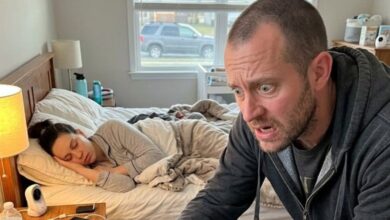
Seeing my mother’s name flash across my phone again and again, I understood that cancelling the celebration had landed somewhere she never expected it to land.
Three days earlier, she had watched my six-year-old daughter try to sleep on cold tile and acted as if there were nothing unusual about it.
Now she was the one who couldn’t settle down.
I stared at the screen for a few seconds before turning the phone face down beside my coffee.
I wasn’t trying to punish her.
That distinction mattered to me.
I wasn’t sitting there imagining her embarrassed or enjoying the idea that she was panicking.
I was thinking about Sofía.
About the way she had looked at me in the car before we ever reached my mother’s house and quietly asked, “Mommy… does Grandma actually like us?”
Children notice more than adults want to believe.
They notice who gets greeted first.
They notice which cousins get the good plates and which children get the old plastic ones.
They notice prepared beds, fresh sheets, cookies on nightstands, and the absence of those things when it is their turn to be cared for.
Most of all, they notice when a parent keeps pretending not to notice.
For years, I had been doing exactly that.
My name is Gabriela, and at thirty-three, I had built my life around being dependable.
I worked in an emergency room, where twelve-hour shifts could become longer without warning and where someone always needed something urgently.
At home, Sofía and Mateo needed breakfast, clean clothes, baths, school things, snacks, medicine when they were sick, stories when they were scared, and a mother who could somehow make ordinary life feel steady even when she was exhausted.
Their father was no longer part of my daily life in the way I had once expected him to be.
Our marriage ended after I learned he had cheated while Mateo was still wearing diapers.
I didn’t like talking about that period because people often wanted a dramatic explanation when the truth was much less glamorous.
I was tired.
I was hurt.
I still had children to raise.
So I kept going.
My mother, Elena, had never forgiven me for the shape my life had taken.
She didn’t say that in one clean sentence.
She said it in pieces.
She mentioned the distance I lived from her.
She mentioned the divorce.
She mentioned how often Patricia visited.
She mentioned how Patricia drove her to appointments or brought groceries or sat with her after my father died.
All of those things were true.
Patricia lived twenty minutes away.
I lived nearly four hours away.
Patricia could stop by during the week.
I worked long hospital shifts and had two young children to manage by myself.
None of that made Patricia wrong for being close to our mother.
What hurt was watching my mother turn those circumstances into a ranking system for her grandchildren.
That November weekend made the ranking impossible to ignore.
I had finished a night shift, prepared a tray of lasagna, packed toys and blankets, loaded two excited children into the car before sunrise, and driven almost four hours because I still wanted my children to have a relationship with their grandmother.
I wanted that badly enough that I had been explaining away uncomfortable moments for years.
When nobody came outside to greet us, I told myself everyone was busy.
When Patricia’s family had already filled the guest room, I told myself perhaps the sleeping arrangements had simply worked out that way.
When I saw fresh sheets on the beds and cookies beside the water bottles, I felt something tighten inside me, but I still said nothing.
At dinner, the difference became harder to rationalize.
Patricia’s children ate from the porcelain dishes that had belonged to my grandmother.
My children were handed old plastic plates.
It sounds small when you describe it as dishes.
That was how I had trained myself to think about these things.
It’s only a plate.
It’s only a room.
It’s only a greeting.
It’s only a cookie.
But children don’t experience favoritism as a collection of harmless objects.
They experience the message those objects carry.
Later that evening, I heard my mother tell an aunt that Patricia had been her lifeline since my father died.
I understood why she felt grateful to my sister.
Patricia had been physically present in ways I could not be.
But I sat at the other end of the table cutting Sofía’s food while keeping Mateo’s cup from tipping over, and I noticed that my name never entered the conversation.
I had become the daughter whose absence was remembered more clearly than anything she did manage to give.
Still, I stayed.
At nine that night, I finally asked where we were supposed to sleep.
My mother went to a closet and pulled out two sleeping bags that had once belonged to my father.
She dropped them in the living room.
“The floor is clean,” she said.
Sofía looked at them.
Then she looked toward the guest room where her cousins had proper beds waiting for them.

“On the floor, Mommy?”
Before I could answer, Patricia appeared in the doorway.
“Well, you should have booked a hotel.”
Then she laughed.
There are moments when an argument would almost be easier.
An argument gives everybody something loud to focus on.
It gives people a way to say both sides behaved badly.
It gives them an excuse to forget what caused the argument in the first place.
I didn’t give anyone that escape.
I unrolled the sleeping bags.
I helped Mateo settle down.
I watched Sofía kneel on cold tile and shift her body around, trying to make herself comfortable.
Down the hall were made beds and cookies.
In front of me was my daughter on the floor.
That contrast did more than any speech could have done.
Later, I found my mother in the kitchen.
I told her Sofía had asked whether her grandmother loved her.
My mother said I was exaggerating.
I pointed out the difference between the way the children were being treated.
Her answer was immediate.
Patricia came every week.
Patricia helped with appointments.
Patricia brought groceries.
I had moved away.
I had gotten divorced.
“Decisions have consequences,” my mother told me.
I remember looking at her and thinking about how strange that sentence sounded when the person being made to feel the consequence was six years old.
Sofía had not moved away from anybody.
She had not gotten divorced.
She had not decided how far her mother’s job should be from her grandmother’s house.
She had simply arrived excited to visit family.
And somehow she had ended the night wondering why her cousins were worth a bed while she was not.
I could have argued for an hour.
Instead, I went back to my children.
Around eleven, Sofía came close to me and whispered, “Mommy, my back hurts.”
That sentence ended the debate I had been having inside myself.
I looked at Mateo sleeping beside her.
I looked at my daughter trying not to complain.
I looked at the old sleeping bags that had once belonged to my father.
And I finally understood that I had been asking the wrong question for too long.
The question was not whether I could make my mother treat my children equally.
I couldn’t control that.
The question was whether I was going to keep placing my children in situations where they had to absorb the difference.
That part was mine.
“Pack your things, sweetheart,” I told Sofía. “We’re leaving.”
She didn’t protest.
She quietly put her toys into her backpack while I gathered our blankets and lifted a half-asleep Mateo.
When my mother realized what I was doing, she followed us toward the entrance.
“Are you really leaving over this?” she asked.
I didn’t answer.
I had spent too many years explaining myself to people who heard every explanation as an invitation to debate my limits.
This time, I simply opened the door.
Sofía took my hand.
Then we walked outside together.
My mother had no idea that another decision had already been made before I crossed that threshold.
For three months, I had been helping prepare a celebration for her that cost more than 140,000 pesos.
Until that weekend, I had thought of the expense as something families did.
You contributed.
You showed up.
You helped make the day special.
You ignored the occasional resentment because family obligations were rarely perfectly equal.
But driving away from my mother’s house changed the meaning of the money.
I kept seeing Sofía on the tile.
I kept hearing Patricia laugh.
I kept hearing my mother tell me that choices had consequences.
By the time we were back home, the party no longer felt like generosity.
It felt like another version of the same pattern.
I was expected to absorb the inconvenience.
I was expected to contribute quietly.
I was expected to accept whatever position my mother assigned me in the family and still show up when something important needed to be done.
Three days later, I stopped doing that.
I cancelled the party.
There was no dramatic family announcement.
I didn’t send a long message describing the sleeping bags.
I didn’t demand an apology first.
I didn’t call Patricia and tell her what I thought of her laughter.
I simply withdrew my time, my effort, and my money from a celebration I no longer felt responsible for carrying.
Then my mother began calling.
Again.
And again.
And again.
The urgency was impossible to miss.
That was the part that stayed with me.
When Sofía said her back hurt, my mother had not suddenly become alarmed.
When her granddaughter questioned whether she was loved, my mother called it exaggeration.
When I gathered my children and left, she treated my decision as unreasonable.
But once the party disappeared, she understood immediately that something important had changed.
For the first time, I did not rush to repair the discomfort for her.
I went to work.
I came home.
I made dinner for my children.
I helped Sofía with the ordinary things a six-year-old needs help with.
I checked on Mateo.
My phone kept lighting up.
Every time it did, I felt the old reflex telling me to answer quickly and smooth everything over.
That reflex had been trained into me over years.
Be reasonable.
Don’t make things worse.
Remember what your mother has been through.
Remember Patricia does more because she lives closer.
Remember everyone is tired.
Remember family is complicated.
All of those statements could be true without requiring my daughter to sleep on the floor beneath the roof of someone who had a bed available for another grandchild.
That was the line I had finally learned to see.
Boundaries are sometimes described as dramatic acts, but mine did not feel dramatic.
It felt practical.
My children had been shown where they stood.
I believed what I had seen.
That was enough.
I did not need my mother to agree with my interpretation before I protected them from experiencing it again.
I did not need Patricia to admit that her joke had been cruel.
I did not need another relative to declare who had been right at dinner.
I needed to stop teaching Sofía that love meant staying somewhere she was clearly being treated as less important.
That was the part I cared about most.
Because six-year-olds eventually become older children who remember what their parents tolerated.
I didn’t want Sofía remembering only the floor.
I wanted her to remember that when she told me her back hurt, I listened.
I wanted her to remember packing her backpack and walking out beside me.
I wanted her to understand that being related to someone did not require accepting humiliation from them.
And I wanted Mateo, even though he was too young to understand everything happening that night, to grow up in a home where that rule applied to him too.
My mother’s calls continued because cancelling the party had made my decision visible in a way leaving her house apparently had not.
Money had a way of making people recognize boundaries they were willing to dismiss when those boundaries involved feelings.
More than 140,000 pesos was suddenly real.
The cancelled plans were real.
My absence from the work behind the celebration was real.
And for once, I was not volunteering to make the consequences disappear.
I thought again about the sentence my mother had used in her kitchen.
Decisions have consequences.
She had meant my decisions.
My move.
My divorce.
My life.
But that principle did not belong only to me.
Her decisions had consequences too.
Choosing to prepare comfort for one set of grandchildren while telling another set to sleep on the floor had a consequence.
Laughing at my daughter’s discomfort had a consequence.
Treating my effort as an obligation while treating my children as optional had a consequence.
The consequence was not revenge.
It was that I stopped participating in the arrangement.
That difference gave me more peace than any argument could have.
I didn’t know whether my mother would ever see that weekend the way I did.
Maybe she would continue telling herself that Patricia had earned special treatment because she lived nearby.
Maybe she would continue believing I was too sensitive.
Maybe she would focus entirely on the cancelled party because that loss was easier to discuss than a little girl asking whether her grandmother liked her.
I could not control which version she chose.
I could control what happened next in my own home.
That evening, after another missed call from my mother, Sofía sat near me with the same backpack she had carried out of that house.
Nothing about it looked dramatic now.
It was just a child’s backpack again, holding toys and the small things she liked to carry around.
That mattered to me more than I expected.
Three nights earlier, I had watched her quietly stuff those toys inside because she understood we were leaving a place where she no longer felt comfortable.
Now she was home.
She had her own bed.
Mateo was nearby.
The ordinary rhythm of our life had returned.
My phone lit up once more with my mother’s name.
I looked at it, then looked at my children.
For years, I had believed being a good daughter meant answering every call, solving every problem, contributing when asked, and swallowing whatever hurt seemed too complicated to confront.
That weekend changed the definition for me.
I could love my mother and still refuse to let her choices teach my daughter that affection had to be earned by proximity, obedience, or usefulness.
I could appreciate what Patricia did for her and still reject the idea that my children deserved less because I lived farther away.
I could understand grief without allowing grief to become an excuse for favoritism.
And I could stop paying for celebrations that required me to pretend none of that mattered.
So I left the phone where it was.
Then I turned back toward Sofía and Mateo, choosing the family in front of me instead of rushing once again to rescue the feelings of someone who had made my daughter question whether she was loved.