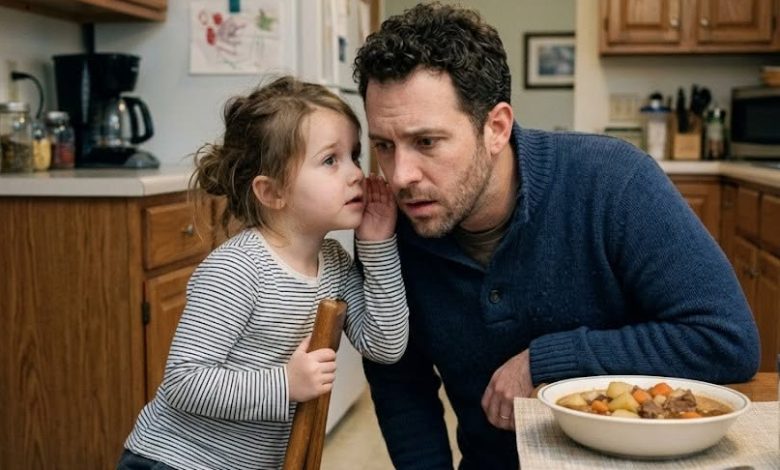
Lily lifted one small hand toward the upstairs hallway. I followed her finger, but whatever had caught her attention was outside my line of sight. Then she whispered something so softly I had to lean closer, and in that instant I understood one thing with sickening clarity: David had not simply guessed where she was.
A few hours earlier, I still thought I was babysitting my niece for three days.
That was all Sarah had asked me to do.
She was leaving for a business trip, Lily was staying with me, and my biggest concern had been whether a five-year-old would get bored with the cartoons I had queued up or complain about the dinner I planned to make.
Sarah had stood in my entryway with her bag over one shoulder while Lily clung to her leg.
“Light dinner, no sweets, and don’t let her throw any tantrums,” Sarah told me.
The instructions sounded strict, but not alarming.
Sarah had always been organized. She worried about schedules, sugar, bedtime, manners, and whether Lily behaved in front of other people.
I had teased her about it before.
I almost did that afternoon.
Then Sarah bent down and kissed Lily on the forehead.
“Be a good girl,” she said. “Don’t make your mother look bad.”
Lily’s fingers tightened around the fabric of Sarah’s pants.
For a second, I thought she was simply having trouble saying goodbye.
Kids do that.
Except Lily wasn’t crying.
She wasn’t asking her mother to stay.
She was watching Sarah’s face the way someone watches for instructions.
Sarah gently peeled Lily’s hands away, hugged her once, and left.
I closed the door and tried to turn the mood around immediately.
I told Lily she could pick a cartoon.
She looked at me before touching the remote.
“You mean I can choose?”
“Of course.”
She picked one, sat at the far edge of the couch, and kept both feet planted together on the floor.
She didn’t lean back.
She didn’t curl up with her doll.
She didn’t ask for a snack.
At first I thought she was being unusually polite because she wasn’t used to staying with me overnight.
By dinner, that explanation stopped making sense.
I made beef stew because it was easy, filling, and familiar.
Potatoes, carrots, tender beef, rice on the side.
The smell filled the kitchen while Lily sat quietly at the table.
I set the bowl in front of her and turned to grab my own plate.
When I sat down, she hadn’t moved.
Her hands were flat against her knees underneath the table.
Her eyes were on the spoon.
“You don’t like stew?” I asked.
She didn’t answer.
“Lily?”
Her voice came out barely above a whisper.
“Uncle… am I allowed to eat today?”
I stared at her.
I genuinely thought I had heard the sentence wrong.
“What do you mean, allowed?”
She looked from me to the bowl.
Not picky.
Not embarrassed.
Scared.
I pushed the bowl slightly closer.
“Yes. You can eat. Of course you can eat.”
She still didn’t touch it.
“Is it because your mom said light dinner?” I asked.
Lily shook her head.
I picked up the spoon, set it beside the bowl again, and kept my voice calm.
“You can eat whenever you’re hungry here.”
Her eyes filled with tears.
Then she began eating.
Fast.
Too fast.
I had to tell her to slow down because she was swallowing before she had fully chewed.
She tried.
Then she sped up again.
She ate potatoes, rice, carrots, broth, every piece of beef she could catch with the spoon.
She cried quietly while she ate, wiping her cheeks with the sleeve of her shirt as if even the tears were something she wasn’t supposed to draw attention to.
I didn’t ask another question until the bowl was empty.
Then Lily looked at me.
“Are you going to let me eat tomorrow, too?”
I felt something cold settle in my stomach.
“Yes.”
She waited.
“Yes, Lily. Tomorrow too.”
She nodded like I had just promised her something extraordinary.
After dinner, I began noticing things I should have noticed earlier.
She asked whether she could sit on the couch.
She asked whether she could use a purple coloring pencil.
She asked whether she could drink water.
She asked whether she could laugh when something funny happened on television.
Every request had the same careful structure.
“Am I allowed?”
“Can I?”
“Is this okay?”
And every time I answered yes, she studied my face before doing it.
I started replaying Sarah’s words from the doorway.
Light dinner.
No sweets.
No tantrums.
Be a good girl.
Don’t make your mother look bad.
None of those sentences proved anything by themselves.
Together, standing beside a child who wanted permission to drink water, they felt different.
I didn’t call Sarah immediately because I didn’t want Lily listening to an argument she might not understand.
I also didn’t want to frighten her by suddenly interrogating her.
So I kept the evening ordinary.
Cartoons.
Coloring.
A glass of water left within reach.
Her doll beside her.
When she yawned, I showed her the guest room.
I told her she could keep the hallway light on if she wanted.
She looked relieved.
Then I said she could leave the bedroom door open.
Her whole posture changed.
“You’re not going to put the chair there?” she asked.
“What chair?”
She stopped moving.
The relief vanished.
I waited, but she wouldn’t explain.
I didn’t push.
I tucked the blanket around her, set her doll beside the pillow, and told her I would be downstairs if she needed me.
She asked one more question before I left.
“Can I come get you?”
“Anytime.”
She watched me for a long moment.
Then she whispered, “Okay.”
I left the door open.
I sat downstairs for nearly twenty minutes staring at a television I wasn’t really watching.
My mind kept going back to the chair.
A child doesn’t invent a sentence like that for no reason.
Maybe it was harmless.
Maybe someone had used a chair to keep a door from drifting shut.
Maybe Lily misunderstood something.
I wanted one of those explanations to be true.
Eventually I went upstairs to check whether she was asleep.
She was curled around her doll, breathing evenly.
Her backpack was sitting near the wall.
I remembered Sarah saying she had packed extra clothes.
I decided to lay them out for the morning so Lily wouldn’t have to search for anything.
There were socks, a shirt, underwear, and a small pair of pants.
Then I saw the coloring book.
Something was tucked inside it.
A folded sheet of paper.
I almost put it back without opening it.
Then I remembered Lily asking whether she could eat.
I unfolded the page.
The handwriting was clearly adult.
Monday: No dinner.
Tuesday: Water only.
Wednesday: Bread if she obeys.
Thursday: No speaking.
Friday: Lockdown.
I read it twice.
The second time was worse because my brain had stopped trying to reinterpret the words into something harmless.
At the bottom, underneath the adult handwriting, was a sentence written in purple crayon.
“I really do want to be good.”
I recognized the color immediately.
It was the same purple Lily had asked permission to use earlier that evening.
I sat on the edge of the guest bed with the paper in my hand.
I looked at my niece.
Five years old.
Small enough that her feet barely reached the floor from one of my kitchen chairs.
Young enough to believe that food could be something adults awarded for obedience.
Young enough to write an apology beneath a punishment schedule because she had apparently decided the problem was herself.
I folded the paper carefully along its original crease.
My first instinct was to wake Lily and ask her everything.
I stopped myself.
She had spent the entire evening asking whether ordinary things were permitted.
Turning bedtime into an interrogation would only give her another reason to be afraid of answering incorrectly.
So I left the paper with me and went downstairs.
My phone buzzed before I could decide whether to call Sarah.
Her name was on the screen.
I answered immediately.
“Sarah, we need to talk.”
She cut me off.
“Michael… do not let her come back to this house.”
There was no greeting.
No explanation.
Just that warning.
I stood in the kitchen with the folded list still in my hand.
“What happened?” I asked.
Sarah was breathing quickly.
I could hear movement on her end of the line.
“I mean it,” she said. “Don’t let anyone take her.”
“Anyone?”
She didn’t answer that part directly.
I lowered my voice.
“I found something in Lily’s backpack.”
Sarah went quiet.
“A list,” I continued. “Days of the week. Food restrictions. No speaking. Something called lockdown.”
The silence on the phone changed.
It wasn’t confusion.
It was recognition.
“Sarah.”
“I know.”
Those two words hit harder than any denial could have.
“You know?”
“I didn’t know all of it.”
“Then tell me what you did know.”
She started to answer, but footsteps sounded above me.
I turned.
Lily was standing at the top of the stairs with her doll pressed against her chest.
Her face looked pale.
“Uncle…”
I raised one finger gently, signaling that I was listening.
She looked toward the front of the house.
“He’s already here.”
Three knocks came from the door.
Slow.
Measured.
I stopped breathing for a second.
Then David’s voice came through from outside.
“Michael, I know Lily is in there with you. I just came to collect my little girl.”
The words sounded calm.
That calmness bothered me more than shouting would have.
Sarah heard him through the phone.
“Don’t open it,” she whispered.
I moved toward the stairs instead of the door.
Lily came down quickly and stopped behind me.
I put myself between her and the entryway.
David knocked again.
“Michael.”
I didn’t answer.
Sarah was still speaking in my ear.
She told me David could not know where Lily was supposed to be staying.
That sentence made me look at the door differently.
Sarah had brought Lily to me herself.
She hadn’t announced it in front of David.
At least that was what I understood from her warning.
Yet he was standing outside my house on the first night.
I looked at Lily.
She wasn’t watching the door anymore.
She was watching me.
Waiting to see what I would allow.
I crouched so we were closer to eye level.
“You’re staying with me right now,” I told her. “You don’t have to go to that door.”
Her grip loosened slightly around the doll.
Not much.
But enough for me to notice.
David spoke again from outside.
“I don’t want trouble. Sarah left. Lily belongs at home.”
Sarah heard that too.
Her voice sharpened.
“Michael, listen to me.”
“I am.”
“What I found before I left wasn’t just about the food.”
I looked at the folded list on the kitchen counter.
“What did you find?”
“A camera.”
I thought she meant a baby monitor or some ordinary household device.
“Where?”
“In Lily’s bedroom.”
I straightened.
Sarah continued before I could respond.
She said the device had been concealed rather than openly used.
I looked at Lily again.
The chair.
The rules.
The permission for water.
The list.
Now a hidden camera.
For the first time, the separate details began to look less like isolated acts of strict parenting and more like parts of the same system of control.
David knocked once more.
Still calm.
Still patient.
Still outside.
I kept my voice low.
“Sarah, why did you leave for a business trip if you found that?”
Her answer came immediately.
“Because I needed Lily out first.”
I closed my eyes for half a second.
That explained Sarah’s warning.
It did not explain everything else.
“Why didn’t you tell me?”
“I was afraid you’d confront him before I understood what I was looking at.”
“You should have told me I was bringing a child into my house who might be followed.”
“I know.”
Her voice cracked on the last word.
I didn’t comfort her.
Not yet.
Lily needed my attention more than Sarah needed forgiveness.
“Tell me what the camera has to do with the list.”
“I don’t know yet.”
“What do you mean, you don’t know?”
“I mean the camera was only the first thing I found.”
David spoke through the door again.
“Lily? Sweetheart? Daddy’s here.”
Lily flinched.
The reaction was small, but unmistakable.
I stepped farther in front of her.
She pressed the doll against her mouth.
I could hear Sarah whispering through the phone, telling me not to respond to him.
David waited.
He didn’t pound on the door.
He didn’t threaten me.
He didn’t raise his voice.
He simply stayed there, behaving as if patience itself would eventually give him access.
That may have been the most disturbing part.
Inside the house, Lily kept asking permission without speaking.
Her eyes moved toward the stairs.
Then toward me.
Then toward the hallway above.
I watched her carefully.
“What is it?” I asked.
She didn’t answer immediately.
Instead, she lifted her hand.
Her finger pointed past the top of the stairs toward the upstairs hallway.
I turned my head, trying to see what she had noticed.
From where I stood, I could see the open guest-room door, part of the wall, and the edge of the landing.
Nothing moved.
Nothing obvious had changed.
Lily continued staring at the same spot.
Her breathing became shallow.
Sarah was asking me what was happening, but I barely heard her.
I looked from Lily to the hallway again.
“What do you see?”
She moved closer to me without lowering her hand.
Then she whispered something that made the timing of David’s arrival feel different.
Not lucky.
Not accidental.
Not the result of Sarah casually mentioning where Lily had gone.
David had known where to come.
And Lily, somehow, seemed to understand why.
I tightened my grip on the phone and stepped backward until Lily was fully behind me.
On the kitchen counter, the folded punishment list sat beside the bowl she had emptied only a few hours earlier.
Upstairs was the hallway she could not stop watching.
Outside was the man asking me to hand her over.
And in my ear, my sister was telling me that the hidden camera was only the beginning.