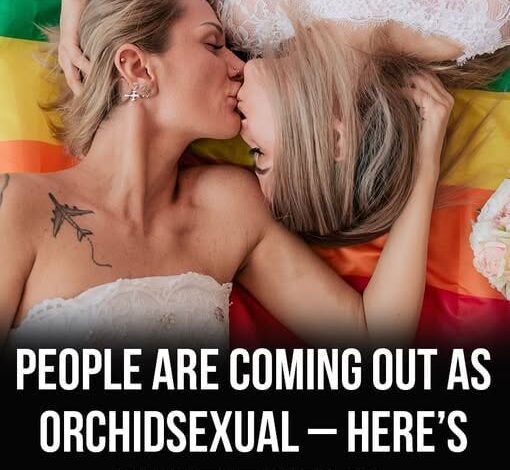
Orchidsexual is a term used to describe people who are capable of feeling sexual attraction, but who do not have a genuine desire to act on that attraction or pursue sexual relationships. A person who identifies this way might recognize that someone is sexually appealing, attractive, or desirable in a theoretical sense. They may even experience attraction clearly enough to name it as sexual. But when the idea shifts from feeling attraction to actually wanting sex, the interest disappears, becomes uncomfortable, or simply does not feel true to who they are.
That distinction is important. Orchidsexuality is not usually framed as celibacy, abstinence, repression, fear, or a temporary decision to avoid sex. Celibacy generally describes a choice not to engage in sex, often for personal, religious, emotional, or practical reasons. Orchidsexuality, by contrast, describes an internal experience: the presence of attraction without the desire to turn that attraction into sexual action. In other words, it is not necessarily “I want this, but I choose not to do it.” It is closer to “I can feel the attraction, but I do not want the act itself.”
For people outside the asexual spectrum, that difference may seem confusing or overly specific. Some might wonder why a separate word is needed at all. But for those who have spent years trying to explain themselves, the label can feel deeply clarifying. It gives shape to an experience that might otherwise be misunderstood by partners, friends, or even the person experiencing it. Without language, someone may assume they are contradictory, broken, afraid, or simply “doing attraction wrong.” A word like orchidsexual can offer relief by showing that their experience is not unique or impossible.
The label also helps separate attraction from behavior. Human sexuality is often discussed as though attraction naturally leads to desire, and desire naturally leads to action. But many people’s inner lives are more complicated than that. Someone can admire a person sexually without wanting physical intimacy. Someone can understand sexual appeal without wanting sex to be part of their life. Someone can feel attraction in the mind or body while still feeling that actual sexual contact would be unpleasant, unwanted, or disconnected from their needs.
That is why metaphors are often used to explain orchidsexuality. One common comparison is a scented candle: you may enjoy the scent, notice it, and find it pleasant, but that does not mean you want to eat the candle. The attraction may be real, but the expected action does not follow. The metaphor is simple, but it captures something many orchidsexual people recognize — appreciation and desire are not always the same thing.
Flags, microlabels, online communities, and shared language all serve a similar purpose. They give people a way to point to their experience and say, “This is what I mean.” For some, the word may become a major part of how they understand themselves. For others, it may only be a temporary stepping stone, a useful explanation, or a term they quietly relate to without adopting publicly. Either way, its value lies in the recognition it can provide.
Of course, not everyone finds microlabels helpful. Some people see them as too narrow or unnecessary, especially when sexuality can be fluid, complex, and difficult to define. But for others, these words are not about building walls around identity. They are about opening doors. They allow people to describe themselves with more honesty and less shame. They also remind others that sexual attraction, romantic desire, intimacy, and behavior do not always line up in simple or expected ways.
Whether or not someone uses the word orchidsexual, the concept points to a larger truth: human sexuality is not one-size-fits-all. People relate to attraction, desire, bodies, relationships, and intimacy in deeply personal ways. Some want sex often, some rarely, some never, and some can feel attraction without wanting sex at all. None of these experiences automatically makes a person broken, incomplete, or incapable of meaningful connection.
At its heart, orchidsexuality is not just about a label. It is about permission — permission to recognize attraction without forcing it into action, permission to reject assumptions about what desire is supposed to mean, and permission to exist honestly in a world that often expects sexuality to follow a single script. For those who need the word, it can be a quiet but powerful reminder: you are not alone, and your way of experiencing attraction is real.