While I was deployed, my daughter sent me a message that made everything go still. “Mom, Dad has been bringing women to the house while you’re gone.” I stared at the screen, then calmly typed back, “Thank you for telling me, sweetheart.”

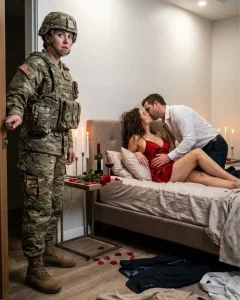
I didn’t confront my husband. I didn’t warn him. I simply changed my return date and came home three weeks early—ready to uncover the secret he thought I would never find.
Part 1: The Message That Changed Everything
I was four months into my third deployment when my fifteen-year-old daughter, Emily, sent me a message that made the noise around me disappear.
Mom, I need to tell you something, but I’m scared.
She rarely texted while I was away unless it was about school or to say she loved me. So when I saw those words, my mind went straight to danger.
Whatever it is, sweetheart, you can tell me. Are you safe?
Yes. It’s about Dad.
I sat inside a dusty metal container thousands of miles from home, staring at my phone while equipment hummed around me.
What happened?
A few seconds passed.
Then Emily wrote the sentence that changed everything.
Dad has been bringing women to the house. Different ones. They stay late. Sometimes overnight.
For a moment, I could not move.
Eight years of marriage seemed to collapse through a tiny glowing screen.
Emily kept apologizing. She said she had stayed quiet for weeks because she didn’t want to stress me out while I was deployed.
Are you mad at me?
I typed back immediately.
Never. You did the right thing. How are you handling this?
She said she mostly stayed in her room with headphones whenever Bao, her father, had visitors. My ten-year-old son, Binh, did not seem to understand what was happening, which meant at least one of my children had been spared the truth.
I told Emily not to confront her father and not to act differently. I would not let my daughter become the battlefield for my marriage.
Then she asked if I was okay.
I wasn’t.
But I refused to make her carry my anger.
I’m fine. Love you. Everything will be okay.
After the conversation ended, I stayed awake thinking about the man Bao had pretended to be: the devoted home-front spouse, the supportive military family posts, the patriotic captions, the perfect image.
But I knew I could not destroy my marriage based only on one message, even from a daughter I trusted.
I needed proof.
My first call was to Mai, an old military friend who lived an hour from my house.
“Bao’s having company while I’m gone,” I told her.
“Girl… what’s going on?”
“Emily told me.”
Within a week, I had footage.
Within two weeks, I had names, timestamps, and proof Emily had not exaggerated.
Bao still believed I was thousands of miles away.
So I quietly changed my return plans.
Then I checked our finances.
And what I found there made the betrayal even worse.
Part 2: Preparing From 7,000 Miles Away
Once I began reviewing our finances, I discovered that Bao’s behavior extended far beyond the women visiting our house. The extra money I earned during deployment was supposed to cover household expenses and strengthen our savings, but he had been spending it on expensive clothes, wine, dinners for two, and other purchases that had nothing to do with our family.
One transaction immediately caught my attention: a $400 charge from Hotel Rosewood. When I compared the date with the security footage, I realized it matched the night Bao had told Emily he was attending an overnight gathering for military spouses.
Then I discovered a private Instagram account he had apparently assumed I would never find. Among the posts were photographs from the same hotel with one of the women, accompanied by a caption about how he was “living his best life.”
I stopped thinking about confrontation and started preparing for separation. I opened an individual bank account, redirected my future pay into it, and left enough money in our joint account to continue covering the mortgage and utilities so the children would not be affected.
Part 3: The Ambush at Sunset
The flight back from overseas was a blur of fluorescent airport lighting, endless turbulence, and a burning, cold clarity. Seven thousand miles of travel gave me plenty of time to process grief, but by the time my boots touched down state-side, grief had burned off entirely, leaving behind raw, calculated resolve.
I didn’t call home. I didn’t announce my arrival on social media. I collected my sea bags, rented an unmarked mid-size sedan at the airport, and drove straight to Mai’s house.
Mai met me at her door before I even finished turning off the ignition. She pulled me into a fierce, silent hug that nearly knocked the wind out of me. Inside, her dining room table looked like a tactical command point. She had printed out high-resolution stills from the camera footage her contact had gathered over the past three weeks, organized by date and time in neat plastic sleeves.
“He’s home right now,” Mai said, pushing a steaming mug of coffee toward me. “His car has been in the driveway since 4:00 PM. But you aren’t going in there alone, and you aren’t going in there unprepared.”
“I’m not going in angry,” I replied, my voice steadier than I felt inside. “Anger gives him power. It lets him play the victim or claim I lost control. I’m going in with a ledger.”
For the next two hours, Mai and I finalized the plan. We coordinated with a local process server named David—a former bailiff Mai knew—who agreed to wait around the corner until I gave the signal. I didn’t want a screaming match. I didn’t want tears. I wanted a business transaction.
At 6:30 PM, as the sun began to sink below the tree line and cast long, golden shadows across our quiet suburban street, I pulled up two houses down from my own home. My home—the one I had paid off with combat deployment pay, hazard duty bonuses, and twelve-hour shifts in ninety-degree heat.
I texted Emily first.
M: Sweetheart, I’m outside. Take Binh and go out the back door. Mai is waiting for you at the corner in her blue SUV. Go straight to her car.
A minute passed, agonizingly slow. Then I saw the side gate open. Emily emerged, holding ten-year-old Binh by the hand. She had his oversized backpack slung over her shoulder, stuffed with clothes she’d quietly packed over the last forty-eight hours under the guise of an “overnight school trip.” She looked up, caught my eye through the windshield, and gave a single, tight nod. She didn’t cry. She was a soldier’s daughter.
Once I saw Mai’s SUV tail lights disappear down the main road with my children safely inside, I stepped out of the car.
The air felt cool against my face. The neighborhood was peaceful—lawnmowers humming in the distance, children riding bikes two blocks down, the smell of fresh-cut grass and charcoal grills. It was the quintessential picture of American suburban bliss.
I walked up the concrete driveway, unlocked the front door using my personal brass key, and stepped inside.
The house smelled of garlic, roasted chicken, and an expensive cologne that I had never bought for him. Music was playing softly from the kitchen—a slow jazz playlist.
Bao was at the kitchen island, pouring two glasses of Cabernet Sauvignon. He was wearing a tailored linen shirt I had never seen before. Sitting on the kitchen counter, casually swinging her legs, was a woman with blonde hair, wearing a silk robe that belonged to me.
The front door clicked heavy into its frame behind me.
Bao turned around, a casual smile on his lips, expecting Emily or Binh coming back downstairs.
When his eyes met mine, every drop of color drained from his face so fast I thought he might faint. The wine glass in his hand wobbled, sloshing dark red liquid over his knuckles and onto the white quartz countertop.
“M-Maya?” he stammered, his voice dropping an octave into a pitch of pure panic. “What… what are you doing here? You’re not supposed to be home until next month.”
I pulled off my jacket, hung it calmly on the coat rack near the entrance, and walked into the kitchen with unhurried steps.
“My orders were adjusted,” I said quietly. “Though it seems your schedule cleared up quite a bit as well.”
The woman on the counter scrambled off immediately, clutching the robe tightly around her neck. Her face was flushed bright red, her eyes darting frantically between Bao and me. “Bao… who is this? You said your ex-wife was stationed overseas.”
“Ex-wife?” I chuckled, a dark, quiet sound that echoed in the high-ceilinged kitchen. “Is that what he told you? We’ve been married eight years. And you’re currently wearing a anniversary gift he bought me three years ago with our joint account.”
“Maya, please, let’s talk about this in private,” Bao stammered, stepping between me and the woman. His hands were trembling. “This isn’t what it looks like. She’s a colleague—she was just… she had an emergency—”
“Save it, Bao,” I cut him off, raising one hand. “I’m not here to listen to a story you haven’t had time to draft yet.”
I pulled my phone out, tapped the screen twice, and hit send. Outside, a car door shut. Ten seconds later, the doorbell rang.
“Who is that?” Bao gasped, his eyes wide with genuine fear now.
“That would be the process server,” I said. “Why don’t you get the door? Or should I let him hand you the papers in front of your guest?”
Part 4: The Unraveling
The look of absolute, unadulterated shock on Bao’s face when he realized how thoroughly he had been outmaneuvered was something I would carry with me for the rest of my life. There was no rage in me—only an overwhelming feeling of disgust that I had spent nearly a decade sharing a bed with a man who had so little respect for his family.
David step inside, handed Bao a thick manila envelope containing the divorce petition, temporary custody filings, and an emergency motion for exclusive occupancy of the home, and politely excused himself.
The woman—whose name turned out to be Sarah—didn’t wait around for the legal drama. She darted upstairs, changed into her clothes in under two minutes, and ran out the front door without saying another word to Bao, leaving her designer bag on the foyer table in her rush.
Bao stood in the center of the living room, holding the legal documents in one hand, staring at me as if I were a stranger.
“You brought a process server to our house?” he whispered, his voice trembling with a mixture of shame and rising anger. “You set me up. You ambushed me in my own home!”
“This stopped being your home the second you brought women into the bed my deployment money paid for,” I said, walking over to the dining table and unzipping my leather binder. “Sit down, Bao.”
“No! I’m not sitting down!” he shouted, throwing the manila folder onto the table. “You can’t just show up after months away and throw me out! I take care of this house! I take care of the kids while you’re off playing soldier!”
“You take care of the kids?” I repeated, looking up at him with a cold stare that made him instantly check his tone. “Emily is fifteen. She has been cooking meals for Binh while you were out at Hotel Rosewood. She spent the last three weeks putting headphones on her ten-year-old brother so he wouldn’t hear you entertaining strangers down the hall.”
He froze. The anger died instantly, replaced by a sick, hollow dread.
“Emily…” he swallowed hard. “Emily talked to you?”
“Emily protected her brother when her father failed to,” I corrected him. “She came to me because she felt unsafe in her own house. And because of that, you are leaving tonight.”
“I have rights, Maya!” he snapped, trying to regain his footing. “This house is under both our names! The accounts are joint!”
I pulled out a thick stack of papers from my binder and slid them across the polished wood table toward him.
“Let’s talk about those joint accounts,” I said smoothly.
On top of the pile were printed bank statements from the past three months, highlighted in bright yellow markers.
“Four hundred dollars at Hotel Rosewood on July 14th—the night you told Emily you were at a regional management seminar,” I pointed out. “Two thousand eight hundred dollars at a jewelry store downtown. Nine hundred dollars in fine dining charges over eight weekends. Over eleven thousand dollars of my deployment savings spent on clothes, dates, and private getaways.”
Bao stared at the yellow lines, his mouth opening and closing silently.
“And then there’s this,” I continued, sliding over a second folder. “Full color prints from your private Instagram account, ‘@Bao_Unchained’. Lovely photos, by the way. The lighting at the Rosewood rooftop pool really brought out your smile.”
He dropped into a chair, burying his face in his hands. “Maya… please. It was a mistake. I was lonely. You were gone for months at a time, and I felt like I was living alone anyway—”
“Don’t you dare blame my service for your lack of character,” I said, leaning forward, my voice dropping to a icy whisper. “Thousands of military spouses manage to remain faithful every single day without stealing from their children’s future. You didn’t make a mistake, Bao. You made a series of calculated choices because you thought I was too far away to notice.”
I pulled out one final document—a proposed settlement agreement drafted by my attorney three days prior.
“Here are your options,” I said, tapping the paper. “Option one: You sign this temporary agreement tonight. It gives me temporary full custody of Emily and Binh, exclusive occupancy of this house, and freezes all joint marital assets until formal mediation. You pack one suitcase with your personal clothes, hand over the keys to my car, and leave immediately.”
Bao looked up, his eyes bloodshot. “And option two?”
“Option two: We go to court on Monday morning. My attorney files a motion alleging dissipation of marital assets, presenting every single receipt, camera timestamp, and Instagram post into public record. I notify your employer’s HR department about the corporate card charges you ran up at the Rosewood that were cross-referenced with our personal account refunds. And I make sure every mutual friend, family member, and neighbor knows precisely why this marriage ended.”
He stared at me, searching my face for any sign of hesitation, any flicker of the forgiving, soft-spoken wife he thought he had married eight years ago.
He found nothing.
“Where am I supposed to go?” he asked softly, his voice completely broken.
“There are plenty of luxury hotels in the city,” I replied, standing up and closing my binder. “I hear Hotel Rosewood has lovely rooms for four hundred dollars a night.”
Part 5: The Reconstruction
By 8:30 PM, Bao was gone.
I stood by the living room window and watched as he hauled his single suitcase down the driveway to his car, his head bowed, looking smaller and weaker than he ever had in his life. He didn’t look back as he pulled away into the dark.
As soon as his tail lights vanished, I called Mai. Ten minutes later, her SUV pulled up.
When the front door opened, Emily stepped inside first. She looked around the quiet foyer, sensing the shift in the air immediately. She looked at me, then down at the empty space where her father’s shoes usually sat.
I opened my arms, and for the first time in weeks, my strong, resilient fifteen-year-old girl dropped her guard. She ran to me, burying her face in my shoulder, and sobbed quietly. I held her tight, feeling the trembling in her small frame, wiping away the tears she had held back for far too long.
“It’s over, baby,” I whispered into her hair, kissing the top of her head. “You did so good. You saved us. I’ve got it from here.”
Binh walked in behind her, carrying his oversized backpack. He looked confused, but when he saw me, his face lit up with that pure, innocent joy that only a ten-year-old child possesses. He dropped his bag and sprinted across the living room, tackling my legs in a massive hug.
“Mom! You came home early!” he yelled, oblivious to the storm that had just swept through our lives. “Did you finish your mission?”
I knelt down, wrapping an arm around him while keeping Emily close to my side.
“Yes, Binh,” I said, looking into his bright, clear eyes. “My mission overseas is done. Now I’m right where I belong.”
Over the next six months, the fallout of the divorce played out exactly as I had planned. Faced with the mountain of evidence, Bao’s attorney advised him not to contest the terms. We reached an out-of-court settlement before the summer ended.
I retained full ownership of the home, primary physical custody of both children, and a structured repayment plan where Bao was forced to reimburse the joint account for every dollar he had spent on his affairs. His reputation among our shared social circle disintegrated once the truth quietly surfaced, and he ended up taking a lateral transfer to an office two states away out of sheer embarrassment.
The road to healing wasn’t easy. Emily went to counseling for several months to process the burden she had carried alone while I was deployed, and I worked hard to rebuild the sense of safety and predictability that our home had lost. We changed the furniture, repainted the walls in soft, bright colors, and installed a brand-new security system—not out of fear, but as a symbol of our fresh start.
One evening in late autumn, almost a year after that fateful message, I sat on the back patio with a hot cup of tea. The air was crisp, and the leaves were falling gently across the green lawn.
Inside, I could hear Binh laughing loudly at a video game in the living room, while Emily was at the dining table, humming softly to herself as she worked on an art project for school.
My phone chimed on the wooden table beside me. It was a text from Emily from the other room.
E: Thanks for making dinner tonight Mom. Love you.
I smiled, staring at the little glowing screen that had once brought my world crashing down. The pain of betrayal was gone, replaced by a deep, unshakeable peace.
I typed back immediately.
M: Love you more, sweetheart. Always.