“Please don’t come to my wedding.” After raising my daughter alone, I never expected those words. She was marrying into a wealthy family, and apparently, I didn’t belong. I went anyway, hiding in the last pew just to watch her walk down the aisle. Then the groom spotted me. His face went pale. He released her hands—and walked straight toward the mother she wanted hidden.

Part 1: The Last Pew
Three weeks before her wedding, my daughter asked me to stay away because I might embarrass her. On the day itself, I slipped into the last pew—and her fiancé abandoned the altar the moment he saw me.
I had raised Julia alone since her father died when she was six. My job in a credit union’s mortgage department paid for our modest life, though every unexpected bill meant stretching something else.
As a child, she promised to buy me a house with two kitchens. We had little money, but I never doubted she felt loved.
She met Daniel during her junior year of college. She called him “annoyingly smart” and insisted I would love him, yet every attempt to meet him ended with another excuse.
When he proposed, we cried together over the phone. But afterward, her calls dwindled, and she canceled both dinners I arranged for them.
Then she appeared in my kitchen three weeks before the ceremony. Over coffee, she explained that Daniel’s family was wealthy and respected, and his father had rebuilt a construction company.
“I bought a dress,” I told her. She lowered her eyes and asked me not to come.
“Are you afraid I’ll embarrass you?” I asked. Her silence answered me.
“Does Daniel know you’re asking this?” She hesitated, and I agreed to stay home.
The relief on her face hurt more than the request. I had expected sorrow, perhaps an apology.
On the wedding morning, I stayed home until nearly noon before taking my mother’s pearl locket from a drawer. She had worn it at her wedding, as I had at mine, and Julia had always wanted her turn.
I placed it in a velvet box and drove to the church, intending to leave it with an usher. Then the organ began, and I couldn’t walk away.
Hidden behind white roses in the last pew, I watched my daughter approach the altar. For a moment, I saw the little girl who had practiced that walk wearing a pillowcase veil.
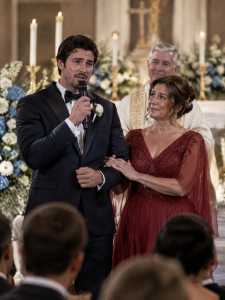
Daniel took her hands, then glanced toward the back of the church. His smile vanished, his face turned pale, and he let her go.

Part 2: A Face He Recognized
Daniel spoke quietly to the officiant and came down the aisle toward me. Nearly two hundred guests turned as Julia called his name, but he kept walking.
“Is it really you?” he asked when he reached my pew. I stared at him, unable to understand how a man I had never met could recognize me.
Julia hurried over, and he looked between us. “This is your mother? Why is she sitting back here?”
“I wasn’t invited,” I answered before she could. “I only came to leave her something.”
I showed him the velvet box. When he asked Julia why she had excluded me, she whispered that it was complicated.
He introduced himself, and I replied, “I gathered.” A surprised laugh escaped him before his eyes filled with tears.
Then he offered his arm and asked me to come with him. Julia tried to stop him, but he led me toward the altar.
Facing the guests, Daniel said there was something they needed to know before the ceremony continued. “Julia’s mother is the reason my family still has a home.”
A woman rose from the front row, crying as she approached. Only when she came closer did I recognize her.
“Helen?” I asked. Suddenly, I remembered a frightened woman sitting across my desk twelve years earlier.

Part 3: The Photograph on the Mantel
Helen’s husband’s business had collapsed, their mortgage was months overdue, and foreclosure was approaching. Overwhelmed by the hardship forms, she had come to the credit union for help.
I completed the paperwork with her and spent several days making follow-up calls after my shifts until the documents were approved. To me, it had been one case among many; to her family, it had changed everything.
“You saved our home,” Helen said. When I answered that I had simply done my job, she shook her head.
“Your shift was over. You stayed.” Then Daniel’s father stood and told me they kept my photograph on their mantel.
Years earlier, I had received a small community service award. They had framed the photograph with a brass plate bearing my name: Caroline.
Daniel turned to Julia. “You’ve visited my parents dozens of times. Did you know who your mother was to us?”
She said nothing until he asked again. Finally, she admitted she had recognized both the photograph and the name.
He stepped back, struggling to understand. “Then why did you keep finding reasons for us never to meet?”
Julia began crying. “Because I lied.”

Part 4: The Family She Invented
We moved behind the sanctuary to speak privately. As soon as the door closed, Julia admitted she had told Daniel our family was wealthy.
In her version of our lives, I traveled constantly, spent months in Europe, and owned several properties. Every exaggeration had required another explanation, until introducing us threatened to unravel everything.
“You said your parents owned property,” Daniel reminded her. Julia protested that her father had, and I quietly corrected her: “He owned our house.”
I wanted to comfort her, but I needed an honest answer first. “When did being raised by me become something you needed to hide?”
She said it had started in college, surrounded by people with more money, better connections, and parents whose careers impressed everyone. At first, she embellished small details; after meeting Daniel, the stories grew.
When she discovered my photograph in his parents’ home, she panicked. She knew meeting me would expose the difference between the family she described and the one she had.
“You weren’t worried I would embarrass you,” I said. “You were worried I would reveal the truth.”
This time, she admitted it. Helen hugged me, then told Julia that her mother had been deeply respected in their home for twelve years.
Julia apologized through her tears, while Daniel remained silent. Finally, he told her he loved her but couldn’t marry her that day.
“I need to know what was real,” he said. “I want to work through this, but I can’t begin our marriage pretending it didn’t happen.”
The wedding was postponed, and before I left, the usher returned the velvet box. Julia noticed it and apologized again.
“I don’t deserve to wear that today,” she whispered. I told her the locket had never been something she needed to earn, but I put it back in my purse.
Part 5: The Seat She Saved
Three months later, Julia and Daniel married in a small ceremony. This time, there was no invented family fortune and no effort to keep me out of sight.
Before she walked down the aisle, I opened the velvet box. Her eyes filled, and she turned around, asking me to fasten the locket.
As I closed the clasp, she touched the pearls. “I spent so long trying to make my life sound more impressive.”
I met her eyes in the mirror. “There was already plenty in it to be proud of.”
Someone called from the chapel that they were ready. Julia took my hand and told them to wait.
“I’m not starting until you’re in your seat,” she said. Then she walked me into the chapel herself.
Three months earlier, I had hidden behind flowers at the back, hoping only to witness a moment of her happiness. Now my daughter stood beside me until I was settled in the front row.