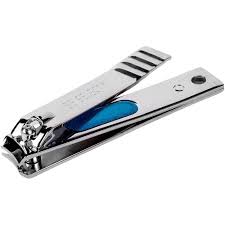
That small, round hole on your nail clipper may look like an ordinary detail, but it carries a surprisingly practical history. It was not added simply for decoration, balance, or manufacturing convenience. Its purpose was much more useful: it served as an anchor point. Through that little opening, a nail clipper could be attached to a chain, key ring, cord, or hook, making it harder to lose and easier to keep within reach.
Today, nail clippers are so common and inexpensive that most people do not think twice about misplacing one. But in earlier times, small grooming tools were treated with more care. Private bathrooms were not always common, especially in crowded homes, boarding houses, military barracks, schools, or shared washrooms. Personal items could easily be forgotten, borrowed, dropped into laundry, or taken by someone else. Replacing even a simple tool was not always convenient, and for many people, every useful object had to last.
That tiny hole helped solve a real everyday problem. It allowed the clipper to be secured to a place where it belonged, whether that was a washroom wall, a travel kit, a pocket chain, or a household drawer. It turned a small object that could easily disappear into something dependable and harder to misplace. In that sense, the hole was more than a design feature. It was a quiet form of survival engineering, created for a world where practicality mattered and nothing useful was meant to be wasted.
What makes the detail even more interesting is that it never really went away. Grooming habits changed. Bathrooms became more private. Materials improved, packaging became modern, and nail clippers were produced in countless shapes and styles. Yet the little hole remained. Manufacturers kept it because it still worked. It did not need explanation, advertising, or reinvention. Its usefulness was obvious to anyone who had ever wanted to hang, carry, or attach a clipper somewhere safe.
Over time, the hole outlived the people who first designed it, the early owners who relied on it, and the shared washrooms where it once had its most obvious purpose. It became one of those design choices that survived not because it was fashionable, but because it was quietly effective. It reminds us that innovation does not always arrive as something dramatic or complicated. Sometimes the smartest design is almost invisible.
A single small circle in a piece of metal kept a personal tool from slipping away, and that was enough. It solved a problem so simply that no one felt the need to improve it. The nail clipper’s hole is proof that good design does not always need to call attention to itself. Sometimes it just stays there, doing its job, generation after generation.