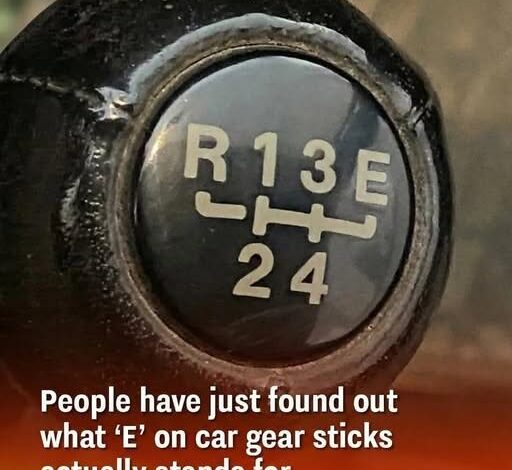
For decades, driving a car was a fairly straightforward experience when it came to understanding the gear selector. In manual vehicles, drivers usually saw numbered gears arranged in a familiar pattern, along with an “R” for reverse. In automatic vehicles, the layout became even more recognizable: “P” for park, “R” for reverse, “N” for neutral, and “D” for drive.
Because these letters and numbers became so common, most drivers rarely stopped to think about them. They learned the layout, used it every day, and treated it as one of the most basic parts of operating a vehicle. But every now and then, an unfamiliar symbol from an older car catches people’s attention and turns a simple piece of automotive design into a small mystery.
Recently, many younger drivers and car enthusiasts have become curious after seeing the letter “E” on the gear selector of certain older vehicles. To people used to modern cars, the letter can seem confusing. It does not fit neatly into the standard pattern of park, reverse, neutral, and drive, and it is not something most newer vehicles display in the same way. As photos and videos of older gear sticks circulated online, people began asking the same question: what did the “E” actually mean?
In many older cars, the “E” stood for “Economy.” It was a driving mode or gear setting designed to help improve fuel efficiency. Long before modern vehicles relied on advanced computer systems to monitor fuel use, adjust engine behavior, and optimize performance automatically, automakers used simpler systems to give drivers more control over how efficiently their cars operated.
Economy mode was created with practicality in mind. When selected, it encouraged the vehicle to use less fuel by changing the way power was delivered. Depending on the vehicle, it could reduce engine revolutions per minute, soften throttle response, or alter transmission shift behavior so the engine did not work as hard during normal driving. The goal was not speed or sharp acceleration. The goal was smoother, more efficient operation.
For drivers, this usually meant a noticeable change in the way the car felt. Acceleration could become slower, the vehicle might feel less eager when pulling away from a stop, and the engine might seem quieter or less forceful at certain speeds. But for many motorists, that trade-off was worth it. Using less fuel meant saving money, especially during long commutes, highway trips, or periods when fuel prices were high.
The “E” setting reflected a time when drivers were more directly involved in managing a vehicle’s behavior. Today, many cars make countless adjustments automatically without the driver noticing. Engine management systems, sensors, electronic throttle controls, and computerized transmissions constantly work in the background. Older vehicles, however, often required the driver to make more deliberate choices. Selecting Economy mode was one of those choices.
The appearance of the “E” gear also points to a larger moment in automotive history. As fuel costs rose and efficiency became a growing concern, manufacturers began looking for ways to make cars more economical without completely sacrificing usability. Automakers had to balance performance, reliability, comfort, and fuel consumption. Economy settings gave drivers the option to prioritize savings over power when conditions allowed.
This was especially useful during steady-speed driving, such as cruising on highways or traveling long distances. In those situations, a car did not always need maximum engine response. A gentler, more efficient mode could help reduce fuel consumption while still allowing the vehicle to operate comfortably. For everyday drivers, that made the “E” setting a practical feature rather than a novelty.
In some vehicles, the “E” worked like an overdrive or economy-oriented gear. It could allow the engine to run at lower RPMs once the car reached cruising speed. Lower RPMs generally meant the engine was not working as hard, which could improve fuel efficiency and reduce noise. In other vehicles, Economy mode influenced when the transmission shifted, encouraging earlier upshifts to keep the engine in a more efficient range.
The exact function varied depending on the make, model, and transmission design. That is part of why the letter can be confusing today. Not every “E” setting worked in precisely the same way, and not every automaker used the symbol identically. But the general idea remained consistent: “E” was connected to economical driving.
For older generations of drivers, this was not especially mysterious. It was simply one more option on the gear selector, like choosing a lower gear for hills or selecting drive for ordinary movement. But as automotive design changed, dedicated “E” markings became less common, and the meaning began to fade from everyday knowledge. What was once ordinary eventually became unfamiliar.
As technology advanced, vehicles no longer needed drivers to manually select an economy gear in the same way. Computer-controlled engines and transmissions became capable of optimizing fuel use automatically. Modern cars can adjust fuel injection, air intake, gear changes, throttle response, and other performance factors in real time. Many drivers today benefit from economy-focused engineering without ever selecting a special gear.
That does not mean the idea disappeared. It simply evolved. Many modern vehicles now include “Eco” buttons, drive mode selectors, hybrid systems, start-stop technology, regenerative braking, and dashboard displays that encourage efficient driving. These features are descendants of the same basic goal represented by the old “E” gear: helping drivers go farther while using less fuel.
In some modern cars, Eco mode reduces throttle sensitivity, adjusts climate control output, changes transmission timing, or limits unnecessary power use. Hybrid and electric vehicles take this even further by using sophisticated software to manage energy flow between batteries, motors, and engines. The technology is far more advanced, but the purpose remains familiar.
Interestingly, the letter “E” has also taken on a new meaning in the automotive world. Today, it is often associated with electric vehicles, electrification, and environmentally conscious transportation. Instead of simply standing for Economy on an older gear stick, “E” now appears in conversations about electric mobility, emissions reduction, and the future of driving.
That shift shows how much the industry has changed. In the past, fuel economy was often treated as a practical concern tied to cost and conservation. Today, efficiency is also connected to climate concerns, battery technology, government regulations, and the global transition toward cleaner transportation. The old “E” gear may seem small, but it belongs to a much larger story about how cars have changed over time.
Still, there is something charming about that simple letter on an older gear selector. It represents a period when solutions were more mechanical, more visible, and more directly connected to the driver’s choices. Instead of hidden software making hundreds of invisible adjustments, the car presented a clear option: choose Economy if you want to save fuel.
For collectors, restorers, and automotive history enthusiasts, these details are part of what makes older vehicles interesting. A single letter on a gear stick can reveal how engineers thought about efficiency, how drivers interacted with their cars, and what concerns shaped vehicle design during a particular era. It is a small reminder that even ordinary dashboard markings can carry history.
For younger drivers, discovering the meaning of “E” can also be a reminder that modern automotive habits did not appear overnight. Features that now seem automatic or highly advanced often began as simpler ideas. Long before touchscreen menus and digital drive modes, carmakers were already trying to help people drive more efficiently with the tools available at the time.
Although the old Economy gear is no longer common, its purpose has not disappeared. It lives on in modern Eco modes, fuel-saving systems, hybrid drivetrains, and electric vehicle technology. The methods have changed, but the goal remains the same: reduce waste, improve efficiency, and make driving more practical.
So the mysterious “E” on older gear sticks is not a forgotten code or an unusual mechanical trick. It is a symbol of economy, efficiency, and a stage in automotive design when drivers were given a simple way to influence fuel consumption. What may look strange today was once a useful feature for people trying to get more miles from every tank.
In that sense, the old “E” gear is more than just a letter. It is a small piece of automotive history, a reminder of how cars evolved from purely mechanical machines into increasingly intelligent systems. It shows that the pursuit of smarter, more efficient transportation did not begin with modern electric vehicles or computer-controlled engines. It has been part of driving culture for generations, quietly marked on gear selectors by a single, practical letter.