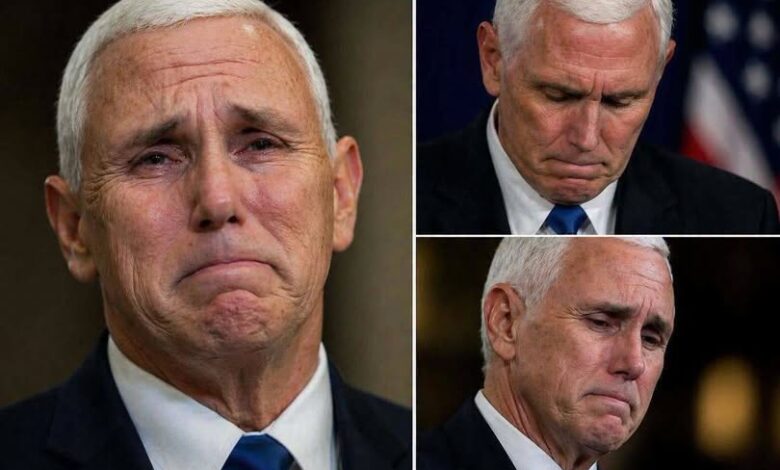
Mike Pence is walking a political tightrope with no safety net underneath, and every step seems to reveal just how narrow his path has become. On one side is the burden of loyalty to the man he once served, the former president whose administration gave Pence his highest office and national visibility. On the other is his increasingly urgent effort to reclaim relevance in a Republican Party that has largely moved on without him. He is trying to speak as an elder statesman, a principled conservative, and a guardian of old Republican doctrines, but the audience he once hoped to lead is no longer listening in the same way.
His CNN remarks about the Ukraine weapons pause were clearly designed to project seriousness, experience, and institutional command. By framing the issue as a troubling sign of a rogue Pentagon or a breakdown in orderly decision-making, Pence appeared to be reaching for the language of responsibility. He wanted to sound like someone who still understands the machinery of government and the stakes of American leadership abroad. But the effect was almost the opposite. Rather than underscoring his authority, the comments highlighted how far he has drifted from the center of gravity inside his own party.
Pence’s problem is not simply that he disagrees with Trump on foreign policy. It is that his disagreements belong to an older Republican world. When he criticizes Trump’s foreign speeches, warns against weakening America’s posture abroad, or invokes the importance of the war on terror, he is speaking in the vocabulary of a party shaped by interventionism, national security orthodoxy, and deference to institutions. That version of the GOP once treated American power as a moral obligation and viewed global leadership as central to conservative identity.
But the MAGA base does not want a return to that era. It does not want lectures about institutional stability or the old architecture of foreign policy consensus. It wants defiance, disruption, and a leader willing to reject the very establishment Pence still seems to respect. To many of Trump’s supporters, Pence’s careful warnings sound less like conviction than nostalgia. They hear in his words the voice of a Republican Party they believe failed them, a party too polite, too restrained, too eager to defend systems they now distrust.
That leaves Pence in an almost impossible position. If he remains silent, he disappears. If he speaks too sharply against Trump, he alienates the voters he would need for any political comeback. If he criticizes Trump carefully, as he often does, he satisfies almost no one. Trump loyalists see disloyalty. Trump critics see hesitation. Traditional conservatives may admire his tone, but admiration is not the same as political power. Each carefully measured jab at Trump only seems to deepen the sense that Pence is stranded between two eras.
His isolation is made sharper by the fact that he was never fully embraced by the populist revolution he helped legitimize. Pence was useful to Trumpism because he gave it a bridge to evangelical voters, congressional conservatives, and the institutional Republican establishment. He offered reassurance to those who wanted to believe that Trump’s movement could be contained, disciplined, or translated into familiar conservative terms. But MAGA was never truly Pence’s movement. It tolerated him when he served its purposes and rejected him when he became an obstacle to its will.
Now, as he tries to reassert himself, Pence finds that the party has absorbed the lesson of Trump more deeply than the lesson of his own vice presidency. The GOP’s energy is no longer with the patient institutionalist or the polished conservative messenger. It is with the fighters, the provocateurs, and those willing to treat politics as open conflict. Pence’s appeal to seriousness may be sincere, but sincerity alone cannot rebuild a constituency that has vanished.
His remarks on Ukraine, Trump’s rhetoric, and America’s global role are therefore about more than policy. They are a window into a larger political displacement. Pence is attempting to defend a Republican identity that once seemed permanent but now feels increasingly like a relic. He still speaks of duty, alliances, national security, and moral clarity abroad. Yet the party he addresses is more skeptical of foreign commitments, more hostile to elite consensus, and more interested in cultural combat than international stewardship.
In the end, Pence is trapped by the very transformation he helped enable. He served beside Trump, benefited from Trump’s rise, and helped reassure conservatives that the movement could coexist with traditional Republican values. But the movement outgrew him. It kept Trump’s defiance and discarded Pence’s restraint. It kept the populist energy and abandoned the older conservative framework that Pence still represents.
That is why his political tightrope looks so unforgiving. He is not simply choosing between loyalty and criticism. He is trying to stand between a party he no longer leads and a revolution that never fully accepted him. His every attempt to sound principled reminds voters of a Republican past many have rejected. His every criticism of Trump reminds them that he is no longer safely inside the movement’s inner circle. And his every appeal to seriousness only raises the same question: in today’s GOP, is there still a place for Mike Pence, or is he speaking to a party that has already decided to leave him behind?