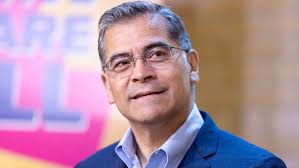
Xavier Becerra’s breakthrough into California’s November gubernatorial election is more than a personal win. It is a rescue mission completed at the very edge of disaster for Democrats. After months of uncertainty, bitter intraparty tension, collapsed campaigns, scandal-driven exits, and growing panic among party insiders, Becerra’s climb from doubt to inevitability gave Democrats something they badly needed: a secure place on the general election ballot and a candidate around whom the party can at least plausibly unite.
For a party accustomed to dominance in California, the road to this point was far messier than expected. The state’s Democratic establishment had assumed that its political machine, donor networks, and demographic advantages would be enough to produce a smooth path forward. Instead, the race became a warning sign. Heavyweights hesitated. Rising stars faltered. Promising campaigns became tangled in controversy. Voters appeared restless, distracted, and less loyal to familiar assumptions than party leaders hoped. What should have been a predictable contest began to feel unstable.
Becerra’s success changed that, at least for the moment. He offered Democrats a figure with experience, national stature, and a long record in public life. He may not have entered the race as the most electrifying personality in the field, but in a chaotic year, steadiness became its own argument. His campaign survived where others stumbled. He absorbed attacks, endured doubts about his viability, and slowly positioned himself as the safest vessel for a party desperate to avoid embarrassment in its own stronghold.
That is why his place on the November ballot matters so much. It prevents Democrats from facing the nightmare of being pushed aside in a state they are supposed to control. It gives the party a focal point after months of drift. It allows elected officials, labor groups, donors, and activists to stop waiting and begin organizing around a nominee. In political terms, Becerra has restored order. In emotional terms, he has given Democrats permission to breathe.
But relief should not be mistaken for certainty. The race ahead remains unpredictable, and the unresolved battle for the second spot may determine the entire character of the general election. If Trump-aligned Republican Steve Hilton advances, Becerra will likely frame the race as a stark ideological choice between California’s Democratic governing tradition and a national conservative movement eager to turn the state into a referendum on crime, immigration, taxes, homelessness, and Democratic mismanagement. That matchup would give Democrats a familiar enemy and a clear partisan contrast.
If billionaire Democrat Tom Steyer claims the second slot instead, the race could become something more complicated and more painful for the party. A Becerra-Steyer contest would not be a simple left-versus-right battle. It would become an intraparty reckoning over money, climate policy, establishment politics, outsider ambition, and the future identity of California Democrats. Instead of uniting against a Republican challenger, the party could be forced into a bruising family fight with national implications.
That uncertainty hangs over Becerra’s victory. He has won his way into the general election, but he does not yet know the kind of battlefield awaiting him. He may face a Republican opponent eager to nationalize the race around Trump-era grievances and California decline. Or he may face a wealthy Democrat capable of spending heavily, disrupting party unity, and forcing Becerra to defend his record from inside his own coalition. Either path will test him.
Becerra also enters the next phase with vulnerabilities. His experience is his strongest selling point, but it is also the source of many attacks against him. Years in public office create a record, and records can be used as weapons. Opponents will point to controversies, policy decisions, bureaucratic failures, and unresolved crises that unfolded during his time in public life. Becerra will argue that experience has prepared him to govern. His critics will argue that experience makes him responsible for the very problems voters want solved.
That tension may define his campaign. California voters are weary. They are frustrated by the cost of living, housing shortages, homelessness, crime concerns, climate disasters, water pressures, immigration debates, and a sense that the state’s promise has become harder to reach for ordinary families. In that environment, a résumé alone will not be enough. Becerra must convince voters that his long career is not evidence of stale politics, but proof that he understands the machinery required to fix problems that slogans cannot solve.
He will need to argue that governing California requires more than charisma or outsider disruption. It requires knowledge of federal systems, state agencies, legal frameworks, budgets, courts, health care programs, environmental rules, labor politics, and the difficult trade-offs that come with leading a state of nearly 40 million people. In a year dominated by spectacle, he must make the case that competence is not boring; it is necessary.
At the same time, he cannot sound like a caretaker of the status quo. That may be his hardest task. California’s political establishment is under pressure because many voters feel that familiar leadership has not delivered enough. If Becerra runs only as the experienced hand, he risks seeming like a defender of a system people distrust. He must present experience as a tool for change, not a shield against criticism. He must show that he can diagnose the state’s failures honestly while still arguing that he is the person capable of addressing them.
The second-place contest will sharpen that challenge. Hilton would likely attack Becerra as part of a Democratic machine that has made California unaffordable and unsafe. Steyer would likely attack him as too cautious, too tied to the old order, and insufficiently bold for the scale of the state’s crises. In either case, Becerra will be forced to defend not only himself, but a broader governing record that many Californians are now questioning.
Still, his victory has already altered the political landscape. It gives Democrats a nominee with seriousness, durability, and institutional credibility. It also forces Republicans and insurgent Democrats alike to confront a candidate who has survived more than one political era and knows how to endure pressure. Becerra may not inspire the kind of instant enthusiasm that some campaigns chase, but he has demonstrated something just as valuable in a chaotic race: staying power.
For now, Democrats have avoided disaster. They have their place on the ballot. They have a candidate who can credibly speak to health care, legal battles, federal-state relations, immigrant communities, working families, and the responsibilities of government. They have someone capable of turning the race away from pure spectacle and back toward the question of who can actually govern.
But the larger uncertainty remains. California’s political future is still unsettled. The unresolved fight for the second spot will determine whether November becomes a partisan showdown, a Democratic civil war, or a broader referendum on whether the state’s ruling party still understands the people it governs. Becerra has completed the rescue mission, but the campaign ahead may be even harder than the one he just survived.
His breakthrough is an ending only in the narrowest sense. In reality, it is the beginning of a new and more consequential test. He must now prove that experience can still persuade, that survival can become momentum, and that a weary electorate is willing to trust a familiar figure to lead them through unfamiliar crises.