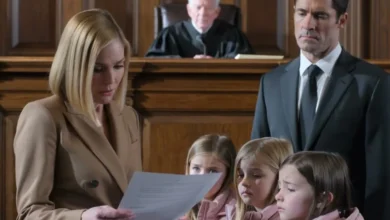
The courtroom did not move. For one suspended moment, even the air seemed to hold its breath, as if everyone inside that room understood that something irreversible was about to happen. Papers stopped rustling. Shoes stopped shifting against the floor. No one coughed, whispered, or dared to interrupt the silence gathering around Judge Benton’s bench.
My mother’s smile disappeared first. It did not fade gently; it collapsed, shrinking into a tight, uncertain line that made her look suddenly older. My father leaned forward in his chair, his hands gripping the edge of the table as though getting closer to the evidence could somehow change what had already been written, signed, recorded, and sealed years before. Beside them, Graham Phelps kept his eyes locked on the judge, but the confidence he had carried into the room was beginning to fracture.
Judge Benton turned another page in the sealed packet. The sound was small, but in that silence, it landed like a warning. His expression tightened, not with confusion, and not with doubt, but with the unmistakable recognition of a man who had just found the missing center of the case.
“This,” he said slowly, each word measured and deliberate, “is not a simple letter of intent.”
My mother’s fingers curled against the table.
The judge continued, eyes still moving over the page. “This is a full evidentiary directive from the original trust architect.”
A low murmur moved through the courtroom, spreading from one side to the other before the bailiff’s stern look forced it back into silence. Judge Benton finally lifted his gaze and looked directly at me. For the first time since proceedings began, there was something in his expression that went beyond formal neutrality. It looked almost like curiosity. Maybe even respect.
Then he said the words that changed everything.
“Your grandmother anticipated fraud.”
The courtroom reacted before anyone could stop it. A sharp breath escaped somewhere behind me. Someone whispered, “My God.” Graham Phelps straightened in his seat so abruptly that his chair creaked against the floor. My father’s jaw tightened. My mother went pale.
Judge Benton slid the documents forward, aligning them carefully as if the order of the papers mattered as much as the truth they contained. “The bank trail confirms unauthorized withdrawals from accounts linked to the trust. The signature comparison shows clear inconsistencies across multiple transfer documents. And the video transcript…”
He paused there.
The pause was worse than the sentence itself.
His eyes moved briefly toward my parents, and something heavy passed over his face.
“The video transcript explicitly states that any attempt to reassign ownership, redirect beneficiary control, or transfer property assets without trustee consent would result in immediate forfeiture of controlling interest.”
My father shook his head once, sharp and angry. “That’s impossible,” he muttered.
But the words had no force left. They fell flat between him and the judge, stripped of the power they might have had an hour earlier. No one turned to him for explanation. No one rushed to believe him. Even Graham Phelps did not speak.
My mother whispered my name.
It was not soft enough to be tender. It was not loud enough to be a threat. It sounded like a warning she had meant to give long ago, before everything broke open, before the documents surfaced, before my grandmother’s careful planning reached beyond death and pulled the truth into the light.
Judge Benton leaned back in his chair and exhaled slowly through his nose. He looked tired now, but not uncertain.
“So, to be clear,” he said, “the seven properties were never transferable in the manner presented to this court. The filings submitted in support of that transfer are contradicted by the original trust directive, the financial record, and the recorded testimony of the trust’s architect.”
No one moved.
“And Ms. Whitaker…”
His gaze returned to me, steadier now.
“…is not the one who lost anything here.”
The gavel did not need to fall. There was no dramatic slam, no sudden outburst, no final speech that could undo what had just been revealed. It was already over in the silence that followed.
My parents sat frozen at the table, not merely defeated, but exposed. They had not only lost their argument. They had lost the story they had spent years building around it—the story where I was ungrateful, confused, manipulated, or standing in the way of what rightfully belonged to them. That version of events had carried them all the way into court.
And then it had collapsed under the weight of my grandmother’s foresight.
For the first time since I had walked into that courtroom, I did not feel like I was defending ownership. I did not feel like I was fighting to prove I deserved what had already been left in my care. I felt like I was standing inside the moment my grandmother must have imagined when she wrote those instructions: the moment when truth, delayed but not destroyed, finally refused to stay hidden.
I looked at my parents, at their stunned faces and silent hands, and realized something I had not allowed myself to believe before.
They had tried to take the properties.
But they had never truly held the power.
My grandmother had.