At one time, many superstitious people believed the $2 bill carried bad luck. Some even thought it was cursed, suspicious, or connected to dishonesty. Because it was not seen as often as the $1 or $5 bill, it developed an unusual reputation. People tucked it away, refused to spend it, or treated it like something strange instead of ordinary money.
But that old myth could not be further from the truth. In reality, the $2 bill may be one of the most misunderstood pieces of American currency. Far from being unlucky, it can sometimes be a pleasant surprise in your wallet. For most people, it is simply worth its face value. But for collectors, certain $2 bills can be worth much more—sometimes hundreds or even thousands of dollars—depending on their age, condition, printing details, and serial number.
The $2 bill has often been treated like the forgotten member of the paper-money family. While the $1 bill is used constantly and recognized everywhere, the $2 bill has spent much of its history in the background. Many Americans rarely receive one in change, so they assume it must be rare, discontinued, or no longer accepted in stores. This misunderstanding has only added to the bill’s mysterious image.
Contrary to popular belief, $2 bills are still legal U.S. currency. The Bureau of Engraving and Printing also maintains public production reports for U.S. notes, including recent years, though $2 notes are produced in smaller quantities and not as frequently as more commonly used denominations. Because they do not appear often in everyday transactions, many people mistake “uncommon” for “rare.” That is why someone may react with surprise when they see one, even though the bill remains valid and spendable.
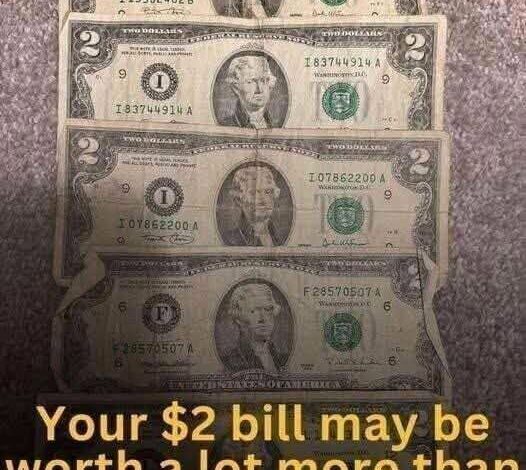
Still, not every $2 bill should be treated casually. Some are worth examining before you hand them over at a cash register. Collectors often look for older series, unusual printing varieties, crisp uncirculated condition, star notes, low serial numbers, repeating numbers, ladder serial numbers, binary serial numbers, or other patterns that make a bill stand out. A $2 bill with a common date and heavy wear may only be worth two dollars, but one with the right combination of rarity and condition can attract serious interest.
Age can also matter. Older $2 notes, especially large-size notes from before modern small-size currency, may carry significant collector value. Even later bills can be desirable if they have special features or have been preserved in excellent condition. A bill’s value is not determined by the denomination alone. It depends on the details.
That is why anyone who finds a $2 bill should take a closer look before assuming it is ordinary. Check the year, the seal color, the serial number, whether there is a star at the end of the serial number, and the overall condition of the paper. If the bill looks unusually old, perfectly crisp, or has a serial number that seems special, it may be worth researching or showing to a currency expert.
The truth is that the $2 bill is not cursed, unlucky, or useless. It is a fascinating piece of American money with a history full of myths, misunderstandings, and collector interest. For some, it is a novelty. For others, it is a good-luck charm. And for a lucky few who know what to look for, it might be a small piece of paper hiding a surprisingly valuable secret.