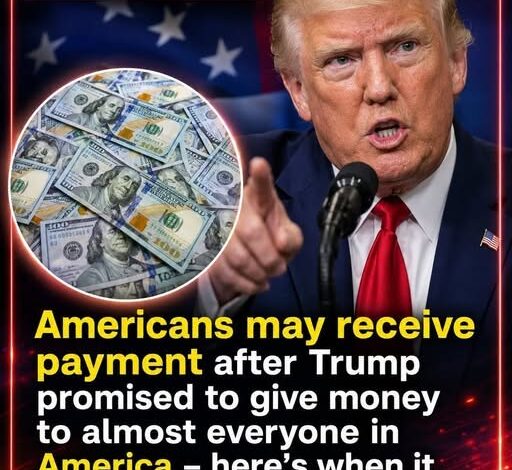
A viral post claiming that Americans may soon receive money after President Donald Trump promised payments to “almost everyone in America” has sparked widespread attention online. The image, styled like breaking news, suggests that cash could eventually hit Americans’ bank accounts, but the reality is more complicated: the idea has been discussed publicly, but no guaranteed nationwide payment has been finalized.
The proposal centers on what Trump has described as a possible “tariff dividend.” Under the idea, revenue collected from tariffs on imported goods could be used to send payments to many Americans, excluding high-income earners. Trump has floated figures of at least $2,000 for eligible people, arguing that tariff revenue should benefit ordinary citizens while also supporting the country’s finances.
Supporters of the idea say it could provide much-needed relief for families dealing with high prices, rising household expenses, and lingering economic pressure. For many Americans, the possibility of a direct payment immediately brought comparisons to earlier stimulus checks, which helped millions of households during periods of financial uncertainty.
However, experts and policy analysts have urged caution. A promise is not the same as an approved payment program. For money to actually be sent out, the plan would likely need clear rules, funding approval, and cooperation from Congress. There would also need to be decisions about who qualifies, how income limits would work, whether the payment would be issued as a check, direct deposit, tax credit, or rebate, and when any distribution could begin.
Another major question is whether tariff revenue would be enough to fund such a large program. Analysts have noted that sending $2,000 to a broad share of Americans could cost hundreds of billions of dollars. Critics argue that tariff collections may not be sufficient to cover that cost, especially if the government also intends to use the same revenue to reduce debt or pay for other priorities. Fact-checking organizations and financial experts have said the math behind the proposal remains uncertain.
There are also legal and political hurdles. Tariff revenue goes into the U.S. Treasury, and a president generally cannot simply direct that money into personal payments without congressional action. Some of the tariff policies connected to the proposal have also faced legal scrutiny, which could affect how much money is available and whether the program can move forward as described.
For now, Americans should treat viral posts about immediate payments with caution. There is no confirmed date for money to arrive in bank accounts, and there is no official final application process or guaranteed eligibility list. Any real payment program would be announced through official government channels, such as the Treasury Department or IRS, not only through social media graphics or comment-section links.
Still, the viral attention shows how closely Americans are watching for signs of financial relief. The idea of a tariff-funded payment has become a major talking point because it touches on several issues at once: inflation, trade policy, household budgets, government spending, and trust in political promises.
Until legislation or formal federal guidance is released, the safest conclusion is this: Trump has promoted the idea of sending tariff-funded payments to many Americans, but the plan remains uncertain. No one should assume a payment is guaranteed, and people should be careful about posts asking them to click links, enter personal information, or “claim” money before an official program exists.
If a payment plan does move forward, the most important details to watch will be the amount, eligibility rules, income limits, approval status, and official payment timeline. Until then, the headline may be exciting, but the money has not yet been promised in a way Americans can count on.