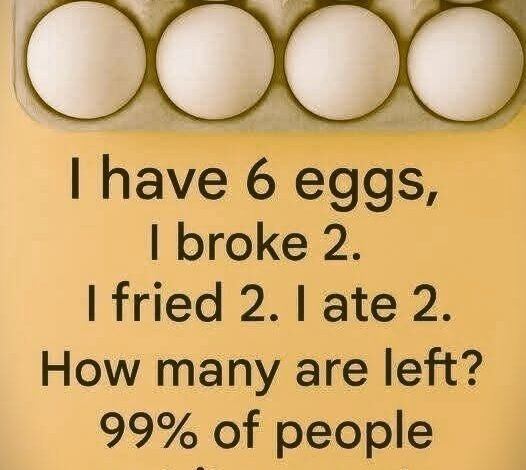
The “six eggs” riddle is a classic brain teaser that seems simple at first, but it is really designed to test how carefully someone reads the wording. It is not a difficult math problem, even though many people try to solve it as one. Instead, the trick lies in understanding that the actions described may be happening to the same eggs, not to different eggs each time.
The riddle usually says that someone has six eggs. They break two eggs, fry two eggs, and eat two eggs. At first glance, many people assume this means two eggs are broken, two separate eggs are fried, and another two eggs are eaten. Following that logic, all six eggs would be used up. That is why a common answer is zero eggs left.
However, that answer comes from reading too quickly. The riddle does not say that different eggs are used for each action. The same two eggs can be broken, then fried, and finally eaten. Breaking, frying, and eating are simply three steps in the process of preparing and consuming the same two eggs.
So, if the person started with six eggs and only used two of them, four eggs remain untouched.
The correct answer is four.
This riddle is a good reminder that not every problem is about complicated calculation. Sometimes the challenge is in the wording. It teaches us to slow down, pay attention to sequence, and avoid making assumptions that are not actually stated. Careful reading often matters just as much as logic, and in this case, it is the key to finding the right answer.