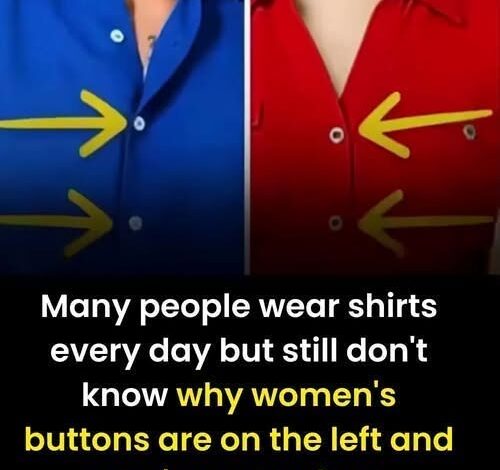
Most people go through life buttoning their shirts without ever noticing one small but revealing detail: women’s shirts usually fasten from the left, while men’s shirts fasten from the right. It seems like a harmless design choice, the kind of ordinary clothing feature few people think to question. But this difference carries a history shaped by class, gender, convenience, and inequality.
For wealthy women in the 18th and 19th centuries, getting dressed was not always a simple private routine. Clothing could be elaborate, layered, restrictive, and difficult to manage alone. Gowns, corsets, petticoats, bodices, and fine blouses often required the help of servants or maids. Dressing became not only a necessity, but also a performance of wealth and status. A woman who needed assistance to dress was often seen as refined, privileged, and removed from ordinary labor.
Because most servants were right-handed, placing buttons on the left side of women’s garments made the process easier for the person fastening them from the front. In other words, the design was not created primarily for the comfort or independence of the woman wearing the clothing. It was created for the convenience of the person dressing her. What seems like a tiny detail in fashion was actually tied to a larger social structure in which wealthy women’s clothing reflected dependence, status, and the labor of others.
Over time, that practical arrangement became tradition. Even after clothing became simpler and women dressed themselves more often, the button placement remained. What began as a convenience for maids hardened into a silent fashion rule, passed down through generations until most people forgot its origin. The left-side buttons became associated with femininity, refinement, and convention, even though their roots were connected to a world where women’s clothing often limited freedom rather than supported it.
Men’s clothing developed under a different logic. Historically, men’s garments were shaped by movement, work, riding, and warfare. Since many right-handed men carried weapons on the left side of the body, clothing that fastened from the right made it easier to reach across, draw a sword, or open a coat quickly when needed. This design supported speed, access, and readiness.
As military influence spread into everyday fashion, men’s button placement became associated with practicality, control, and action. Coats, uniforms, and shirts reflected a world where men were expected to move through public life with authority. While women’s clothing often signaled display and dependence, men’s clothing was more likely to signal function, mobility, and command.
Today, most people no longer carry swords or rely on servants to get dressed. Modern shirts are mass-produced, and button placement is usually treated as a standard design tradition rather than a meaningful social marker. Yet the divide remains. A woman may button her blouse from one side and a man may button his shirt from the other without either of them realizing they are repeating an old code embedded in fabric.
That is what makes the detail so fascinating. Clothing can preserve history long after the world that created it has disappeared. A button, something so small and ordinary, can carry traces of class hierarchy, gender expectations, military influence, and social power. It reminds us that design is rarely neutral. Even the most familiar objects often come from choices shaped by who had freedom, who had authority, and who was expected to serve.
The difference between men’s and women’s shirt buttons may seem insignificant, but it quietly reveals how old customs survive in everyday life. We may not think about it when we get dressed in the morning, but every shirt still carries a small reminder of the past. It shows how habits become traditions, how traditions become invisible, and how the simplest details can reflect histories of inequality we rarely stop to question.