Just days into his papacy, Pope Leo XIV drew global attention with a brief exchange that quickly became one of the most discussed moments of his early leadership.
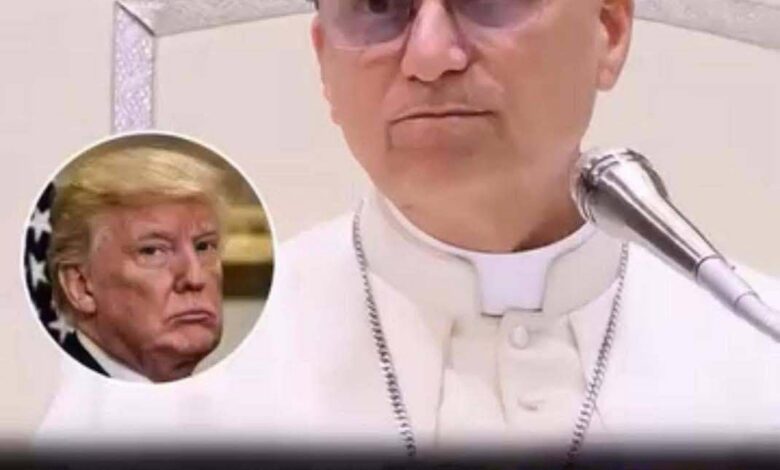
During a May 12 encounter with members of the press, a journalist asked whether the newly elected pope had a message for the United States. The Chicago-born pontiff paused, smiled, and offered a response that was striking because of its restraint. Instead of delivering a prepared statement or launching into a detailed reflection, he answered with a single word: “Many.” He then added a simple blessing: “God bless you all.”
The exchange was brief, but its impact was immediate. Online, the response spread rapidly, with commentators and viewers interpreting the moment in sharply different ways. Some described it as cryptic, even chilling, suggesting that the pope’s pause and choice of words hinted at deeper concerns about the direction of American public life. Others praised the reply as subtle, disciplined, and unmistakably papal — a reminder that spiritual authority often speaks most powerfully when it refuses to be reduced to a political sound bite.
The moment gained even more attention because of Pope Leo XIV’s background. Born Robert Francis Prevost, he became the first U.S.-born pope when he was elected on May 8, 2025. His American roots immediately made his relationship with the United States a subject of fascination. Unlike previous popes, who could comment on American politics from a greater cultural distance, Leo XIV carries both personal familiarity and spiritual independence. That combination makes even his shortest remarks feel unusually charged.
His past public commentary has added to the scrutiny. Before becoming pope, Prevost had drawn attention for criticism connected to U.S. immigration policy, including concern for migrants, refugees, and families affected by harsh enforcement measures. Those views appear consistent with the broader Catholic emphasis on human dignity, care for the vulnerable, and the moral duty to protect people on the margins.
At the same time, Pope Leo XIV has not presented himself as a figure easily claimed by one American political party. Although critics from Trump-aligned circles have focused on his past objections to certain conservative immigration policies, observers have also noted that his worldview is rooted more in Catholic social teaching than in partisan alignment. He has emphasized compassion, human dignity, peace, and justice — themes that may challenge both the right and the left depending on the issue.
That is why the word “many” carried such weight. It allowed room for interpretation without surrendering to easy categorization. To some, it suggested that the pope sees many problems in the United States: polarization, inequality, harsh rhetoric, immigration conflict, social fragmentation, and the weakening of dialogue. To others, it suggested many blessings, many responsibilities, or many hopes. The ambiguity was not necessarily evasive. It may have been the point.
Pope Leo’s chosen name also shaped early interpretations of his priorities. By taking the name Leo XIV, he invited comparison to Pope Leo XIII, remembered especially for his social teaching and his concern with labor, workers’ rights, economic justice, and the dignity of ordinary people. That historical echo suggested that the new pope may approach modern crises through a lens of fairness, solidarity, and moral responsibility rather than narrow political loyalty.
His first public messages reinforced that impression. Rather than centering partisan controversy, he emphasized peace, dialogue, unity, and the need to build bridges. In his May 12 address to media representatives, he called for communication that serves peace and rejects aggression, prejudice, resentment, and hatred. That emphasis placed his early papacy within a broader mission: not to inflame divisions, but to challenge the conditions that make those divisions worse.
Still, the attention around his one-word response shows how difficult that mission will be. In a polarized media environment, even a blessing can become a battleground. Every pause, phrase, and gesture from the first American pope will be examined for hidden meaning, especially when the subject is the United States. Supporters will search for moral clarity. Critics will look for political bias. Catholics and non-Catholics alike will try to understand whether Leo XIV intends to confront American power directly or speak above its partisan categories.
For now, the viral moment remains powerful precisely because it was unfinished. Pope Leo XIV did not give America a lecture. He did not offer a slogan. He did not reduce his message to a partisan warning or a diplomatic courtesy. He simply suggested that there was much to say — perhaps too much for a passing question — and then offered a blessing.
That restraint may become one of the defining features of his early papacy. Pope Leo XIV appears to understand that words from the papal office carry unusual weight, especially when directed toward his country of birth. His challenge will be to speak clearly enough to guide consciences, but carefully enough not to become trapped inside the political categories others are eager to impose on him.
The United States may have asked for one message. His answer suggested there are many. And in that brief, quiet response, the first American pope made clear that his relationship with America will be watched closely, interpreted fiercely, and measured not by one viral phrase, but by the moral direction of his papacy.