Charlie Kirk, the founder of Turning Point USA and one of the most recognizable conservative voices of his generation, was shot and killed on September 10, 2025, during an appearance at Utah Valley University. The event was meant to mark the launch of his “American Comeback Tour,” a campus-focused effort built around political discussion, youth engagement, and direct conversation with students. Instead, what began as a public gathering under a campus tent ended in violence that stunned his supporters, his critics, and the broader political world.
Kirk was speaking with students when a gunman opened fire, striking him in the neck. He was only 31 years old. The suddenness of the attack made the moment even more horrifying: a political appearance, filled with the ordinary noise of a campus event, was transformed in seconds into a scene of panic, grief, and disbelief. For those present, and for the millions who later learned what had happened, the killing became another grim reminder of how fragile public life has become in an era of anger, polarization, and escalating threats.
Authorities arrested 22-year-old Tyler Robinson the following day. Investigators later described the attack as planned and politically motivated, adding another painful layer to a tragedy already heavy with national implications. Prosecutors announced that they would seek the death penalty, signaling the seriousness with which they viewed the case. Kirk’s widow, Erika, also received a protective order against the suspect, a detail that underscored not only the legal gravity of the case but the fear and vulnerability left behind for the family.
The killing prompted an outpouring of grief across conservative circles and beyond. President Donald Trump paid tribute to Kirk, recognizing his influence in Republican politics and his role in mobilizing young conservatives. Supporters remembered him as a tireless organizer, a father, a husband, and a man who built a national platform at an unusually young age. Even many who disagreed sharply with his politics acknowledged the brutality of his death and the devastating loss facing his family.
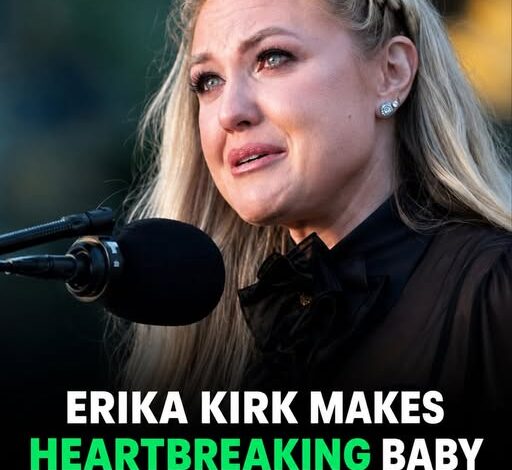
But the deepest grief belonged to Erika Kirk, who was left to carry the weight of a future suddenly torn apart. On The Megyn Kelly Show, she spoke emotionally about the life she and her husband had imagined together and the family plans that would now never come to pass. She and Kirk were already parents to two young children, but they had dreamed of having more. Erika said they had hoped for at least two additional children, a reflection of the family-centered life they were still building when he was killed.
Her words revealed a kind of grief that statistics and headlines cannot fully capture. She admitted that after her husband’s death, she prayed she might already be pregnant, describing the possibility as a blessing that could have existed inside the tragedy. That admission was deeply personal and painful, not only because it spoke to her love for her husband, but because it showed how quickly loss can turn ordinary hopes into unreachable memories. What had once been a shared plan between two parents became, in an instant, something she had to mourn alongside the man himself.
Now raising their children without him, Erika has spoken about the ache of knowing what her husband will miss: birthdays, milestones, small daily moments, and the chance to watch their family grow. Her grief is not only about the public figure the country lost, but about the private man her children will know through stories, photographs, memories, and the legacy others help preserve. For a young widow, the pain is both immediate and lifelong.
In the aftermath, Erika has urged young couples not to delay starting families if children are truly part of their hopes. Her message is shaped by loss, but also by urgency. Careers, ambitions, public success, and financial goals may matter, she has said, but time with children is something no one can recover once it is gone. Her advice is not presented as a political argument, but as a lesson born from tragedy: life can change without warning, and the future people assume they have may be shorter than they imagine.
The story of Charlie Kirk’s death therefore became more than a political assassination case or a national headline. It became the story of a family interrupted, a widow forced into unimaginable strength, and children growing up without the father who had planned to help raise them. It also became a sobering reflection on the cost of political hatred when it crosses from rhetoric into violence.
For Erika, the public tributes and legal proceedings may bring recognition, but they cannot restore the life she lost. They cannot give her children more mornings with their father, or return the future she and her husband had quietly planned. What remains is grief, memory, faith, and the responsibility of carrying forward a family story that changed forever on what was supposed to be the beginning of a new tour.
In speaking openly about her pain, Erika has turned private heartbreak into a message for others: do not assume there will always be more time. Do not postpone love, family, or the things that matter most because the world insists something else must come first. Her husband’s death left behind a national shock, but for her, the loss is measured in empty chairs, unfinished dreams, and the children she must now raise with both sorrow and strength.