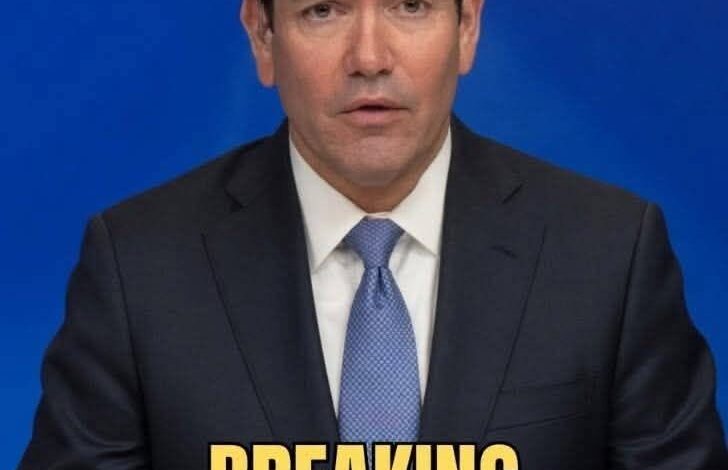
Secretary of State Marco Rubio revealed on Friday that back-channel discussions to halt the U.S.-Israel war with Iran is “a little bit of movement.”

Rubio’s caution may sound measured, but beneath it is a grim strategic calculation: if Iran attempts to turn the Strait of Hormuz into a pay-to-pass chokepoint, the confrontation will almost certainly move beyond statements, sanctions, and diplomatic warnings.
The Strait is not just another stretch of water. It is one of the most important energy corridors on Earth, a narrow passage through which nearly a fifth of the world’s oil supply moves. Any attempt by Tehran to impose a “tax” on vessels crossing it would not merely raise shipping costs or rattle markets. In Rubio’s view, it would amount to an illegal seizure of global commerce, a direct threat to energy security, and a challenge to the international order itself.
That is why his language matters. By calling such a move “completely illegal” and a “threat to the world,” Rubio is not simply criticizing Iran’s behavior. He is helping define the boundary of what Washington is willing to tolerate. Behind the careful phrasing is a broader understanding shared by many in Washington and across European capitals: the Strait of Hormuz is a red line, not a bargaining chip.
The danger is that Tehran may be testing exactly how firm that red line really is.
As Pakistan works to shuttle messages between Washington and Tehran, diplomats are racing against a rapidly shrinking window. The hope is that back-channel talks can still prevent escalation before military options move from contingency planning to reality. But the situation is growing more unstable by the day. European officials are quietly preparing measures against the people believed to be designing or enforcing the blockade plan, while U.S. officials weigh how far they are willing to go if Iran refuses to back down.
At the same time, the wider region is already under enormous pressure. Israeli strikes in Lebanon have sharpened fears of a broader conflict. Hezbollah’s continued defiance has made de-escalation more difficult. Iran’s creation of a new “Persian Gulf Strait Authority” appears, to its critics, like an attempt to give bureaucratic cover to a policy that could choke one of the world’s most vital trade routes.
Each development adds another layer of risk. What might have once looked like diplomatic theater now feels increasingly like preparation for a confrontation no side fully controls.
President Trump may describe the situation in cautiously optimistic terms, suggesting that a deal is still possible. But Rubio’s repeated references to a “Plan B” tell a different story. They suggest that Washington is preparing for the possibility that diplomacy fails, and that if Iran moves from threat to enforcement, the response could be swift and severe.
For now, the region remains suspended between negotiation and escalation. Diplomats are still talking. Messages are still moving through intermediaries. Sanctions are still being shaped behind closed doors. But the pressure is building, and the Strait of Hormuz has become the place where economic security, military power, and political resolve are all colliding.
If Iran backs away, the crisis may be remembered as another dangerous standoff that stopped short of disaster. If it does not, Rubio’s warning may be remembered as the moment Washington signaled that the next phase would not be handled with words alone.
In that uncertainty, “Plan B” hangs over the entire region like a storm gathering just beyond the horizon.