Raising children in today’s world can be deeply rewarding, but it can also be incredibly demanding. Parents are expected to keep their children safe, teach them independence, manage their emotions, and make the right decisions in situations that are often unpredictable. At the same time, many young parents also face constant opinions from relatives, strangers, and especially social media users.
In the digital age, parenting is more visible than ever. A short video, a photo, or a single moment shared online can quickly become the subject of public debate. Choices that were once made privately within families are now judged by thousands, sometimes millions, of people who may not understand the full situation. This has created an environment where parents are not only raising their children, but also navigating criticism from an audience they never asked for.

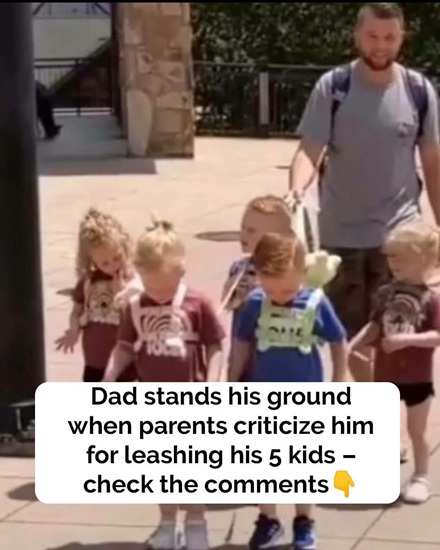
One example that gained widespread attention involved Jordan Driskell, a young father of quintuplets. His five children were born at the same time, meaning they are all the same age and going through similar stages of development together. As any parent knows, caring for one energetic toddler can be challenging. Caring for five young children of the same age in public spaces can be overwhelming.
As the children grew older and became more mobile, simple outings became far more complicated. A trip to a store, park, airport, or aquarium required planning, patience, and constant attention. With five curious children wanting to walk, explore, and move in different directions, keeping everyone safe became a major concern.
Driskell, who is in his early thirties, explained that managing a large group of young children in crowded public places required practical solutions. Like many parents of multiples, he initially used a large multi-seat stroller designed to keep the children together. The stroller helped with organization and safety, especially when the children were younger. However, as they became more active, it became less practical.

The children wanted to walk. They wanted to look around, explore their surroundings, and experience the world instead of staying seated for long periods. The large stroller was also difficult to maneuver in certain places, especially in crowded areas. What worked during one stage of childhood no longer worked as well in the next.
Because of this, Driskell and his family began looking for another way to balance safety with freedom of movement. They wanted the children to be able to walk independently, but they also needed to make sure none of them wandered away or became lost in a busy public setting.
The solution they chose was the use of child safety harnesses, sometimes referred to by critics as “leashes.” These harnesses are designed specifically for young children and are often used in crowded environments such as airports, theme parks, shopping centers, and tourist attractions. Their purpose is to allow children to walk while still helping parents keep them close and supervised.

For Driskell’s family, the harnesses made public outings more manageable. Each child could move, walk, and engage with the world around them, while the parents could still maintain control in situations where one quick moment of distraction could become dangerous.
The family’s decision attracted major attention after a video of one of their outings, including a visit to an aquarium, was shared online. The footage showed the children walking with their parents while using the safety harnesses. The video quickly went viral, receiving millions of views and sparking intense discussion across social media.
As often happens with viral parenting content, reactions were deeply divided.
Many people criticized the use of child harnesses. Some argued that children should not be restrained in that way, saying the practice looked uncomfortable or inappropriate. Others commented that children are not pets and should not be treated as though they are being walked on a leash. Some critics suggested that parents should rely only on verbal guidance, discipline, and supervision instead of using physical safety tools in public.
However, many others defended the parents’ decision. Supporters pointed out that raising five young children at the same developmental stage is not the same as managing one child. They argued that safety should come before appearances, especially in crowded places where a child can disappear from view in seconds. To them, the harnesses were not a sign of poor parenting, but a practical tool used by parents trying to keep their children safe.
Some parents shared their own experiences, explaining that they had used child safety harnesses for toddlers, children with special needs, or children who were especially likely to run off unexpectedly. For these families, the tool provided peace of mind and helped prevent dangerous situations.
The debate also brought attention to broader views from parenting and child development experts. Specialists have noted that safety harnesses can be useful in certain situations, especially with very young children, children with developmental differences, or families managing multiple small children at once. In these cases, harnesses are not meant to replace teaching, guidance, or supervision. Instead, they can serve as an additional layer of safety.
Experts also emphasize that as children grow older, parents should gradually teach them independence, awareness, and the ability to follow verbal instructions. Safety tools may be helpful for a time, but they are usually most appropriate during early developmental stages or specific high-risk situations. The goal is not to restrict children forever, but to protect them while they are still learning how to navigate public spaces safely.
In Driskell’s case, the controversy highlighted a larger question many parents face: how do you balance safety, independence, and public judgment? What may look strange or unnecessary to an outside viewer may make complete sense to a parent dealing with the reality of five young children in a crowded environment.
The situation also shows how quickly social media can turn a personal parenting decision into a public debate. A video meant to capture an ordinary family outing became a viral conversation about parenting styles, discipline, safety, and judgment. People who did not know the family, the children, or the full context formed strong opinions based on a brief clip.
This is one of the challenges of modern parenting. Families are often judged not by the full reality of their daily lives, but by short moments shared online. A few seconds of footage can lead to assumptions about a parent’s character, choices, and abilities. In many cases, those assumptions ignore the complexity of the situation.
Despite the criticism, many supporters argued that parents should be allowed to choose what works best for their family, especially when their decisions are focused on safety. Every household has different needs. What works for one child may not work for another. What seems unnecessary for one family may be essential for another.
For parents of multiples, practical concerns often shape daily decisions in ways outsiders may not fully understand. Keeping five young children safe, calm, and together in public requires planning and tools that many families may never need. That does not automatically make those tools wrong.
In conclusion, the story of Jordan Driskell and his quintuplets reflects the larger reality of parenting in a highly connected world. It shows how ordinary family decisions can become viral topics and spark intense debate among strangers. While opinions about child safety harnesses remain divided, the situation underscores an important truth: parents today must manage not only the difficult work of raising children, but also the constant judgment that comes with doing so in public.
At the center of the debate is a simple question: should parents be judged for using practical tools to keep their children safe, or should society show more understanding for the different challenges families face?
For Driskell and many parents like him, the answer is clear. Safety comes first, even when the internet disagrees.