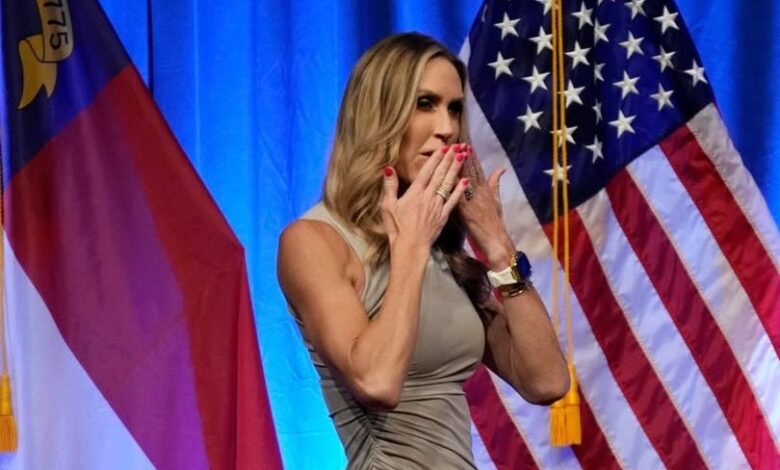
In a quiet, sterile meeting room in North Carolina, a major shift in Republican politics was sealed with little visible drama but enormous symbolic weight.
There were no fireworks, no roaring stadium crowd, and no campaign-style spectacle. Yet the confirmation of Lara Trump as co-chair of the Republican National Committee marked something far more consequential than a routine leadership change. It represented the formal tightening of Donald Trump’s grip on the party apparatus itself — not only its public message, but its money, strategy, staffing, and ground operation.
For years, Trump’s influence over the Republican Party had been undeniable. He reshaped its language, redirected its priorities, and forced nearly every ambitious Republican figure to define themselves either in loyalty to him or in opposition to him. But influence from the outside is different from control from the inside. Lara Trump’s elevation made that distinction harder to ignore.
Her new position placed a member of the Trump family directly inside the institution responsible for raising money, organizing voters, coordinating campaigns, and shaping national Republican strategy. It was not simply a promotion. It was a merger — the party’s official machinery aligning with one family’s political project at the highest operational level.
To Trump’s supporters, the move made perfect sense.
They saw it as long overdue. In their view, Donald Trump had already become the center of gravity in Republican politics, and the party’s leadership should reflect that reality instead of resisting it. For them, Lara Trump’s role was not nepotism or overreach; it was alignment. It meant the RNC would finally operate in service of the voters who had repeatedly chosen Trump as the party’s dominant figure. It meant fewer internal contradictions, less quiet sabotage, and a clearer chain of command heading into a hostile election cycle.
To them, this was the party becoming honest about what it already was.
But to critics inside and outside the GOP, the development carried a very different meaning.
For years, there had been pockets of resistance within Republican institutions — donors, consultants, state officials, legal advisers, and old-guard party figures who hoped Trumpism could be contained, managed, or eventually outlasted. Some resisted openly. Others did so quietly, choosing delay, distance, or procedural caution over direct confrontation.
Lara Trump’s rise suggested that era was ending.
The message was unmistakable: the old guard no longer had the leverage it once claimed. The party would not merely tolerate Trump’s influence; it would be reorganized around it. The RNC, once expected to serve as a neutral national committee for Republican candidates broadly, was now being pulled even more tightly into the orbit of one candidate, one movement, and one family.
That is why the moment mattered.
The RNC controls more than slogans and press releases. It plays a central role in fundraising, voter outreach, legal spending, data operations, state-level coordination, and the practical mechanics of winning elections. Whoever influences the committee influences how resources are distributed, which races receive attention, which messages are amplified, and which priorities dominate the national conversation.
With Lara Trump installed in leadership, Donald Trump’s campaign gained something far more valuable than another public defender on television. It gained a loyal presence near the party’s financial and organizational center.
For supporters, that loyalty is the point. They argue that a party should not pretend neutrality when its voters have already made their preference clear. They believe the RNC should be fully committed to Trump’s return to power and should stop behaving as though some alternative Republican future is waiting around the corner.
For skeptics, however, loyalty is exactly the concern.
They fear the Republican National Committee is being transformed from a party institution into a personal political instrument. They worry that the committee’s resources could be increasingly shaped around Trump’s needs, Trump’s grievances, Trump’s legal battles, and Trump’s preferred candidates. What once might have been described as party strategy now risks being seen as family strategy.
The distinction is not small.
Political parties are supposed to outlast individual figures. They are meant to contain factions, manage competing ambitions, and build coalitions broad enough to survive changing political winds. But when a party becomes too closely tied to one person, its fortunes rise and fall with that person’s decisions, scandals, victories, and defeats.
That is the gamble now facing Republicans.
Lara Trump’s confirmation did not create Donald Trump’s power inside the GOP. That power had already been built over years of rallies, primaries, endorsements, loyalty tests, and the repeated collapse of his internal rivals. But her new role made the arrangement more official. It placed the family brand not just at the top of the ticket, but inside the party structure tasked with supporting it.
In that sense, the moment in North Carolina was less a beginning than a confirmation.
The resistance had already weakened. The cautious voices had already grown quieter. The politicians who once imagined a post-Trump Republican Party had either left the stage, changed their tone, or learned to survive by keeping their criticism private. What remained was a party increasingly defined by those willing to embrace Trump’s leadership without hesitation.
Lara Trump’s rise sends a clear signal to every Republican operative, donor, candidate, and committee member: the center of power has been decided.
There may still be disagreements within the party. There may still be private doubts. There may still be Republicans who worry about the long-term cost of this transformation. But the space for meaningful internal resistance has narrowed dramatically.
The Republican National Committee is no longer merely adjusting to Trump’s dominance.
It is being shaped by it.
And for many observers, that is the most important part of the story. This was not only about one woman receiving a powerful title. It was about the party’s institutional future being brought into closer alignment with Trump’s personal political destiny.
To his loyalists, it is unity.
To his critics, it is surrender.
But either way, the conclusion is difficult to avoid: the Republican Party is entering a new chapter in which the boundaries between party, campaign, and family are becoming increasingly blurred.
The room in North Carolina may have been quiet.
The decision was not.
It marked the sound of an old internal order giving way — and the beginning of a party structure built by those who never intended to share power once they had finally secured it.