The timing could hardly be more charged. A nation preparing to stage a grand, made-for-television celebration of American “freedom” now finds itself staring at something far darker and more unsettling. The 250th anniversary of the Declaration of Independence was supposed to be wrapped in spectacle: flags, speeches, flyovers, patriotic music, and an 80-year-old president standing before the world as fighter jets thundered across the sky.
Instead, attention has shifted to the grass.
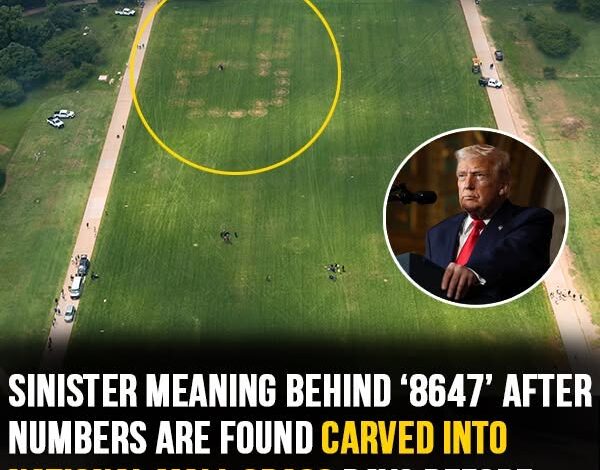
Between the Capitol and the Lincoln Memorial, on one of the most symbolic stretches of land in the country, a patch of dead, discolored turf now forms the numbers “8647.” From the ground, it is strange enough. From above, it is impossible to miss. Every helicopter passing over the National Mall catches the message glaring upward like a scar cut into the center of the capital’s carefully staged celebration.
To Trump’s supporters, the act feels like an attack on sacred ground, a deliberate defacement of a place meant to represent national unity, sacrifice, and history. They see it not as a prank or protest, but as desecration timed to humiliate the president and disrupt a moment of patriotic pageantry. To his fiercest critics, the message reads differently: grim, cryptic, and politically loaded, a symbol of resistance planted where cameras and security aircraft would be forced to see it.
That ambiguity is exactly what makes the incident so volatile.
Investigators are now trying to determine whether the numbers are simple vandalism, a veiled threat, or a piece of political theater designed to provoke maximum outrage at the most sensitive possible moment. The phrase itself only deepens the unease. “86” has long carried multiple meanings, from restaurant slang for removing or refusing something, to darker interpretations that have circulated in mob stories, internet memes, and modern political rhetoric. Paired with “47,” a number tied unmistakably to Trump’s presidency, the message becomes even harder to dismiss as meaningless.
That uncertainty has left authorities moving carefully. Park Police are reportedly examining the damaged ground, looking at whether chemicals, tools, or other methods were used to kill or mark the grass. Security officials are reviewing surveillance, patrol routes, and access points across the Mall. The Secret Service, already operating under heightened pressure, has quietly tightened its posture around upcoming events, aware that even a symbolic act can carry dangerous implications in a country where political anger often moves quickly from language to action.
The public reaction has been just as divided as the country itself. Some see the numbers as an ugly but effective protest, a visual interruption of power at a moment designed for patriotic unity. Others see something far more dangerous: a coded message placed in the shadow of national monuments, timed to coincide with a presidential appearance, and aimed at a political figure already surrounded by intense security concerns.
What cannot be ignored is the precision of it. Whoever left those numbers did not choose a random patch of grass. They chose the National Mall. They chose a location framed by the Capitol, the Washington Monument, and the Lincoln Memorial. They chose a moment when news crews, helicopters, federal agents, and millions of viewers would be focused on the capital. Whether the act was meant as protest, provocation, intimidation, or spectacle, it was designed to be seen.
That is why the message has landed with such force. It turns a landscape of ceremony into a crime scene of symbols. It forces a celebration of national unity to confront the bitterness and suspicion running beneath it. And it reminds the country that even its most polished patriotic rituals cannot fully conceal the political fracture underneath.
As investigators test soil samples, review footage, and search for those responsible, the numbers remain more than a mark on the ground. They are a warning about the atmosphere surrounding this moment: tense, performative, angry, and dangerously open to interpretation. In Washington, symbols matter. Timing matters. Location matters.
And whoever carved “8647” into that stretch of grass understood exactly where it would be seen, exactly when it would be noticed, and exactly why it would hurt.