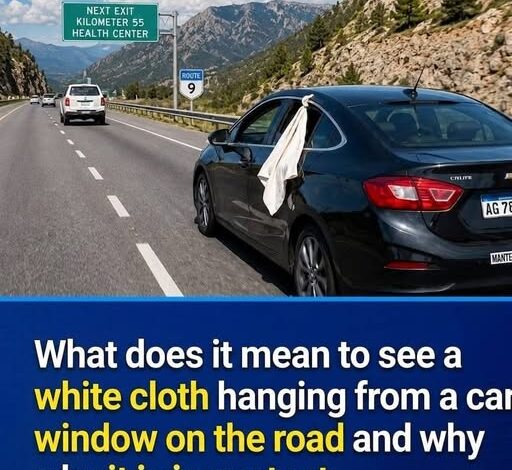
That white cloth tied to a vehicle is not an official code, but it often functions like an improvised language on the road. It is a signal born from uncertainty, panic, breakdowns, emergencies, and moments when drivers may have nothing available except a handkerchief, towel, shirt, or scrap of fabric and the hope that someone will understand.
To one driver, it may mean the car has broken down and cannot be moved safely. To another, it may signal that the vehicle is out of fuel, stuck, or waiting for roadside assistance. In more serious situations, it may be used when someone inside the vehicle is experiencing a medical emergency and the driver is trying to warn others that something is wrong. In some places or informal groups, a white cloth may also help convoy members identify one another while traveling together.
Because the meaning can vary so widely, the cloth should never be treated as a precise legal signal. It may carry urgency, fear, or a plea for patience, but it does not carry legal authority. A private vehicle with a white cloth attached does not become an ambulance. It does not gain permission to speed, run red lights, drive on shoulders, ignore traffic rules, or force other drivers out of the way. It is a human signal, not an emergency-vehicle designation.
That distinction matters. Roads depend on shared rules because panic can quickly create more danger. If every improvised signal were treated as permission to override traffic laws, the result could be confusion, crashes, and delayed help for the very people who may need it most. A white cloth may tell you that something unusual is happening, but it does not tell you exactly what is happening or what the safest response should be.
Your reaction matters more than the cloth itself.
When you see a vehicle displaying a white cloth, slow down if needed, create space, and pay close attention to the situation around you. Avoid tailgating, honking aggressively, or trying to pass recklessly. Look for other signs: hazard lights, erratic movement, a vehicle pulled onto the shoulder, people waving for help, smoke, damage, or someone visibly in distress. The safest first response is calm observation, not sudden action.
If the vehicle appears disabled, give it room. If it is moving unpredictably, keep your distance and avoid placing yourself in its path. If it looks like a serious emergency, call emergency services and provide the location, direction of travel, vehicle description, and what you observed. Professional responders are better equipped to handle medical crises, crashes, stranded vehicles, and dangerous roadside conditions.
Helping can be the right thing to do, but only when it is safe. Pulling over on a busy highway, stepping into traffic, or approaching an unknown situation without caution can turn one emergency into two. If you are in a safe location and can assist without putting yourself or others at risk, you may offer help. But if the scene feels dangerous, unstable, or unclear, staying back and calling for trained assistance may be the most responsible choice.
The white cloth is powerful because it reminds us that every vehicle contains a person with a story we cannot see. Behind the windshield may be a frightened parent, a stranded traveler, an elderly driver, a sick passenger, or someone simply trying to make it through a bad moment. The signal asks for awareness, patience, and humanity.
Still, humanity must work alongside safety. The best response is not panic, pursuit, or blind intervention. It is caution. It is distance. It is noticing what is happening and choosing the safest way to help. Sometimes that means slowing down. Sometimes it means calling emergency services. Sometimes it means doing nothing more than giving the vehicle space and allowing professionals to respond.
In a road system built on fixed signs, painted lines, traffic lights, and formal rules, a white cloth is something different. It is unofficial, imperfect, and deeply human. It does not replace the law, but it can reveal distress. It does not command other drivers, but it can ask them to pay attention.
Ultimately, that small piece of fabric is a reminder that emergencies do not always arrive with sirens and flashing lights. Sometimes they appear as a cloth tied to a window, a mirror, or a door handle, moving in the wind while someone hopes to be seen. And when we do see it, the safest kind of help is usually calm, cautious, and guided by common sense.