Lip reader ‘reveals’ Donald Trump’s 8-word remark to UFC fighter who called Michelle Obama ‘a man’

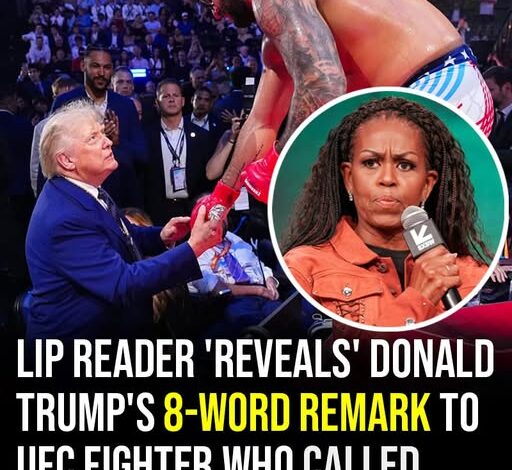
UFC Freedom 250 was supposed to be a spectacle of patriotism, athletic power, and carefully staged national symbolism. On the White House lawn, under bright lights, waving flags, and the heavy pageantry of a presidential backdrop, the event was presented as something larger than a fight card. It was meant to be a celebration — of strength, country, spectacle, and the unusual fusion of combat sports and political theater.
But one post-fight interview turned the celebration into something uglier.
After his victory, Josh Hokit stepped into the spotlight with the confidence of a man riding the adrenaline of a public win. He praised Donald Trump, soaked in the crowd, and appeared fully aware of the stage he had been given. Then, instead of leaving the moment as a tribute to his performance or the event around him, he veered into a personal insult aimed at Michelle Obama, repeating a long-running and baseless conspiracy theory meant to demean and dehumanize the former first lady.
The remark did not land in a vacuum. It came from a White House lawn, in front of cameras, during an event wrapped in patriotic imagery. That setting gave the comment more weight than an ordinary insult shouted into a microphone. It placed a cruel and false smear inside a space traditionally associated with public dignity, national leadership, and symbolic responsibility.
The crowd’s response seemed to capture the country’s own fractured reaction to moments like this. Some cheered. Some laughed. Others appeared stunned or uneasy. The noise in the moment was not just about Hokit. It was about what kind of behavior public audiences now reward, what kind of cruelty gets framed as humor, and how easily a person’s family, body, or identity can become material for political performance.
Cameras also caught Trump leaning toward the fighter after the remark. Later, lip reader Jeremy Freeman reportedly claimed that Trump responded with, “Too kind, thank you. You are the champion.” Because lip-reading is not the same as an official transcript, the exact wording should be treated with caution. But the perception of the exchange quickly became part of the controversy. To critics, the apparent warmth of the response mattered because it seemed to ignore the smear and instead reward the man who had delivered it.
That is why the moment spread so quickly. It was not simply another offensive comment in an already coarse political culture. It appeared to show a fighter using a national stage to target a former first lady with a false personal attack, and then receiving admiration rather than correction. Whether one views it as a failure of decorum, a failure of leadership, or a symptom of something deeper, the image was hard to separate from the larger climate that produced it.
As the clip moved across social media, the reaction widened beyond the usual partisan lines. Critics condemned the insult as sexist, transphobic, and rooted in years of dehumanizing attacks aimed at Michelle Obama. Some Trump supporters tried to minimize the remark as a joke or an example of free speech. But even among people familiar with the rough edges of combat sports and political rallies, the comment struck many as needlessly vicious.
UFC boss Dana White eventually tried to draw a line. While he has long defended fighters’ right to speak freely and has maintained a close public association with Trump, White condemned “nasty and false things about people’s families.” His statement mattered because it acknowledged a distinction that is often blurred in today’s culture: free speech may protect the right to say cruel things, but it does not require institutions, audiences, or leaders to applaud them.
That distinction is at the heart of the controversy.
No serious debate over public expression requires pretending that every insult is brave or every conspiracy theory deserves a platform. Freedom of speech is not the same as freedom from judgment. A fighter can speak. A crowd can react. A promoter can condemn. A president can choose whether to correct, ignore, or reward. Each choice communicates something about what is acceptable in public life.
The deeper question left hanging over UFC Freedom 250 was not whether Hokit had the ability to make the remark. Clearly, he did. The question was what kind of victory was really being celebrated when a moment of athletic achievement became a platform for humiliation.
Was the crowd cheering a fighter’s performance?
Was it cheering defiance?
Was it cheering cruelty dressed up as humor?
Or was it cheering the permission to say out loud what had once remained confined to the darker corners of the internet?
That ambiguity is what made the moment so unsettling. The White House setting did not soften the insult. It magnified it. The flags, the lights, the cameras, and the presidential presence turned an ugly aside into a national image: a fighter smiling after a win, a former first lady reduced to a smear, and a crowd divided between amusement and discomfort.
For Michelle Obama, the attack was part of a familiar pattern. For years, she has been subjected to racist, sexist, and conspiratorial attempts to strip away her dignity. Those attacks are rarely only about one person. They are about who is allowed to be seen as graceful, feminine, powerful, patriotic, or fully human in the public imagination. When those attacks are repeated on major stages, they do more than insult an individual. They reinforce a culture where demeaning certain people becomes entertainment.
That is why the controversy should not be dismissed as just another viral clip. It revealed how quickly a public celebration can become a test of moral boundaries. It showed how cruelty can be normalized when applause arrives faster than accountability. And it forced a familiar but urgent question back into view: when powerful platforms reward degradation, what exactly are they teaching the audience to admire?
UFC Freedom 250 was meant to project strength.
Instead, for many observers, its most remembered moment may be one of weakness — the weakness of turning a public honor into a personal attack, the weakness of mistaking mockery for courage, and the weakness of a culture that still struggles to tell the difference between winning and lowering the room.
In the end, the controversy was not just about Josh Hokit, Donald Trump, Dana White, or Michelle Obama. It was about the kind of public life Americans are willing to accept. A country can celebrate fighters, competition, patriotism, and free expression without applauding lies meant to dehumanize someone’s family.
The question left behind was painfully simple: when cruelty gets cheered from a stage wrapped in flags, what kind of victory has actually been won?