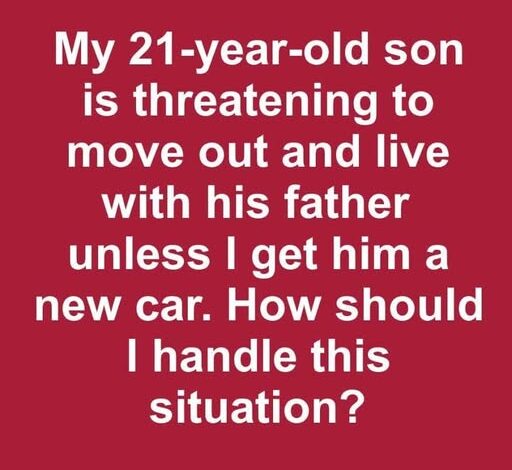
You are not simply dealing with a request for a car.
You are standing at one of those difficult parenting crossroads where love, money, maturity, and boundaries all collide at once. On the surface, your child may be asking for transportation. But underneath that demand is something much larger: a test of where your support ends and where his responsibility begins.
That is why the situation feels so emotionally charged.
A car is rarely just a car to a young adult. It can represent freedom, independence, status, convenience, escape, confidence, and control over one’s own life. To your son, it may feel like the missing piece between dependence and adulthood. He may see friends driving, going where they want, making plans without asking for rides, and feel left behind. He may also feel embarrassed, frustrated, or trapped in ways he does not know how to express calmly.
But even if his feelings are real, an ultimatum is not a healthy way to handle them.
That is where you must begin.
Before discussing money, models, insurance, or payment plans, step out of the emotional storm. Do not argue while he is angry. Do not negotiate while he is threatening to leave. Do not allow the conversation to become a contest over who loves whom more. A parent’s love should never be measured by the price of a vehicle, and a young adult’s frustration should not become a weapon used to force a decision.
You can say something calm and firm:
“I love you, and I am willing to talk about transportation. But I will not make a major financial decision because of a threat. If we discuss this, we discuss it respectfully.”
That boundary matters.
Not because you want to punish him.
Not because you do not care.
But because adulthood requires learning that pressure and manipulation do not replace responsibility. If he wants to be treated like an adult, then the conversation must happen in an adult way.
Once emotions settle, invite him into a real discussion. Ask him what the car actually represents to him. Does he need it for work? School? Safety? Social independence? Is he tired of relying on others for rides? Does he feel ashamed that other people his age seem further ahead? Is he asking because transportation is a genuine need, or because he wants a symbol of freedom without understanding the full cost attached to it?
Listen carefully.
Sometimes young adults communicate practical needs through emotional demands because they have not yet learned how to separate the two. If he says, “Buy me a car or I’ll move out,” he may really be saying, “I feel stuck,” or “I want more control,” or “I don’t know how to become independent without help.”
Understanding that does not mean giving in.
It means responding wisely.
After listening, lay out the real numbers. Many young people think of a car as a one-time purchase, but ownership is ongoing responsibility. Show him the full picture: the purchase price, registration, insurance, fuel, maintenance, tires, repairs, parking, inspections, and emergency costs. Explain your actual financial limits honestly. Do not pretend you can afford more than you can. Do not damage your own stability to rescue him from discomfort.
A loving parent can help without self-sacrifice becoming financial harm.
If transportation is a genuine need, explore shared solutions. Maybe you help with part of the down payment on a reliable used car. Maybe he saves a certain amount first and you match a portion. Maybe he pays insurance while you help with registration. Maybe he uses public transportation temporarily while building savings. Maybe the family shares a vehicle under clear rules. Maybe he works toward the car over several months instead of receiving it immediately.
The goal is not simply to provide transportation.
The goal is to teach responsibility.
If he contributes financially, he will understand the value of what he is asking for. If he helps compare options, calculate costs, and plan maintenance, he will learn that independence comes with obligations. If he wants adult freedom, he must also accept adult expenses.
That lesson is more valuable than the car itself.
If he continues threatening to move out, do not respond with panic. Let him understand what that choice means. Not in a cruel way, but in a realistic one. Sit down with him and create a basic independence budget. Rent, utilities, groceries, transportation, phone, insurance, laundry, medical costs, emergencies. Let him see the numbers clearly.
Not as a scare tactic.
As reality.
Then tell him the truth:
“If you choose to move out, I will respect that as your adult decision. I will not stop loving you. But I will not buy a car because I am afraid of losing you.”
That statement protects both of you.
It tells him your love is steady, but your boundaries are real.
It also teaches him that leaving home is not a threat to use during conflict. It is a serious life decision with consequences, responsibilities, and costs.
Your job at this stage is changing. When children are young, parents solve most problems directly. They provide, protect, organize, rescue, and decide. But as children become adults, the role shifts. You are no longer meant to remove every obstacle from his path. You are meant to help him learn how to face obstacles with maturity.
That can be painful.
It is hard to watch your child struggle, especially when you could make the immediate discomfort disappear with money. But giving in to an ultimatum may solve the transportation issue while creating a larger problem. It may teach him that pressure works, that your guilt can be used as leverage, and that responsibility belongs to someone else whenever life feels hard.
That is not love.
Love is steadier than that.
Love says, “I will help you think this through.”
Love says, “I will not abandon you.”
Love also says, “I will not reward disrespect.”
If you do decide to help, make the terms clear. Put them in writing if necessary. How much will you contribute? What must he pay? Who owns the car? Who covers insurance? What happens if he misses payments? What are the expectations around safe driving, maintenance, and responsibility?
Clarity prevents resentment.
It also gives him the dignity of knowing exactly what is expected.
If you decide not to help financially, you can still support him in other ways. Help him research affordable cars. Teach him how to avoid scams. Review insurance quotes together. Help him create a savings plan. Offer rides temporarily under reasonable limits. Encourage work opportunities. Help him compare transportation alternatives.
Support does not always mean paying.
Sometimes support means guiding.
Sometimes it means refusing to turn a demand into a dependency.
The deeper lesson here is about respect on both sides. He must learn to respect your financial boundaries and emotional limits. You must respect his growing desire for independence, even when he expresses it poorly. That balance is not easy, but it is necessary.
If he is old enough to demand adult privileges, he is old enough to participate in adult problem-solving.
That is the standard to hold.
Not anger.
Not guilt.
Not fear.
A standard.
In the end, this moment is not about whether he gets a car tomorrow. It is about what kind of adult he is becoming and what kind of parent you are becoming as he grows. The healthiest outcome is not one where you “win” and he “loses,” or where he gets everything he wants and you feel used.
The healthiest outcome is one where he learns that love and limits can exist together.
That independence costs money.
That threats do not build trust.
That responsibility is earned through choices, planning, effort, and respect.
And that maturity is not handed over with a set of keys.
It is built, one decision at a time.