She pinched the little metal key by its plastic tag, and the name printed there belonged to her newborn.
For a few seconds, that small key seemed louder than everything else in the apartment—the running water, the baby crying against my chest, the pounding in my temple, even the voices coming from the hallway after she had forced her boyfriend and his sister out.
She turned the key over in her fingers once.
Then she looked at me.
“I didn’t make this.”
I was still trying to keep pressure against the cut near my hairline with my shoulder because both hands felt necessary around the baby.
“You’re sure?”
“I’m sure.”
Her answer came without hesitation.
She knew every spare she had ever made for that apartment, and none of them had a plastic tag with her baby’s name on it.
The tote sat on its side beside the bathroom doorway, partly soaked now, with several tiny shirts and sleepers spilling from the opening where the water had pushed against it.
The key had been underneath that bag.
That mattered.
It meant the packed clothes and the unauthorized key had been together before the tub overflow scattered everything across the floor.
Her boyfriend shouted something from outside the apartment.
She did not answer him.
Instead, she stepped into the bathroom, reached past the wet towels, shut off the water completely, and pulled the drain so the tub finally began to empty.
Then she came straight back to the baby.
“We need to get out of this apartment for now,” she said.
I understood immediately.
If he had copied one key without her knowing, neither of us knew whether there was another copy in his pocket.
I bent carefully, still holding the baby, and managed to scoop my own keys off the wet floor.
The movement made my head throb hard enough to blur the edge of my vision, but the baby was breathing normally against my chest, warm and furious and very much alive.
That sound kept me moving.
The mother gathered only what she could carry without slowing us down, then opened the apartment door just enough to look into the hallway.
Her boyfriend and his sister were farther down the hall, still arguing with each other and with anyone willing to listen.
She shut the door again.
“Downstairs,” she said.
My place was directly below hers, which was the reason I had gone upstairs in the first place when water began dripping through my ceiling.
A maintenance problem had turned into something else before I had even understood what I was looking at.
We moved quickly.
She stayed behind me on the stairs so that if I lost my balance, she could reach for the baby before anything else.
Once we were inside my apartment, she locked the door, checked it twice, then finally held out her arms.
I gave her the baby.
The change in her face when his weight settled against her was almost painful to watch.
She did not collapse or make a speech.
She pressed her cheek against the top of his head, closed her eyes for one second, and then started checking him the way frightened parents do when they are trying to turn panic into a list of things they can verify.
His breathing.
His color.
His hands.
His feet.
His cry.
She checked everything she could see while I sat on the edge of a kitchen chair with a towel against my temple.
Then her phone buzzed.
She looked at the screen and went completely still.
The message was from her boyfriend.
He was demanding that she return the spare key from the baby tote to his sister.
That was the first moment the key stopped being a strange object and became a direct contradiction.
He knew where it had been.
He knew who had been carrying it.
He knew it had been stored with the baby’s packed clothes.
And until that moment, the mother had never told him we had found it.
She read the message twice.
Then she handed me the phone.
“He just told us it’s his,” she said.
I looked from the screen to the baby sleeping uneasily against her chest.
“Don’t answer yet.”
She nodded.
Help had already been called, and when people arrived to check the baby and my injury, she showed them the message exactly as it appeared instead of getting pulled into another argument with the man in the hallway.
That decision changed the rest of the night.
She stopped trying to understand what explanation might make everything feel less frightening.
She started preserving what had actually happened.
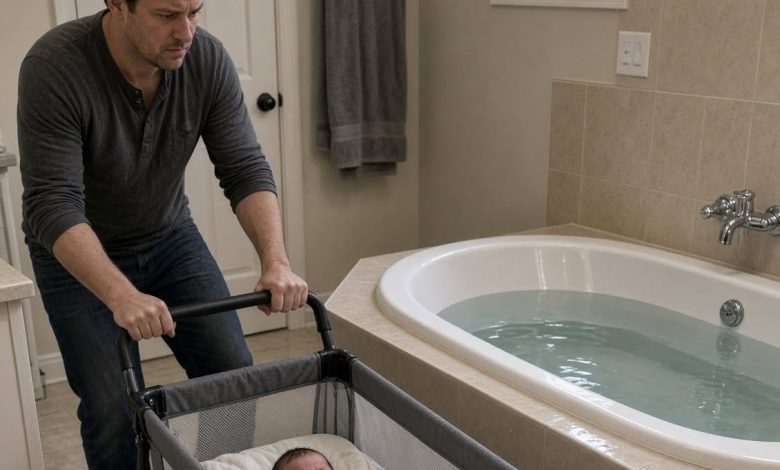
The deep water in the tub.
The portable crib’s position.
The wet floor.
The packed clothing.
The cut near my hairline.
The sleeve his sister had grabbed.
The key beneath the tote.
And now the message confirming that the key belonged to the very people she had never authorized to have it.
Her boyfriend eventually sent another message insisting that everyone had misunderstood.
According to him, his sister had simply been preparing to take the baby somewhere else for a while because the mother was exhausted.
That explanation might have accounted for the packed clothes if you ignored everything surrounding them.
It did not account for the filled bathtub.
It did not account for the crib being pulled toward it.
It did not account for hitting me when I moved the baby away.
And it did not account for why two adults who claimed they were helping had secretly made or obtained a key to an apartment they did not control.
The mother stared at his explanation for a long time.
Then she said something that stayed with me.
“He keeps explaining the one detail that sounds normal.”
She was right.
He had an explanation for a tote bag.
He had an explanation for his sister being there.
He had an explanation for having a spare.
But he never gave one explanation that made all the details belong to the same innocent story.
That was the difference.
Later, when the immediate danger had settled enough for us to speak without shouting, she told me this had not begun as a relationship that looked frightening from the outside.
Her boyfriend had been useful after the baby was born.
He carried laundry when her hands were full, warmed bottles, ran small errands, and told her she needed to rest more.
His sister had offered help too, especially with clothes and the endless little household jobs that pile up around a newborn.
Those were the things that had earned trust.
Not promises.
Not speeches.
Ordinary help.
That was why the bathroom scene had been so difficult for the mother to process at first.
The same people who had learned where the baby’s clean clothes were kept were now standing beside a packed tote.
The same boyfriend who had told her to rest had apparently arranged access to her apartment without asking.
The same pair who called themselves helpful had responded to intervention by attacking the person holding her newborn.
She told me there had also been small arguments about who should be allowed to take the baby out, who knew what was best, and whether she was being too protective.
At the time, she had treated those arguments like the kind of friction that comes when too many adults think they are helping a new parent.
After that night, the meaning changed.
The spare key changed it most.
A disagreement about boundaries is one thing when everyone still needs permission to cross the door.
A secretly held key is different.
It means someone has decided that permission is optional.
Her boyfriend’s sister never offered a clean explanation for that part.
She insisted through messages that she had only been packing what she had been told to pack and that she had not expected the confrontation to become physical.
But she had grabbed my arm while I was holding the newborn.
She had stayed beside the tote while the crib moved toward the bath.
Whatever she wanted to call her role afterward, her actions in the room had already defined it more clearly than her messages did.
The mother refused to debate either sibling that night.
She focused on the baby first.
That mattered more than winning an argument.
The infant was examined carefully, and the mother stayed close enough to touch him the entire time.
I had the cut near my hairline cleaned and closed, and by then the adrenaline had worn off enough that my hands finally started shaking.
I remember looking down at them and thinking how strange it was that they had been steady when I needed them most.
The mother noticed.
She reached across without putting the baby down and pressed her fingers briefly against my wrist.
“You didn’t let go of him,” she said.
“There wasn’t another option.”
She looked at her son.
“There was for them.”
That was as close as she came to talking about motive that night.
Neither of us wanted to invent an answer for why the tub had been filled that deep.
We did not need to.
There are moments when motive matters less urgently than access.
They had access to the apartment.
They had access to the baby.
They had a packed bag.
They had moved his crib toward dangerous water.
And when someone interrupted them, violence followed.
Those facts were enough for the mother’s next decision.
Neither sibling was getting access again.
The lock was changed before she treated the apartment as safe.
She did not accept the boyfriend’s offer to return his belongings privately.
She did not meet his sister alone to “clear everything up.”
She did not allow anyone to turn the baby’s safety into a discussion about whether she had embarrassed them by involving other people.
That pressure came quickly.
The boyfriend complained that she was ruining his life over a misunderstanding.
His sister accused her of choosing a stranger over people who had been helping her for months.
That wording almost worked on her because it attacked the exact place where she was most vulnerable.
I was the person from downstairs who had come up because of a leak.
They were the people she had trusted around her child.
But then she looked at the bandage near my temple and the unauthorized key sealed away with everything else that had been documented.
“You didn’t ask me to trust you,” she said to me later.
I waited.
“You just grabbed the crib.”
There was no good answer to that, so I didn’t try to produce one.
The days after the incident were less dramatic than the bathroom and, in some ways, more important.
The mother had to rebuild routines that had previously included two people she could no longer safely include.
She moved the baby’s things herself.
She checked the lock every night.
For a while, every sound in the hallway made her stop and listen.
She kept her phone close, not because she wanted more messages, but because she did not want to miss anything affecting the baby.
She also had to deal with a harder question than whether her boyfriend had lied.
She had to decide whether she could trust her own judgment again after trusting him once.
I watched her struggle with that more than once.
She would remember some ordinary helpful thing he had done and then immediately look ashamed for remembering it kindly.
I finally told her that the earlier good moments did not erase what happened in the bathroom, and the bathroom did not require her to pretend every previous moment had been fake.
She could judge the danger by what he did when the stakes were highest.
That seemed to help more than telling her she should have known.
Because she could not have known what I saw before I opened that bathroom door.
I barely understood it while I was standing there.
The portable crib was moving.
The water was deep.
The baby was inside.
Those were the facts I had time for.
Everything else came afterward.
A few days later, the water damage in my ceiling was finally opened up and repaired.
The workers found the path the overflow had taken between the floors, and the ugly stain that had sent me upstairs slowly disappeared under fresh drywall and paint.
For everyone else, it was a maintenance repair.
For me, it was the mark of the reason I had been standing beneath the right ceiling at the right moment.
The mother came downstairs with the baby while the work was being finished.
He was bundled against her in a plain sleeper, making the small impatient noises newborns make when they are almost awake but have not decided whether waking is worth the effort.
She looked more tired than she had before all of this.
She also looked steadier.
The boyfriend was no longer living there.
His sister no longer came and went with baby clothes under her arm.
Whatever consequences would continue outside that apartment, the mother’s immediate boundary had remained unchanged.
No private visit.
No unapproved access.
No key.
Weeks passed before she brought up the old spare again.
By then, the baby had begun settling into a more predictable rhythm, and the hallway outside her apartment no longer seemed to control her breathing every time footsteps passed.
One afternoon she knocked on my door with the baby tucked against one shoulder.
She was holding a key in her other hand.
For half a second, seeing it pulled me straight back to the wet bathroom floor.
She noticed my expression.
“New lock,” she said.
I nodded.
She held the key out to me.
“This one is because I want you to have it.”
I did not take it immediately.
“Are you sure?”
“Yes.”
There was no baby’s name written on the tag this time.
There was no packed tote beside it and no secret plan attached to it.
It was simply an emergency spare being handed from one person to another in daylight, with permission spoken out loud.
I closed my fingers around it.
The baby stirred against her shoulder, and she adjusted him automatically, one hand supporting the back of his head while the other remained open between us after releasing the key.
The first spare had represented someone deciding they could enter her life without asking.
The second represented the opposite.
She chose who could come through that door.
She chose who could hold her child.
She chose what help looked like now.
And when she walked back upstairs with her newborn safe against her chest, the new key stayed in my palm because this time, it had actually been given.