The HOA Told My 81-Year-Old Grandpa to Tear Down His Workshop—Then He Opened a Folder He Had Kept Since 1978

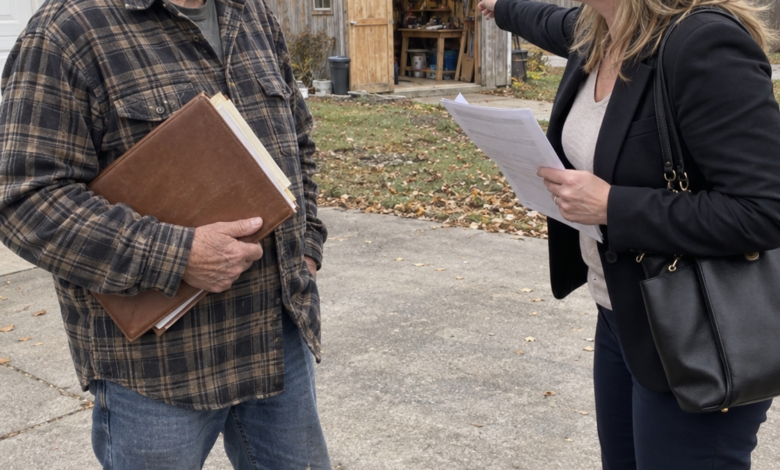
My grandfather Walter was eighty-one when a woman half his age walked onto his property, pointed toward the workshop behind his house, and told him he had thirty days to tear it down.
Grandpa didn’t argue.
He just looked at her, nodded once, and asked:
“Did you bring that in writing?”
She smiled like she had already won.
“I certainly did.”
That was her first mistake.
Walter had lived in the same house for more than forty-five years.
The neighborhood looked completely different when he moved there.
There were fewer houses, no decorative entrance sign, no community pool, and definitely no homeowners association telling people what color they could paint their front doors.
His workshop had been there almost as long as the house.
It wasn’t some rusty shed.
Grandpa had built it himself.
Inside were old hand tools, woodworking benches, shelves filled with jars of screws and hinges, and a radio that had probably been playing country music since I was born.
That building was where he repaired our bicycles when we were kids.
It was where he made my mother’s dining table.
It was where he taught me how to use a hand plane without taking the skin off my fingers.
To everyone in our family, that workshop was part of the property.
Apparently, the new HOA president disagreed.
Her name was Denise.
She had moved into the neighborhood less than two years earlier and somehow became president of the association almost immediately.
She liked rules.
More importantly, she liked reminding everyone that she was responsible for enforcing them.
The letter she handed Grandpa claimed his workshop violated current setback requirements and community architectural standards.
It also said that if he failed to remove it within thirty days, fines could begin accumulating daily.
Grandpa read the entire page while Denise stood in his driveway.
Then he folded it once.
“Anything else?”
She seemed surprised.
“You understand that this is serious?”
“I understand what the paper says.”
“You’ll need to arrange demolition.”
Grandpa looked toward the workshop.
Then back at her.
“No, I won’t.”
Her smile disappeared.
“Mr. Bennett, these rules apply to everyone.”
Grandpa nodded.
“I’m sure they do.”
Then he walked back inside.
When Mom heard about it, she panicked.
She called me.
Then my uncle.
By dinner, half the family was convinced Grandpa was about to get buried in HOA fines because he was too stubborn to cooperate.
I drove over the next morning.
He was sitting at his kitchen table drinking coffee.
The violation notice was beside him.
“Grandpa, what are you going to do?”
“Finish my coffee.”
“I mean about the workshop.”
He looked at me.
“Nothing today.”
I thought he was being difficult.
Then he asked me to follow him into the spare bedroom.
At the bottom of an old filing cabinet, he pulled out a thick brown folder.
Across the front, in faded handwriting, was one word:
PROPERTY.
Inside were documents older than I was.
Original building permits.
Survey maps.
Inspection records.
County correspondence.
Receipts.
Photographs.
And one yellowed permit dated 1978 approving the construction of the workshop exactly where it stood.
Grandpa tapped the paper.
“I built it before half those houses existed.”
Then he pulled out another document.
The original property survey clearly showed the workshop within the approved boundaries.
I stared at him.
“You knew you had all this?”
“Of course.”
“Why didn’t you tell Denise?”
He shrugged.
“She didn’t ask.”
That was Grandpa.
Three days later, the HOA scheduled a meeting.
Denise expected Walter to attend and explain when he planned to remove the structure.
Instead, Grandpa arrived carrying the brown folder.
I went with him.
The meeting room was packed.
Apparently, Denise had been issuing warnings to several older homeowners.
Fences.
Sheds.
Driveways.
Additions that had existed long before the current HOA rules.
When Grandpa’s name was called, Denise read the violation aloud.
Then she looked at him.
“Do you have a proposed removal date?”
Grandpa stood slowly.
“No.”
She sighed.
“Then we’ll have to move forward with fines.”
Grandpa opened his folder.
“I’d like this entered into the record first.”
Denise looked irritated.
“What is it?”
“My permit.”
The room became quieter.
He handed copies to the board.
The permit showed that the workshop had been legally approved in 1978.
Then he produced the inspection sign-off.
Then the survey.
Then correspondence from the county confirming the structure had been reviewed and accepted.
Denise barely looked at them.
“Our rules are current, Mr. Bennett.”
That was when the HOA’s attorney, who had been sitting quietly near the end of the table, finally leaned forward.
“When was the association created?”
Nobody answered immediately.
One board member checked the paperwork.
“1994.”
Grandpa smiled.
His workshop had already been standing for sixteen years by then.
The attorney started reading.
The expression on his face changed.
He asked whether the board had reviewed the property’s history before issuing the violation.
Denise said the current rules were clear.
The attorney repeated the question.
She hadn’t.
Then he explained the problem.
Grandpa’s workshop wasn’t an unapproved structure someone had built last weekend.
It had been legally permitted decades before the HOA even existed.
Any attempt to force its removal would require considerably more than pointing to a modern architectural guideline.
The violation was suspended that evening.
But Grandpa wasn’t finished.
He didn’t attack Denise.
He didn’t demand she resign.
He asked one question.
“How many other homeowners received letters like mine?”
The room went silent again.
Several hands went up.
One belonged to a seventy-six-year-old widow who had been told her back fence violated community rules.
Another belonged to a retired teacher whose enclosed porch had been built in the 1980s.
Grandpa looked at the board.
“You might want to check their paperwork too.”
That sentence created a much bigger problem for the HOA than his workshop ever had.
Over the next few weeks, several violations were reviewed.
Some were legitimate.
Others weren’t.
A number of homeowners had structures that predated the association or had prior approvals nobody on the current board had bothered to research.
The HOA had been sending threatening letters first and checking facts later.
That stopped.
New procedures were adopted requiring property history to be reviewed before certain violations were issued.
Denise stayed president for a few more months.
Then another election was held.
She lost.
Grandpa never campaigned against her.
He barely talked about her.
The workshop stayed exactly where it had always been.
A few months later, I visited and found him inside sanding a small wooden box.
The old radio was playing.
The violation notice was pinned to the wall above his workbench.
I laughed.
“You kept it?”
He glanced up.
“Sure.”
“Why?”
He smiled.
“Reminds me to keep my paperwork.”
The following spring, a new family moved into the house next door.
Their ten-year-old son became fascinated with Grandpa’s workshop.
Before long, Walter was showing him how to measure a board properly and why you never force a dull saw through good wood.
I stood in the doorway watching them.
That building had survived more than forty years.
Storms.
New houses.
Changing neighborhoods.
And finally, an HOA president convinced that an old man probably wouldn’t know how to defend himself.
She had been wrong about the workshop.
But she had been even more wrong about Walter.
She saw an eighty-one-year-old man standing quietly in his driveway and assumed silence meant confusion.
Grandpa had spent a lifetime building things carefully enough to last.
Apparently, that included his records.
And in the end, he never needed to shout, threaten anyone, or prove he was tougher than the people trying to push him around.
He just opened a folder.
Sometimes fifty years of patience looks a lot like weakness—right up until someone discovers you kept every receipt.