The officer tapped the screen, set the phone on speaker, and held it low between us.
For half a second, all we heard was breathing from the other end.
Then a woman said, “Well? Did he finally get through to her?”
My foster wife went rigid with the baby against her chest.
The stepfather pushed harder against the floor with his palm, but the paramedic beside him immediately told him not to get up.
“Hang up,” he said.
The woman on the phone laughed once, like she thought he was talking to someone else.
“What?”
His voice sharpened.
“Mom. Hang up.”
That one word changed the room.
The caller stopped laughing.
The officer did not rush to fill the silence, and that seemed to make it worse for the man on the floor.
He looked at the phone. He looked at the officer. He looked at his wife. He said nothing.
Then his mother spoke again.
“Why are you putting me on speaker?”
The officer identified himself and told her there had been an emergency at the house.
She immediately said she did not know anything about an emergency.
Nobody had accused her of knowing.
My foster wife heard that too.
Her swollen eye was narrowing by then, not because the swelling was better, but because she was finally looking past the chaos and listening to the words people chose when they were scared.
The baby made a small sound against her shoulder.
She shifted him carefully, keeping one hand behind his head while the paramedic watched his breathing and the redness on his skin.
The officer asked the caller whether she had sent messages to that phone earlier.
“I text my son all the time,” she said.
The stepfather closed his eyes.
The officer asked nothing else for a moment.
His mother apparently mistook the silence for permission to explain.
“I was only checking whether she had calmed down,” she said. “That’s all.”
My foster wife stared at the speakerphone.
“Calmed down from what?” she asked.
The caller went quiet.
The stepfather suddenly started talking over everyone.
He said his wife was confused, the baby had never been in danger, and I was the only person who had actually attacked anyone.
Then he made the mistake that I still remember more clearly than the sound of the extinguisher hitting him.
“The lid wasn’t even tight,” he said.
The officer turned toward him.
My foster wife did too.
So did I.
Until that moment, he had been insisting the whole thing with the jar had been misunderstood.
Now he had just volunteered a detail about the lid.
“I thought you said the baby wasn’t in it,” my foster wife said.
He answered too quickly.
“I said he wasn’t trapped.”
That was not what he had said before.
His mother spoke through the phone again, her voice thinner now.
“You told me it was just supposed to scare her.”
The stepfather shouted for her to stop talking.
The baby startled at the volume, and my foster wife turned her entire body away from him, covering one of the baby’s ears with her palm.
The paramedic stepped between them.
The officer ended the call soon afterward and kept the phone with my foster wife’s permission so the messages already on it could be preserved.
No one in that kitchen needed a speech about what had just happened.
The man’s own words had done enough.
The phone had done the rest.
We needed the baby safe. We needed her examined. We needed the phone preserved. We needed the truth to stop moving every time he opened his mouth.
A second paramedic asked my foster wife if she could walk.
She said yes.
Then she tried to take one step and grabbed the edge of the counter.
I moved toward her automatically, but she shook her head and tightened her grip on the baby.
“Take the bag,” she told me.
It was such an ordinary sentence that it nearly broke me.
A diaper bag.
Bottles. Wipes. A change of clothes. The little things people carry because babies need something every twenty minutes and rarely care whether the adults around them are having the worst day of their lives.
I picked it up.
My hands were still trembling.
On the counter behind it sat the clear jar.
There were chilies stuck to the glass above the brine line, and the smell of vinegar still filled the kitchen under the chalky extinguisher dust.
I couldn’t look at it for long.
My foster wife could.
She pointed at it without moving any closer.
“Don’t let that disappear,” she told the officer.
The stepfather laughed from the floor, but there was nothing amused in it.
“You’re acting like I tried to kill somebody.”
She turned toward him.
Her lip was swollen, and one side of her face had already begun changing color around the eye.
She did not raise her voice.
“You put a baby in a jar full of chilies to teach me something.”
He tried to interrupt.
She kept going.
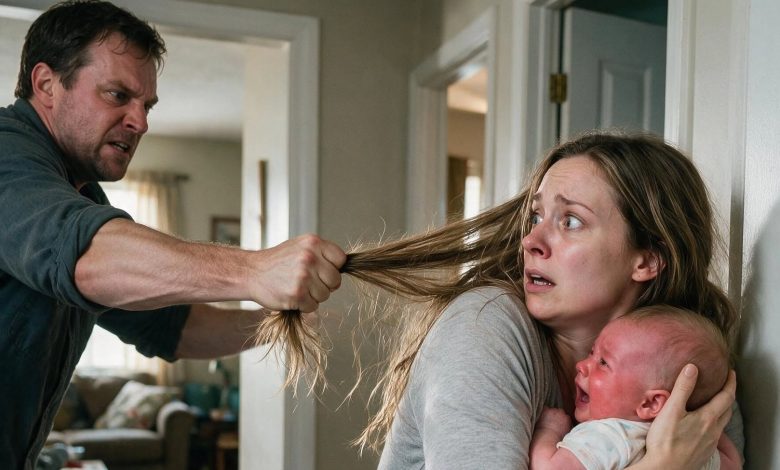
“Then you dragged me through this house by my hair while I was holding him.”
He said she was making it sound worse than it had been.
That sentence landed harder than shouting would have.
The officer asked him to stop speaking over her.
For the first time since I had come through the door, he obeyed.
My foster wife looked down at the baby again.
“I don’t care what he thinks it sounds like,” she said. “I want my son checked.”
That decision moved everything forward.
The paramedics prepared to take her and the baby for further evaluation, while I answered questions about exactly what I had seen when I entered the house.
I did not hide the fire extinguisher.
I did not call what I had done something softer than it was.
I told the officer I had seen her bleeding, seen her shielding the baby, seen the stepfather controlling the space around them, and struck him once with the extinguisher before he went down.
I told him where I had been standing.
I told him where the extinguisher had been.
I told him what happened next.
The stepfather kept insisting that my account proved I was violent.
Maybe he thought that if he repeated it enough, everything that came before my arrival would disappear.
It didn’t.
The bruising around her eye did not disappear.
The blood at her mouth did not disappear.
The baby’s red skin did not disappear.
The jar did not disappear.
And the message asking whether “the lesson” had worked was already sitting on the phone he had wanted nobody to touch.
While the responders continued working, the officer asked my foster wife whether the number that had called was the same number that had sent the message.
She looked at the screen from where she stood and said yes.
Then he asked whether she recognized the number.
She did.
It belonged to the stepfather’s mother.
The man on the floor immediately said his mother had nothing to do with anything.
My foster wife gave him a tired look.
“You just told her to hang up before anyone said who was calling.”
He opened his mouth.
Nothing came out.
The officer did not celebrate the contradiction or throw some dramatic line at him.
He simply noted what had been said and kept going.
That calmness seemed to bother the stepfather more than anger would have.
He could fight an accusation.
He could argue with me.
He could accuse his wife of exaggerating.
What he could not easily fight was the sequence.
A message arrived asking whether a lesson had worked.
The same number called minutes later.
He recognized the caller before anyone identified her.
She said the plan was supposed to scare his wife.
And he himself had mentioned the jar lid after claiming there had been no danger involving the jar.
The story he had been trying to build around me was shrinking around him.
My foster wife seemed to realize it at the same time.
She stopped answering his insults.
She stopped correcting every lie.
Instead, she answered the paramedic’s questions about the baby.
That shift mattered.
For several minutes, the stepfather had been controlling the room simply by making everyone react to him.
Now she refused to let him decide what required her attention.
Her son did.
When they were ready to move her, she asked me to come with them.
“Don’t go back for anything,” she said.
I told her I wouldn’t.
The stepfather heard us.
“So you’re just taking my family?”
My foster wife stopped near the doorway.
I expected anger.
Instead, she adjusted the baby’s blanket.
“You don’t get to use that word to make me stay,” she said.
Then she walked out.
I followed with the diaper bag.
Outside, the air smelled almost unnaturally clean after the kitchen.
I remember noticing that because my brain had apparently decided fresh air was easier to understand than anything else happening around me.
My foster wife sat where the paramedic directed her and let them continue checking the baby.
She flinched when someone touched near her swollen eye, then apologized for flinching.
The paramedic told her she did not need to apologize.
She nodded, but I could tell the habit went deeper than that moment.
Inside the house, the stepfather was still talking.
We could hear pieces of it whenever the door opened.
He said “misunderstanding.”
He said “family argument.”
He said my name more than once.
He never seemed to understand that the most damaging part of the afternoon was no longer anything I could say about him.
It was what he and his mother had already said themselves.
Later, after the immediate medical checks were underway, my foster wife was asked about the phone again.
She gave permission for the existing thread with his mother to be reviewed and preserved.
There were no grand confessions filling the screen.
The thread was worse because most of it sounded almost casual.
There were messages about her being “too soft.”
Messages about making her understand who made the rules in the house.
And then, close to the time I arrived, the line that made her cover her mouth with one hand.
His mother had written that whatever he did needed to be memorable enough that his wife would stop challenging him afterward.
The stepfather had responded that he had an idea.
The next message from his mother was the one we already knew.
She wanted to know whether the lesson had worked.
My foster wife read only a small part of the thread before turning away.
“That’s enough,” she said.
The officer respected that.
She did not need to absorb every ugly sentence in one afternoon simply because the phone existed.
What mattered immediately was that the messages gave context to what had happened inside the house.
The jar had not appeared in isolation.
The violence after she freed the baby had not appeared in isolation.
Even the stepfather’s frantic need to control the explanation when responders arrived suddenly made more sense.
He had been trying to turn a sequence into separate incidents.
A jar that was supposedly a joke.
A wife who was supposedly hysterical.
A grandfather who was supposedly violent.
A text that was supposedly private.
Separated, each piece gave him room to talk.
Together, they told a different story.
My foster wife asked one question about the messages.
“Did she know he was putting the baby in there?”
The officer told her he could only speak to what was actually preserved and what the caller had actually said.
That answer frustrated her, but it was the right one.
We had spent enough time that day around people turning assumptions into facts.
The caller had admitted knowing something was intended to scare her.
The messages showed encouragement for a “lesson.”
The stepfather had admitted knowledge about the jar that contradicted his earlier denial.
Anything beyond that would have to be established, not guessed.
My foster wife pressed her lips together and nodded.
“Okay,” she said. “Then that’s what I know.”
It was the first time all day I heard her speak about the situation without sounding as if she needed permission.
At the medical facility, the baby remained the center of her attention.
She asked every question twice when she did not understand the answer the first time.
She wanted to know what they were watching for, what she should notice later, and whether the redness was changing.
I sat nearby with the diaper bag between my shoes.
At some point, I noticed dried extinguisher dust on my sleeve.
I had been wearing it for hours.
I brushed at it once and stopped.
My foster wife saw me.
“You thought you killed him,” she said quietly.
I looked at her.
She wasn’t accusing me.
She was remembering my face after he hit the floor.
“For a second,” I said.
She nodded.
“I thought he was going to make me drop the baby.”
Neither of us said anything after that.
There are moments when two fears do not need to compete.
Mine had been what I might have done.
Hers had been what he might do next.
The baby’s had no words at all.
That was the one that mattered most.
Before the night was over, my foster wife made another decision.
She would not return to the house with the stepfather there or with him able to approach her and the baby freely.
She did not make a dramatic announcement about forever.
She did not pretend one afternoon had given her a perfect plan for the rest of her life.
She simply chose the next safe place.
Then the next safe hour.
Then the next safe night.
I could work with that.
When arrangements were made for essential belongings to be separated from the immediate conflict, she gave a short list.
Baby clothes.
Medication and basic toiletries.
Important personal items.
Nothing that required her to walk back into the kitchen and stand beside that jar again.
The diaper bag stayed with us after the relevant phone information had been preserved.
When I handed it back to her, she checked the pockets automatically.
Wipes.
Bottle.
Spare onesie.
Pacifier.
Her hands slowed when she reached the pocket where the phone had been.
For hours, that bag had carried the message that cracked the whole afternoon open.
Now it was just a diaper bag again.
Almost.
The phone itself remained part of the evidence process for as long as necessary, but she had already made her most important choice before anyone could tell her what would happen legally.
She had stopped protecting the story that kept the stepfather comfortable.
She had started protecting herself and the baby instead.
The last time I saw him that day, officers were keeping him separated from us while the circumstances were still being handled.
He was still angry about the fire extinguisher.
Maybe he had every right to answer questions about that part too.
I never needed the story to turn me into a hero.
I had hit a man in the head with a heavy object, and I understood why that action had to be examined along with everything else.
But for once, examination meant the entire sequence mattered.
Not just the moment most convenient for him.
My foster wife’s injured face mattered.
The baby’s condition mattered.
The jar mattered.
The call mattered.
His mother’s words mattered.
His own contradictions mattered.
And the fact that he had begun defending himself before showing concern for either injured person mattered too.
Days later, when I asked my foster wife what she remembered most clearly, I expected her to say the jar.
She didn’t.
I expected her to say being dragged through the rooms.
She didn’t say that either.
“The phone,” she told me.
I understood immediately.
Not because the phone had saved her.
It hadn’t.
She had gotten the baby out herself.
She had shielded him while she was being hurt.
She had handed over the phone herself when the officer asked whether she wanted the message preserved.
What the phone did was different.
It stopped her from having to carry the truth alone.
For a long time, the stepfather had apparently counted on being able to explain each ugly moment after it happened.
He could say she misunderstood.
He could say she was emotional.
He could say everyone else had arrived too late to know the whole story.
But that afternoon, somebody who thought she was helping him called at exactly the wrong moment.
She expected a private report.
Instead, she found herself speaking into a room full of witnesses.
And the man who had spent the entire emergency trying to control the story was the one who told her who was listening.
My foster wife still had healing to do after that day.
So did the baby.
There were questions we could not answer immediately and consequences that would not be decided in one kitchen, one ambulance ride, or one interview.
But the most important change happened before any of those answers arrived.
That evening, she sat with her son asleep against her, his breathing finally quiet enough that she stopped checking his chest every few seconds.
I placed the diaper bag beside her chair.
She reached down, pulled the spare blanket from the top, and tucked it around him.
Then she looked at the empty phone pocket for a moment.
“He wanted that message deleted,” she said.
“I know.”
She smoothed the blanket over the baby’s back.
“I’m glad I didn’t.”
There was nothing dramatic in her voice.
That was what made it stay with me.
The day had begun with someone trying to teach her a lesson about obedience.
It ended with her making a choice nobody else was allowed to make for her.
She picked up the diaper bag, slipped its strap over her shoulder, and carried her grandson out with me toward the place where they would spend the night.