-Did You Know That When a Dog Smells Your Private Area, It’s Not Being Rude at All but Actually Detecting Complex Chemical Signals, Hormonal Changes, and Pheromones That Reveal Health, Emotions, and Even Life Stages—A Fascinating Look into the Science Behind Canine Scent Behavior

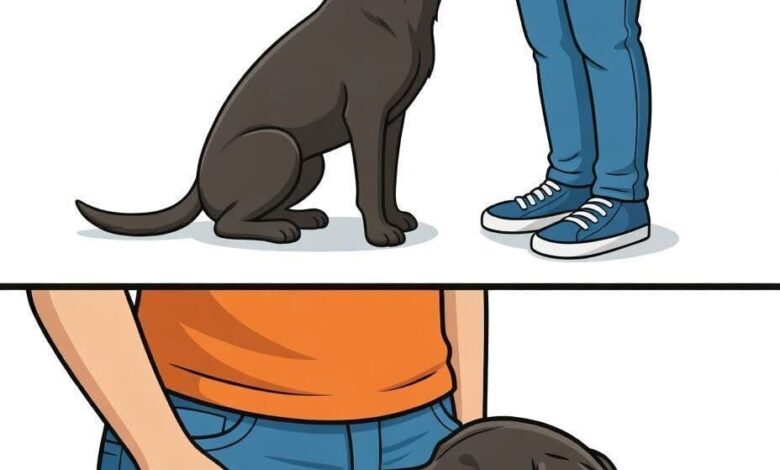
Dogs experience the world in a way humans can barely imagine. While people rely heavily on sight, language, facial expressions, and social rules, dogs are guided first and foremost by scent. To them, smell is not just a sense — it is a complete system of information. A dog can learn about another living being through scent in the same way humans learn through conversation, observation, and memory.
That is why dogs often sniff places that humans consider private or uncomfortable, including the groin area. When a dog buries its nose there, it is not trying to be rude, sexual, or disrespectful. It is following one of its strongest natural instincts: gathering information.
The human body carries different types of scent signals, and some of the strongest come from areas with apocrine glands. These glands are found in places such as the armpits and groin, and they release chemical signals that can carry information about a person’s body. To a dog’s powerful nose, these scents may reveal details about sex, hormonal changes, stress, diet, emotional state, and even subtle shifts in health.
What feels awkward to a human may feel completely normal to a dog. In the dog’s mind, this is not a violation of manners. It is closer to a detailed introduction. Your dog is trying to understand who you are, how you are feeling, where you have been, and whether anything about you has changed since the last time they checked.
This behavior can be especially noticeable when a person is experiencing hormonal changes, stress, illness, menstruation, pregnancy, or a major emotional shift. Dogs are highly sensitive to chemical changes in the body, and many of them become more curious when they detect something unfamiliar or different. They may sniff more intensely not because they are misbehaving, but because their nose has picked up new information that they are trying to process.
Still, understanding the reason behind the behavior does not mean you have to accept it. Humans have boundaries, and dogs can learn those boundaries with patience and consistency. The key is to correct or redirect the behavior without shaming the dog for having a natural instinct.
If a dog starts sniffing in an uncomfortable area, calmly move away, offer your hand for them to sniff instead, or redirect them with a simple command such as “sit,” “leave it,” or “come.” Rewarding the dog when they respond appropriately helps teach them what is acceptable. Over time, they can learn that greeting humans requires different rules than greeting other dogs.
It is also helpful to give dogs structured ways to use their sense of smell. Walks, scent games, puzzle toys, and supervised sniffing activities can help satisfy their natural curiosity in healthier ways. A dog that has regular opportunities to explore the world through scent may be easier to redirect when their curiosity turns toward people in awkward moments.
The important thing is to separate the behavior from human embarrassment. A dog is not trying to humiliate anyone. It is not making a social statement. It is using the most advanced tool it has to understand the people around it.
That uncomfortable moment is actually a glimpse into how closely dogs pay attention. They notice changes humans often miss. They can detect shifts in mood, scent, routine, and physical condition long before those changes are obvious to anyone else. Their nose gives them access to a hidden layer of information, and they use it to stay connected to the people they care about.
So while it is completely fair to set boundaries, it is also worth recognizing the instinct behind the action. Your dog is not being disrespectful. Your dog is investigating, learning, and checking in with you in the only way it knows best.
In a human world, the behavior may feel awkward. In a dog’s world, it is simply communication.


