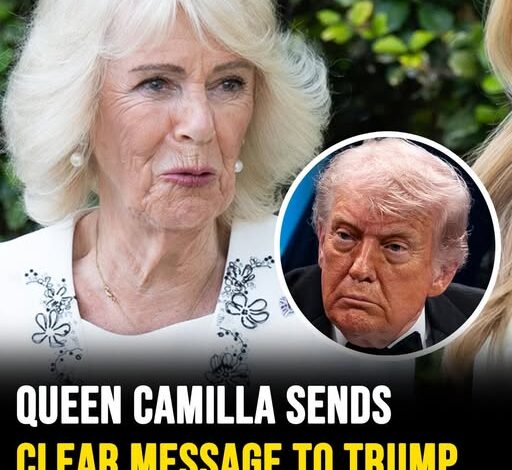
The message was not spoken.
It was worn.
As King Charles and Queen Camilla arrived in the United States, the official focus was on ceremony: handshakes, smiles, motorcades, flags, and the carefully measured language of diplomacy. But as often happens with the royal family, some of the most pointed communication came not from a podium, but from a detail pinned quietly to a dress.
While Charles prepared to speak publicly about reconciliation, renewal, and the enduring bond between Britain and America, Camilla delivered a subtler message through symbolism. Her jewelry did not shout. It did not need to. The brooch she chose carried decades of history in a single glint of diamonds, rubies, sapphires, and memory.
The piece was not random. It featured the Union Jack crossed with the Stars and Stripes, a jeweled tribute to the relationship between the United Kingdom and the United States. Originally presented to Queen Elizabeth II during her 1957 state visit to America, the brooch had already lived through one chapter of Anglo-American diplomacy before finding its way onto Camilla’s shoulder decades later.
That history gave the choice its force.
In royal dressing, jewelry is rarely just decoration. Brooches, tiaras, colors, fabrics, and heirlooms often function as a language of their own — polite enough to avoid direct confrontation, but deliberate enough to be understood by those paying attention. Camilla’s brooch linked the present visit to Elizabeth II’s first state visit to the United States as queen, reaching back to an era when the postwar alliance between the two nations was being publicly celebrated and carefully reinforced.
In one small detail, Camilla evoked the long arc of the so-called “special relationship”: wartime alliance, cultural exchange, military cooperation, diplomatic friction, shared language, shared myth, and decades of presidents and prime ministers insisting that the bond remains strong even when politics strain it.
That is why the brooch could be read as both reassurance and reminder.
For Donald Trump, who has often spoken of the United States and Britain in grand, poetic terms, the symbol carried layered meaning. On one level, it affirmed friendship. It suggested continuity, mutual respect, and the idea that the two nations remain bound by history larger than any single administration. On another level, it could be seen as a quiet challenge: a reminder that alliances are not maintained by nostalgia alone. They require care, restraint, and repair.
The timing mattered. The visit came at a moment when political rhetoric had again placed pressure on old diplomatic assumptions. The language of partnership can be easy to invoke, but harder to sustain when leaders, voters, and governments are divided by questions of trade, war, security, identity, and national interest. In that atmosphere, Camilla’s brooch seemed to say that the relationship still exists — but also that it must be actively renewed.
The power of the gesture was its restraint. Camilla did not need to make a speech about diplomacy. She did not need to criticize, flatter, or explain. She simply wore a piece of royal history that joined two flags together, allowing the symbolism to do what royal symbolism does best: speak softly while carrying institutional weight.
It was also a tribute to Queen Elizabeth II, whose reign was defined in part by her long relationship with American presidents and by her ability to embody continuity across changing political eras. By wearing a brooch once given to Elizabeth during a major American visit, Camilla placed herself inside that tradition. She borrowed not just a jewel, but a memory of steadiness.
That mattered because modern diplomacy often feels louder, faster, and more volatile than the world for which royal gestures were designed. Today, political messages are delivered through viral clips, social media posts, campaign slogans, and televised confrontations. Camilla’s brooch belonged to an older diplomatic grammar — one built on patience, history, and suggestion rather than provocation.
And yet that older language may be precisely why the gesture resonated.
In a single accessory, the Queen signaled unity without pretending there was no tension. She honored the past without ignoring the present. She acknowledged the symbolism of the U.S.-U.K. relationship while allowing room for the reality that even the closest alliances can fray.
The message was not sentimental. It was strategic.
The crossed flags did not simply say, “We are friends.” They said, “We have been friends through difficult chapters before.” They said, “This relationship has survived more than one leader, more than one argument, more than one moment of uncertainty.” They said that diplomacy is not only what is declared aloud, but what is preserved, carried, and chosen again in public view.
Camilla’s choice showed that diplomacy is not always conducted through speeches, treaties, or dramatic gestures. Sometimes it is conducted through inheritance. Through memory. Through the quiet placement of a brooch at the exact moment when the cameras are watching and the world is looking for meaning.
The King may have carried the official words of reconciliation and renewal.
But the Queen carried the image.
And in that small jeweled crossing of two flags, she offered a reminder that history does not repair relationships by itself. People do. Nations do. Leaders do. Sometimes with declarations. Sometimes with policy. And sometimes, before a single speech is given, with a symbol bright enough to say what everyone in the room already knows: the bond is old, valuable, and still in need of care.