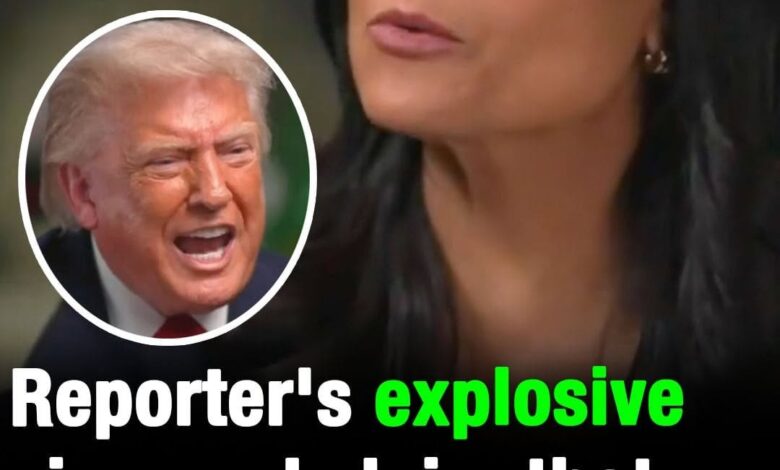
Donald Trump’s tense exchange with Kristen Welker on Meet the Press captured more than a difficult interview. In just a few raw minutes, it exposed the widening fracture between political power, public accountability, and the role of the press in a democracy. What began as a question-and-answer segment quickly became a portrait of a country where evidence, trust, and authority are no longer shared ground, but battlegrounds.
Welker pressed Trump calmly and repeatedly, asking him to provide proof for his claims about “rigged” elections in California and in 2020. Her questions were direct, but not theatrical. She did what journalists are supposed to do when powerful figures make sweeping allegations: she asked for facts, documentation, and specifics. Trump, however, leaned instead on instinct, grievance, and repetition. Rather than offering clear evidence, he pointed to what he said he believed, what he said many people knew, and what he insisted was obvious without proving it.
As the exchange grew sharper, the interview became less about one set of election claims and more about the struggle over whether public figures should be expected to substantiate what they say. Welker’s insistence on evidence seemed to frustrate him. Trump responded by turning his anger toward her personally, calling her “crooked” or “stupid” and casting the questioning itself as hostile. That shift—from answering the question to attacking the questioner—has become one of the defining features of modern political conflict.
His abrupt decision to end the interview was dramatic, but it was not merely a television moment. It symbolized something larger and more troubling: the fragility of public dialogue when facts are treated as optional and accountability is framed as persecution. In a healthier political culture, tough questions might be uncomfortable, but they would still be understood as part of the job. In the current climate, even asking for proof can be recast as an attack, and refusing to provide proof can be reframed as strength.
Welker’s composure stood in sharp contrast to the volatility of the moment. She did not match his anger or turn the exchange into a shouting contest. She stayed focused on the central issue: if a former president and major political figure claims an election was rigged, what evidence supports that claim? Her calmness mattered because it showed a quieter kind of discipline, one that is easy to overlook in an era that rewards outrage. She was not trying to win the loudest moment. She was trying to keep the conversation anchored to facts.
Her willingness to return for another interview despite the hostility also revealed something important about the work of journalism. Reporters who question powerful people are often accused of bias simply for refusing to accept claims at face value. But democracy depends on that refusal. It depends on people willing to ask the uncomfortable follow-up, to press past slogans, and to hold public figures to the same standard they would demand of anyone else making serious accusations.
The clash also reflected the deeper exhaustion of the American public. Many viewers no longer see interviews like this as neutral exchanges. They see them through partisan lenses, with some praising Trump for fighting back against a press they distrust, and others praising Welker for standing firm against evasion and insult. The same moment becomes two different stories, depending on the audience watching it. That division is part of what makes the country feel so politically unstable: even the basic act of asking for evidence can be interpreted in completely opposite ways.
At the center of it all is a question far bigger than one interview, one journalist, or one politician. What happens when a democracy loses agreement over what counts as proof? What happens when evidence is replaced by feeling, when grievance becomes more persuasive than documentation, and when powerful people can dismiss scrutiny by attacking the person asking the question? The danger is not only that false claims may spread. The deeper danger is that the public may stop believing there is any shared method for determining truth at all.
Trump’s storm-off may be remembered as a dramatic confrontation on live television, but its meaning reaches beyond the screen. It revealed how difficult it has become for journalism to perform its most basic democratic function: asking leaders to explain themselves. It showed how quickly accountability can be transformed into spectacle, and how easily a conversation about facts can collapse into accusation.
In the end, the moment left a haunting question hanging over the exchange. If political leaders no longer feel obligated to provide evidence, and if large portions of the public no longer trust the institutions asking for it, what holds democratic debate together? Welker’s steady questioning offered one possible answer: the work must continue anyway. Even when the answers do not come. Even when the interview ends in anger. Even when the air is thick with grievance and mistrust, someone still has to ask, calmly and clearly, “Where is the proof?”