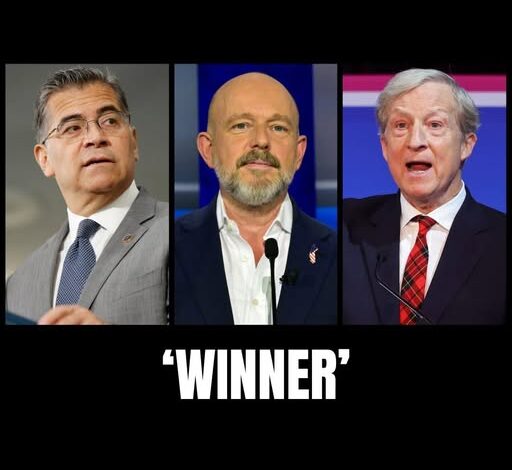
Becerra’s place on the November ballot does more than spare Democrats from a nightmare scenario. It changes the emotional shape of California politics at a moment when the party badly needed something resembling stability. For months, Democrats watched the governor’s race unfold with a sense of unease: major figures declined to run, promising names stumbled, and the party’s usual confidence began to look thinner than anyone expected. What should have been a controlled succession in a deeply blue state instead became a test of whether California Democrats could still organize themselves around a credible standard-bearer.
Becerra’s victory gives them that figure, though not in the flashy way some voters may have imagined. He is not the candidate of spectacle, viral moments, or celebrity-style charisma. His appeal is rooted in something quieter: longevity, discipline, name recognition, and survival. He has been tested by state politics, national politics, legal fights, cabinet-level responsibility, and years of public scrutiny. In a political season dominated by scandal, personality, and chaos, his success functions as an argument for experience. It suggests that, at least for now, a large share of Democratic voters still want someone who knows how government works and has endured enough political storms to understand the stakes.
That matters because California’s political establishment has looked more vulnerable than usual. The state is still Democratic territory, but the mood around the party has shifted. Voters are anxious about affordability, homelessness, crime, immigration, climate pressures, and distrust in government. Republicans see an opening, not necessarily to turn California red, but to make Democrats bleed in places where they once expected easy victories. Progressives, moderates, donors, labor groups, and local machines are all reading the results for signs of where the party is headed next.
Becerra’s nomination gives Democrats a center of gravity. It allows them to avoid the humiliating possibility of being shut out or forced into a chaotic scramble behind a weaker nominee. It gives the party a candidate who can speak to institutional Democrats, Latino voters, labor-aligned constituencies, and voters who may not be excited by politics but still value competence. His campaign can now frame itself around steadiness: a contrast to the volatility surrounding the rest of the field.
But the relief is incomplete, because the race has not yet settled into a clear November shape. The unresolved fight for the second runoff spot may determine whether the general election becomes a traditional partisan contest or something more unpredictable. If Trump-aligned Steve Hilton claims the second slot, Democrats will likely frame the race as a defense of California values against a national MAGA project. That would give Becerra a familiar opponent and a familiar message: experience versus extremism, California versus Trumpism, institutional governance versus ideological disruption.
If billionaire Democrat Tom Steyer advances instead, the race could become far more uncomfortable for the party. A Becerra-Steyer matchup would force Democrats into an intraparty reckoning over money, climate politics, establishment power, outsider campaigns, and the future of the state’s governing coalition. Instead of rallying against a Republican threat, Democrats would have to fight one another in a costly and potentially bruising contest. That kind of battle could expose ideological and class tensions inside the party that a traditional general election might have concealed.
That uncertainty is what keeps the moment volatile. Democrats may have secured their nominee, but they do not yet know what story November will tell. Will it be a standard blue-state defense against a Trump-aligned challenger? Or will it become a battle between two different visions of Democratic power? One version of the race allows the party to unite quickly. The other risks reopening wounds at precisely the moment Democrats want to project strength.
Outside the governor’s race, the surreal drama in Los Angeles only adds to the sense that California politics is entering unfamiliar territory. Spencer Pratt clinging to second place in the mayoral race would once have sounded like a punchline or a stunt. Now it feels like a warning about a political environment where fame, frustration, low trust, and voter unpredictability can combine in ways that established parties are not prepared to control. His presence near the top of the field underscores how unstable even supposedly predictable races have become.
That instability should worry both parties, but especially Democrats, because California has long been treated as one of their safest laboratories of power. When voters in that kind of state begin behaving unpredictably, it suggests something deeper than one unusual campaign. It points to fatigue with familiar names, distrust of institutions, resentment toward insiders, and a willingness to experiment with candidates who would once have been dismissed as unserious. In that sense, the Los Angeles race is not separate from the governor’s race. It is part of the same atmosphere.
Becerra’s success, then, is both a victory and a warning. He gives Democrats a serious nominee at a time when they needed one. He restores a measure of order to a race that had begun to feel dangerously loose. But his path forward will depend on whether voters are still willing to reward experience, or whether California’s mood has shifted toward disruption in ways even a seasoned politician may struggle to contain.
For now, Democrats can breathe. They avoided the worst-case scenario. They have a nominee with a long record, deep connections, and a credible claim to leadership. They can tell themselves that competence still matters and that voters ultimately returned to someone familiar when the stakes became real.
But certainty remains out of reach. The second-place fight will decide the emotional and strategic shape of the general election. The broader political climate remains unsettled. And the strange aftershocks from Los Angeles suggest that California’s establishment may no longer be able to assume that voters will behave according to old rules.
Becerra has given Democrats a starting point. He has not given them a guarantee. November may still become a referendum on Trumpism, a battle over Democratic identity, or a broader test of whether California’s political order can withstand a year defined by anger, spectacle, and impatience. The party has its nominee. What it does not yet have is control over the kind of fight coming next.