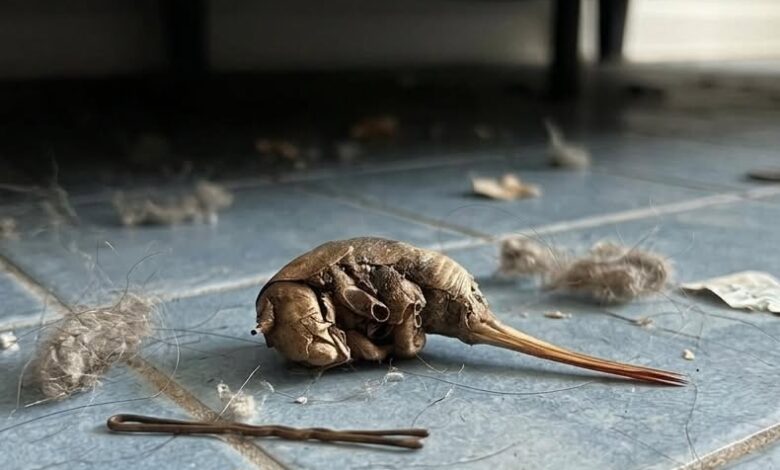
I could not shake the feeling that I was holding something I was never meant to find, something that did not belong in the soft, ordinary clutter of a child’s bedroom. It was too strange to dismiss as trash, too delicate to be some broken toy, and far too unsettling to ignore. The thing looked almost designed, with ridges and curves that seemed purposeful, as if nature had built it with careful, secret instructions. But then there was that long, pointed “stinger” jutting from it, sharp-looking and alien enough to make my stomach tighten.
For a moment, my mind went everywhere at once. Had my son brought in some dead insect from outside? Was it the remains of something dangerous? Had some creature crawled beneath his bed and left this behind? I turned it over in my hand, trying to make sense of it, but every angle made it look less familiar. It seemed like the kind of thing that belonged in a science lab, a horror movie, or a sealed jar on the shelf of someone who studies things most people would rather not touch.
I wondered whether I should call pest control. Then I wondered if that was ridiculous. Maybe a veterinarian would know. Maybe an entomologist. Maybe anyone but me. All I knew was that I had found this strange, dried object under my child’s bed, and for a few uneasy minutes, my imagination did everything it could to make the discovery worse.
So I started searching. I scrolled through forums, image results, insect identification pages, and old posts from people who had found similar objects in garages, gardens, basements, and flower beds. Finally, I found the answer: it was a dried chrysalis from a large hawk moth, also known as a sphinx moth. The horrifying spike that had made my skin crawl was not a weapon at all. It was the protective outer casing for the moth’s future proboscis, the long, delicate tongue it would eventually use to sip nectar from flowers.
In an instant, the fear drained out of the room.
What had looked sinister was not sinister at all. It was not a stinger, not a claw, not the remains of some unknown household invader. It was evidence of transformation. That strange little shell had once held a creature in the middle of becoming something else. Hidden away beneath a child’s bed, forgotten among dust and toys, was the empty architecture of metamorphosis.
The more I looked at it, the less frightening it became. What had first seemed grotesque now seemed almost beautiful. It was eerie, yes, but in the way nature often is when we encounter it too closely, without context or warning. We are used to butterflies and moths as finished things, fluttering through gardens or tapping at porch lights. We are less prepared for the strange, secret forms they pass through before they become what we recognize.
That was what stayed with me most. My first instinct had been fear because I did not understand what I was seeing. I had mistaken mystery for danger. But once I knew the truth, the object changed completely without changing at all. It was still the same brittle, strange, pointed thing in my hand. Only my understanding had shifted.
What I had feared as something invasive or unnatural turned out to be an empty shell left behind by change. Beneath my son’s bed, in the most ordinary corner of the house, nature had left a small reminder that transformation is not always graceful while it is happening. Sometimes it looks strange. Sometimes it looks frightening. And sometimes, only after the creature has gone, do we realize we were looking at a miracle.