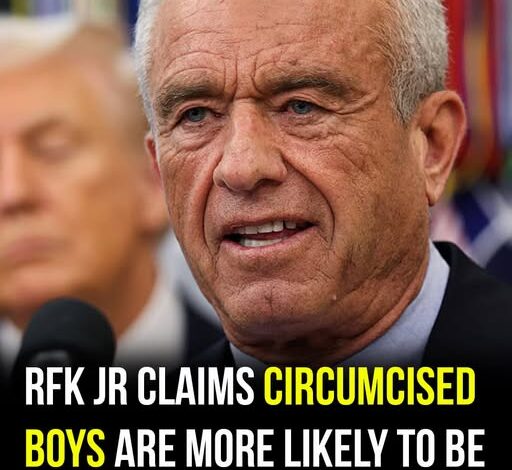
Robert F. Kennedy Jr.’s latest remarks land at one of the most volatile intersections in American public life: politics, parental fear, disability, and trust in medicine. When the nation’s top health official suggests that a common over-the-counter pain reliever may be connected to autism while also acknowledging that the evidence is not sufficient to prove causation, the effect reaches far beyond a single comment or news cycle. It does not merely spark disagreement. It risks weakening confidence in the very public-health systems that are supposed to guide families through uncertainty with care, evidence, and restraint.
The subject is especially sensitive because it touches pregnancy, childhood development, chronic pain, fever management, and the fears of parents who are already trying to make impossible-feeling decisions with imperfect information. Acetaminophen is widely used because many patients have been told it is one of the safer options for pain and fever during pregnancy, particularly compared with alternatives that may carry their own risks. To raise alarm around it without clear proof is not a neutral act. It places anxiety directly into exam rooms, kitchens, pharmacies, and late-night moments when parents are deciding whether to treat a fever or endure pain out of fear.
That fear does not remain abstract. It changes behavior. It can lead pregnant patients to avoid medication they may need. It can make parents second-guess doctors. It can turn ordinary medical decisions into moral tests. And for families already navigating autism, it can reopen an old and harmful wound: the suggestion that autism is primarily a tragedy to be traced back to one parental choice, one exposure, one mistake that might have been avoided.
Autistic people and their families have heard versions of that message for years. They know the damage caused when public conversation treats autism less as a human reality and more as a disaster to be prevented at any cost. Research into causes and supports matters. Better services, earlier identification, and deeper understanding matter. But when speculation is framed carelessly, autistic lives can become reduced to warnings, and parents can be pushed toward guilt rather than support.
That is why the backlash from scientists, autism advocates, medical experts, and former health leaders is not simply irritation. It is alarm. A private citizen speculating about an unproven medical link is one thing. The person responsible for guiding national health policy is something entirely different. His words carry institutional weight. They can influence doctors, regulators, lawsuits, insurers, media coverage, and millions of families who may not have the time or training to separate correlation from causation.
The distinction matters. Some studies have explored possible associations between acetaminophen use during pregnancy and later neurodevelopmental outcomes, but association is not proof that the medication causes autism. Confounding factors, underlying illness, fever, pain, genetics, environment, and other variables can complicate the picture. Responsible public-health communication does not ignore uncertainty, but it also does not turn uncertainty into accusation before the evidence can support it.
The danger is not only scientific confusion. It is the erosion of trust. Public health depends on people believing that recommendations are based on rigorous evidence rather than political instinct, personal suspicion, or ideological preference. Once that trust begins to break down, every official statement becomes suspect. People stop asking, “What does the evidence show?” and start asking, “Who is trying to manipulate me?” In that environment, even accurate guidance becomes harder to deliver.
Free speech is vital, including for public officials. But responsibility is vital too. A health secretary has every right to ask questions, commission studies, and demand better data. But when speaking publicly about pregnancy, medication, children, and autism, the burden is higher than curiosity. The standard cannot be dramatic possibility. It must be evidence strong enough to justify the fear being created.
That is especially true in a country where medical misinformation can spread faster than careful correction. One speculative remark can travel through social media stripped of nuance, transformed into certainty, and repeated until it feels like common knowledge. By the time scientists explain the limitations, many families may already have absorbed the fear. Some may make health decisions based on it. Others may blame themselves for choices made years earlier under medical advice that was considered appropriate at the time.
The moral issue, then, is not whether officials should investigate possible risks. They should. The issue is how they speak before the evidence is clear. Leadership in public health requires discipline: naming uncertainty without inflaming panic, protecting families from both hidden risks and exaggerated claims, and remembering that every statement lands in the lives of real people.
Kennedy’s remarks have therefore become about more than Tylenol, autism, or one controversy. They are part of a larger test of whether health institutions can remain grounded in evidence during an era of mistrust. Parents deserve guidance that is honest without being reckless. Autistic people deserve language that respects their humanity rather than treating their existence as a policy failure. Doctors deserve public officials who strengthen, not undermine, the fragile trust required for medical care.
When words from the powerful can change how millions think about pregnancy, pain, disability, and children, evidence is not a luxury. It is the foundation of ethical leadership. In public health, speculation may be politically useful, but proof is what protects people.