David Letterman was once celebrated as one of late-night television’s sharpest and most influential hosts.
For decades, his dry wit, unpredictable humor, and offbeat interview style helped shape the tone of American talk shows. He built a reputation as a master of awkward pauses, ironic comments, and playful discomfort. But as old clips continue to resurface online, some moments from his long career are being viewed very differently than they were at the time.
One interview that has drawn renewed attention involved Jennifer Aniston.
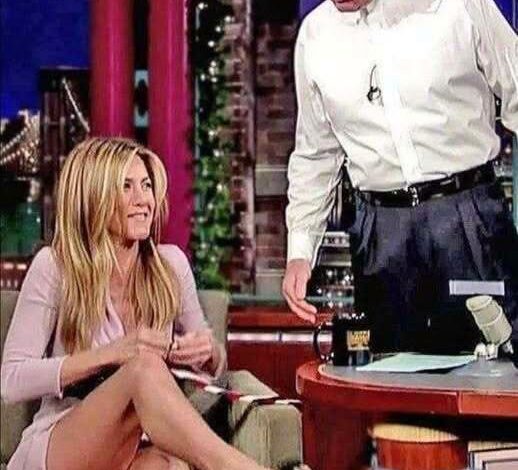
At first, it may have seemed like another ordinary celebrity appearance. Aniston was on The Late Show with David Letterman in 2006 to promote The Break-Up, the romantic comedy she starred in alongside Vince Vaughn. She arrived polished and composed, wearing a black button-down blouse with black shorts, ready to discuss the film and continue the familiar late-night routine.
But almost immediately, the tone of the conversation shifted.
Rather than beginning with the movie, Letterman focused on Aniston’s appearance, especially her legs. He complimented her outfit, then repeatedly returned to the subject, praising her legs in a way that now feels uncomfortable to many viewers. The camera even followed the moment by zooming in, making the exchange feel less like casual flattery and more like a public fixation.
Aniston tried to laugh it off, explaining that she had worn shorts because it was hot. As she had done many times throughout her career, she kept smiling, stayed gracious, and attempted to move the conversation forward.
But Letterman kept circling back.
His repeated remarks about her legs became difficult to ignore. What might once have been dismissed as late-night banter now reads, to many viewers, as a reminder of how often female celebrities were expected to absorb uncomfortable comments without disrupting the show.
The interview grew even more awkward when Letterman shifted to questions about Aniston’s rumored relationship with Vince Vaughn. At the time, public curiosity about her personal life was intense, especially following her highly publicized divorce from Brad Pitt. Instead of keeping the focus on her work, the conversation moved toward speculation, romance, and even questions about whether Vaughn had encouraged her to appear nude in the film.
Aniston appeared caught off guard, but she handled the moment with restraint. She deflected with humor and suggested that Letterman should have asked Vaughn that question when he had been on the show.
That composure has become one of the reasons the clip is being discussed again.
Aniston did not escalate the exchange. She did not lose her cool. She managed to remain professional in a situation that placed her in an uncomfortable position on national television. Yet her poise does not erase the discomfort of the moment. If anything, it highlights how much women in entertainment were often expected to tolerate while promoting their work.
The 2006 interview was not the only Letterman exchange with Aniston that has aged poorly.
Years earlier, during a 1998 appearance, Letterman created another moment that has since become infamous. In the middle of the interview, he leaned toward Aniston, placed his hand near her neck, and put a strand of her hair in his mouth. The moment was strange and visibly uncomfortable. Aniston reacted with surprise, then wiped her hair with a tissue after Letterman handed one to her.
At the time, such moments were often framed as eccentric comedy.
Today, many viewers see them differently.
They see a young actress being put in a position where her discomfort became part of the entertainment. They see how easily boundaries were blurred under the cover of humor. They see how much the culture of celebrity interviews has changed, and how much more willing audiences are now to question behavior that once passed without serious criticism.
Still, Aniston continued to return to The Late Show. That, too, says something about the professionalism expected of stars, especially women. She kept showing up, promoting her projects, smiling through awkward exchanges, and maintaining the kind of composure that helped define her public image.
In 2008, she appeared again, this time while promoting Marley & Me. Once more, images from the interview have circulated online, with many focusing on her appearance. But the moment also included a lighter exchange that showed Aniston taking some control of the room.
She arrived with a gift for Letterman: the Brooks Brothers tie she had worn on the cover of GQ, where she posed wearing only the red, white, and blue necktie. Presenting it as an early Christmas gift, she helped Letterman put it on as the audience reacted. The mood was playful, and Aniston joked that dressing Dave was “exciting.”
Letterman, in typical fashion, added his own suggestive joke when the tie appeared short. It was a moment that, depending on the viewer, could be seen as harmless banter or another example of the kind of humor that often placed women’s bodies at the center of the joke.
Looking back, these interviews reveal more than a few awkward celebrity moments.
They show how entertainment culture has shifted.
What once aired as routine late-night comedy now sparks conversations about boundaries, respect, power, and the way women were treated in public-facing media. Aniston’s interviews with Letterman are being reconsidered not because she failed to handle them well, but because she handled them with such visible grace in situations that should not have required so much grace in the first place.
Jennifer Aniston has never publicly turned those moments into a campaign or a controversy. She has not made them central to her story. But the clips speak for themselves in the eyes of many modern viewers.
They remind us that humor changes with time.
So do standards.
So does the public’s willingness to ask whether laughter came at someone else’s expense.
David Letterman’s legacy in late-night television remains significant, but some of his interviews now sit uneasily beside that legacy. They belong to an era when awkwardness was often treated as entertainment and women were expected to smile through discomfort.
Aniston did smile.
She stayed calm.
She kept the conversation going.
But today, many people watching those moments are no longer laughing in quite the same way.