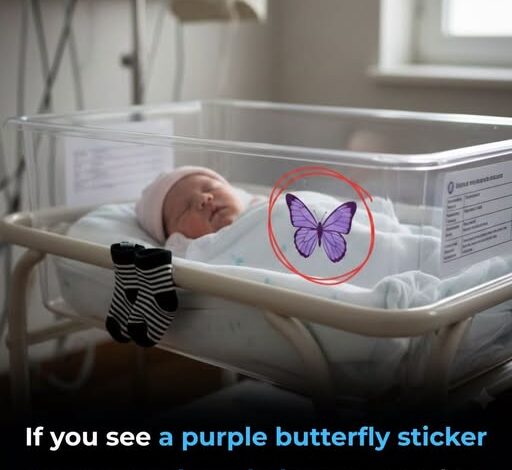
At first glance, it looks like something small and harmless: a purple butterfly sticker placed gently on the side of a hospital incubator.
To someone passing through a neonatal unit, it might seem like a bit of decoration, a soft touch of color in a room filled with machines, wires, monitors, and medical routines.
But for the families who understand what it means, that tiny butterfly carries a grief too deep for ordinary words.
It is not decoration.
It is a message.
A quiet sign that the baby inside the incubator was part of a multiple birth, but that one or more of their siblings did not survive.
The purple butterfly exists so grieving parents do not have to explain the most painful part of their lives over and over again to strangers. It protects them from innocent comments that can reopen a wound they are already struggling to survive.
Behind that symbol is the story of Millie Smith and her partner, Lewis Cann.
When they learned they were expecting identical twin girls, they were filled with joy. Like many parents, they began imagining the future immediately: two sisters growing up side by side, sharing birthdays, laughter, clothes, secrets, and the beautiful chaos of twin life.
But during a routine scan, everything changed.
The room grew quiet.
The conversation shifted.
And the joy of expecting twins was suddenly pierced by devastating news.
One of their daughters had anencephaly, a severe condition that meant she would not live long after birth.
Millie and Lewis were faced with a heartbreak no parent should ever have to carry. Still, they chose to continue the pregnancy and love both daughters for as long as they could. They named their girls Skye and Callie. Skye’s name held special meaning, a tender tribute to the heavens she would soon return to, while Callie represented the future they hoped would continue.
When the twins were born at 30 weeks by emergency C-section, the moment was both miraculous and heartbreaking. Against expectations, both babies cried. For Millie and Lewis, that sound was a gift beyond measure.
They were given three precious hours with Skye.
Three hours to hold her.
To love her.
To memorize her face.
To be her parents in every way possible before she passed away in their arms.
Afterward, life inside the NICU continued around them. Callie remained in the neonatal unit, fighting to grow stronger in her incubator. Millie, still grieving Skye, now had to sit among other parents who did not know her story.
Most of the nurses understood what had happened.
But other parents did not.
To them, Millie appeared to be the mother of one baby in the NICU. They had no way of knowing that she had arrived as the mother of twins and was now grieving a daughter who was no longer beside her.
Then came the comments.
Well-meaning parents, tired and overwhelmed by the demands of newborn care, would say things like, “You’re lucky you don’t have two babies to look after.”
They did not mean to be cruel.
They did not know.
But every innocent remark cut deeply.
Each one forced Millie to either explain Skye’s death to a stranger or swallow her pain in silence. Sometimes she would leave the room in tears, while the other parent remained unaware of the grief they had accidentally touched.
Millie realized that grieving parents in the NICU needed a way to be protected from those moments. They needed something gentle and visible, something that could communicate loss without forcing them to speak it aloud.
That is how the purple butterfly was born.
The idea was simple but powerful. A small purple butterfly sticker would be placed on the incubator of a surviving baby whose sibling had died. The butterfly represented a life that had “flown away,” and the color purple was chosen because it felt neutral and suitable for both boys and girls.
It was a quiet sign asking for tenderness.
A reminder to speak carefully.
A way to acknowledge the baby who was gone while honoring the baby who remained.
From that idea came the Skye High Foundation, created to support families who have experienced the loss of a baby from a multiple birth. What began as one grieving mother’s response to unimaginable pain became a symbol recognized far beyond one hospital ward.
The purple butterfly now helps families, staff, and visitors understand that joy and grief can exist in the same incubator room.
A parent may be celebrating one child’s survival while mourning another child’s death.
A baby may be growing stronger while their sibling is deeply missed.
A family may be grateful and broken at the same time.
That is what the butterfly helps people remember.
For Millie, it also ensures that Skye’s life is never treated as invisible. Skye lived. She was loved. She mattered. Her time was brief, but her impact continues through every family spared from having to explain their loss in a hallway, beside an incubator, or in the middle of their grief.
Callie continues to carry her sister’s story with her. Her life is a reminder of resilience, love, and the complicated beauty of surviving after loss. Through Millie’s courage, Skye’s memory has become a source of comfort for families around the world.
The next time you see a purple butterfly in a neonatal unit, remember what it means.
It is not a decoration.
It is a symbol of courage.
A request for compassion.
A sign that a family is holding both love and loss at once.
It reminds us that every baby matters, even those who only stay for moments. It reminds us to speak gently, to assume nothing, and to recognize that some grief is carried quietly because it is too heavy to explain.
The purple butterfly may be small, but its meaning is enormous.
It turns silence into understanding.
It turns pain into protection.
And through it, Skye’s legacy continues to help families facing the hardest road imaginable feel a little less alone.